

In Praise of Stupidity
Mostly, I just embarrassed myself. Occasionally, I struck gold.
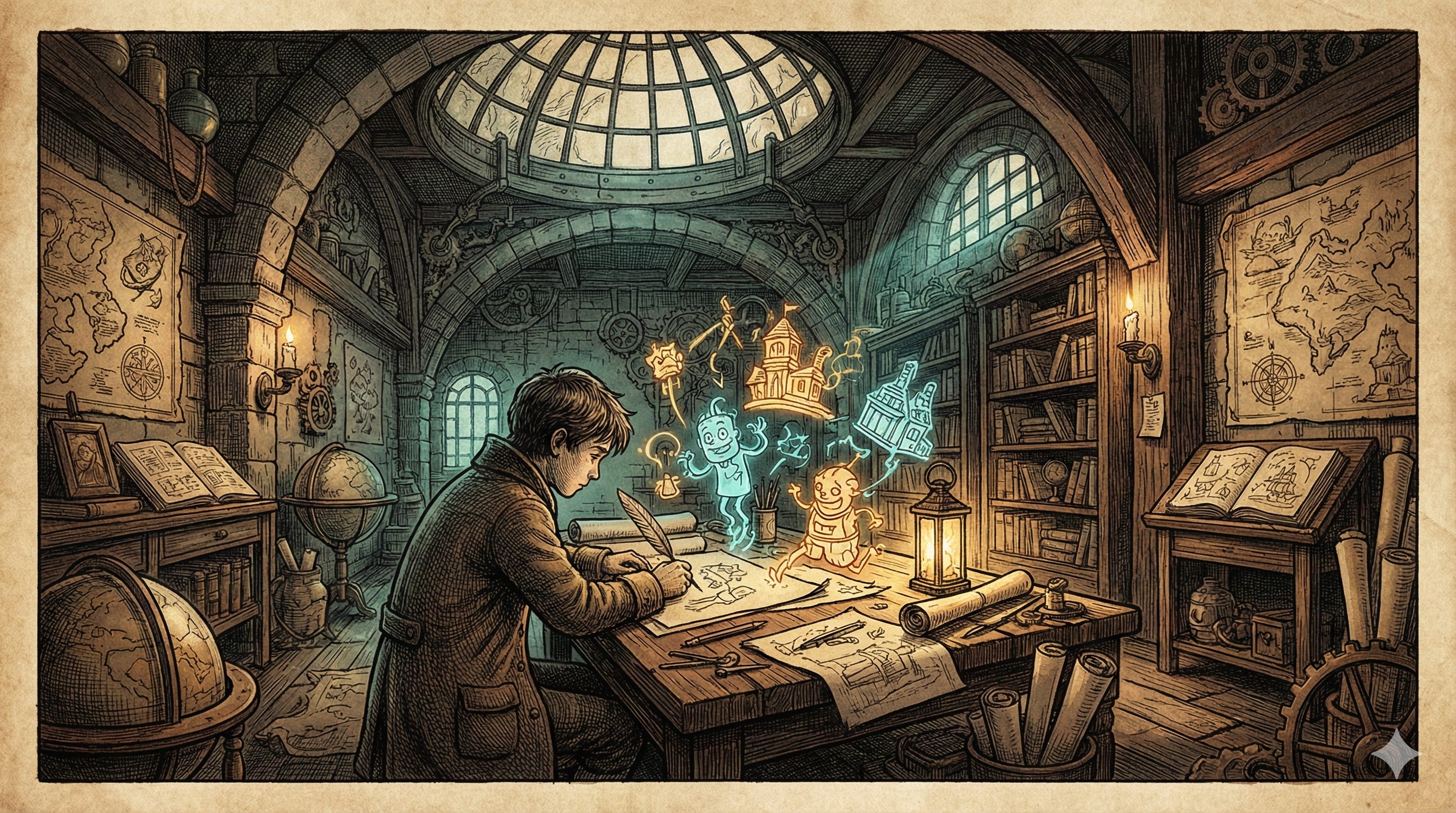
One of our national newspapers printed cartoons such as Garfield, Peanuts, and Hägar the Horrible, and I thought, “Hey, I can draw. I could do that too!”
So I sat down one Sunday afternoon, rapidly produced six three-panel cartoons, and wrote a letter to the newspaper offering them my exclusive artwork and suggesting that I make these funnies for them daily—for a very reasonable fee. The newspaper’s editor sent me a kind letter back, politely declining my gracious offer with the comment that “they were not entirely convinced I could sustain a high enough level of quality.”
I was quite disappointed.
Also, I was twelve.
Undeterred by the minor setback, I placed an ad in our town’s local gazette, offering my services as a young creator of comics. I was funny. I could draw. Surely someone local might be interested! And sure enough, I got a call from a person asking me to draw a caricature of their mom—I had no clue how to do such a thing—and then another from a restaurant owner looking for an artist to draw their new pizza menu, a job I didn’t interpret as even remotely comical.
So I gave up on that career.
I’m afraid few twelve-year-olds these days would never try something so delightfully dumb and audacious as I did in the early 80s. Today’s younger generation happily embraces AI to level up their skills, generate their essays, vibe code their web shops, produce their TikTok videos, and get real-time feedback on their creative ideas to prevent making a fool of themselves. Which seems a very Gen-Alpha kind of thing: to not be seen as doing something dumb and naïve. (Clearly, this never bothered me.)
The young ones of today are among the first to discover that Midjourney, Stable Diffusion, and Pose Scanner can help them produce cartoon art of high, sustainable quality, and that ChatGPT and Claude are more than happy to discuss the most sensible and realistic career trajectories for wannabe creatives. And it’s all for free. More importantly, the AIs are unlikely to respond, “If I were you, I’d send this off to your national newspaper.”
And there, I believe, is a problem.
In 2026, we find ourselves snugly surrounded by reason and sensibility. We use AIs to write and evaluate every portfolio deck and media kit we send out. We ask the LLMs to double-check our strategy and every business decision we make. The algorithms eagerly give each of our naïve product ideas a total makeover, complete with a Job-to-Be-Done analysis and an AI-generated pitch deck. The machines are protecting us from our own ignorance. We insulate ourselves from stupidity.
And that could make it harder for creatives, solopreneurs, intrapreneurs, and lone managers—I call them Solo Chiefs—to fail.
Or make it harder to deal with the inevitable failure.
Because remember this when your product launch just flopped: the AI that helped you polish your idea into something “market-ready” has no skin in the game. It doesn’t lose sleep over reputation and accountability. Only you do. You’re the single wringable neck, and the machines only make sure you have fewer excuses for why something doesn’t work.
No matter how much advice we all get from the algorithms, and how much better we all become, the cold hard math of the market dictates that the failure rate remains the same.
90% of products are still crap. AI just paints the crap in prettier colors.
At twenty-four, when I finished my studies as a software engineer, I set my sights on another career. I wanted to launch a Dutch games studio. (This was 1994. There were practically no Dutch game studios around.) I recruited several programmers, two amazing graphics artists, and I convinced a major Dutch animation studio to buy into my vision. I flew to London several times to present my game ideas to UK publishers until one of them actually sent me an unsigned contract worth a million British pounds.
I was ecstatic.
The only thing missing was a signature on the contract from the publisher’s American head office. That signature never came. In hindsight, I suspect someone on the other side of the ocean, with a bit more sense and significantly more experience, could tell that my team had no fucking clue what we were doing. Our game project was all charades, nothing more than make-believe carefully wrapped in pretty mockups. We didn’t even have a working demo.
The publisher averted what undoubtedly would have become a game development fiasco.
The word ignorance didn’t even cover the extent of our stupidity.
Still, I’m proud that we tried.
These days, few people would be as stupid as I had been back then in the 90s. Not in the least because a single person can now practically run an entire game studio by themselves, using AI for art, dialogue, coding, and QA, building polished games in months that would once have required entire teams and several years. And, most critically, without having to beg for a million-pound advance. The failure rates remain the same. It just hurts a little less.
Nowadays, I use AI to double-check every decision I make. I discuss articles, evaluate tech stacks, and dissect business plans. When the stakes are high and the decision is crucial, I even get the AIs to debate with each other before I commit to anything.
Thanks to AI, we Solo Chiefs are able to experiment with countless ideas in rapid feedback cycles. It’s never been cheaper to derisk our strategy and tactics. And it’s never been easier to make ourselves less dumb.
Our digital co-pilots help us write better, draw better, build faster, and think more critically about everything we do. They raise the quality bar for us all. But here’s the price we pay for that convenience: the LLMs also quietly constrain every idea to the boundaries of their training data. We get a polished self-rejection before the real world has a chance to tell us how dumb we really are. They protect us from public embarrassment.
There’s a Zen saying: in the beginner’s mind there are many possibilities, but in the expert’s there are few. A twelve-year-old pitching cartoons to a newspaper has infinite possibilities. A grown-up running the same idea through ChatGPT gets a tactful explanation of why it will never work, complete with a chain of solid reasoning that’s harder to break than the shackles of a sensible career.
We’ve outsourced our stupidity filter to machines that never did anything dumb in the real world. And in doing so, we suppress our ignorance and constrain our creativity to the likeliest successful paths that others have traveled before. Our business models look the same. Our thinking processes look the same. Our pricing tactics look the same. And every startup makes their own variation of Airbnb’s gold standard pitch deck.
Nobody is willing to do anything really stupid.
I’m 56 now. And I’m finding it harder and harder to do dumb things. (Although my late Agility Scales project might be a decent contender.) I sort of regret that.
The most recent example I might offer is traveling a large part of the entire Caribbean—20 countries, 40 islands—in just 60 days. My brain said it was daring. My friends said it was crazy. ChatGPT said exactly nothing because, two years ago, I wasn’t yet in the habit of discussing everything with the machines. Nobody advised against my adventure, which was probably why it was such a dumb and exhilarating experience.
I don’t regret it.
I will also never do something like that again.
That’s the thing about being a Solo Chief. Every stupid decision is yours alone. But so is every wild, unreasonable adventure that nobody can copy from you, and that may never end up in any AI’s training corpus. (I checked. My ignorance from the 80s is invisible to them. Well, until now.)
Sadly, as a Solo Chief, I find myself not doing such gloriously ignorant things anymore. It’s not just because I’m older and (hopefully) a little bit wiser. It’s also because the AIs won’t let me. Each of them will tell me, 24 hours per day, 365 days per year, what works and what doesn’t, based on what they know about what everyone else has already done before me. In a way, I resent that.
There’s something precious in innocent stupidity. In doing something truly dumb. In acting before the AIs tell you enough to talk yourself out of your idea.
In the mid-80s, I became heavily addicted to eurodisco—Modern Talking, Gazebo, Desireless, Sabrina, Bad Boys Blue, the cheesier, the better. I wanted to know all the songs in that genre. In our city library, I found stacks of Yellow Pages from all over Europe. They helped me locate dozens of discotheques and radio stations across the continent, and I sent them all a letter requesting they send me their weekly playlist. My outrageous idea was to aggregate the most popular dance hits across Europe and then send everyone back the results.
You can imagine my disappointment when I received exactly one reply from a radio station in Iceland. For several months, they dutifully sent me their weekly list of popular songs, most of which meant nothing to me. That was far from enough for my grand vision of a pan-European overview.
I was seventeen.
I did the dumbest things when I was young.
Mostly, I just embarrassed myself. Occasionally, I struck gold.
I’m proud of that.
And I kinda miss it now that AI has ruined my ignorance
Jurgen, Solo Chief
LLMs Are Like Politicians—Confidently Wrong

Politicians Lie. LLMs Bullshit. Here's How I Survive Both.

Confessions of a Fearless Founder—From Crazy Bets to Safe Bets

The Best Founders Aren't Risk-Takers. They're Risk-Avoiders.
AI deals with the probable; only humans deal with the possible
The ignorance didn't produce the good outcomes. It just made trying cheap enough to bother. That's still available. AI didn't take it. Fear did.