

I want to be less like everyone else.
We’re all trapped in digital echo chambers, consuming the same content as millions of others while pretending to be unique. But what happens when you deliberately choose the road less scrolled and start thinking for yourself?
On Christmas Eve this year, I watched the film The Holdovers with our family. Never heard of it. Nobody recommended it to me. I just stumbled onto it by refusing to play the algorithm’s game—by deliberately hunting through the digital underbrush for lesser-known Christmas movies instead of letting some recommendation engine pre-chew my entertainment. Turns out, the film was excellent.
Had I trusted ChatGPT’s curated wisdom, Google’s search results with “best of” listicles, or any popularity ranking designed to maximize engagement, we’d have landed squarely in the algorithmic popularity pile: Home Alone, Die Hard, Elf, The Grinch, Scrooged—the same holiday rotation everyone else watches because everyone else watches it. A perfect closed loop of manufactured consensus.
I didn’t want that. I wanted something else. Something outside the gravitational pull of collective taste-making.
I’m done pretending to be unique while marching in perfect lockstep with everyone else on the planet.
Exactitudes: The Art of Looking Different While Being the Same
I’m not much of an art enthusiast, but if there’s one project that I can appreciate, it’s Exactitudes.

Exactitudes is a decades-long photographic experiment by Dutch duo Ari Versluis and Ellie Uyttenbroek, launched in my hometown Rotterdam back in 1994. They systematically catalog people who dress, style, and pose nearly identically, then photograph them against neutral backgrounds in identical frames. Arranged in strict 3×4 grids and labeled by “tribe” and location, the work exposes the beautiful absurdity at the heart of modern identity: everyone is desperate to stand out, yet they all end up indistinguishable from everyone else in their chosen subculture.

The punchline isn’t subtle. We think we’re expressing ourselves. We think we’re differentiating. But zoom out, and we’re all just pixels in the same tired mosaic, locked into the aesthetic codes of whichever group we’ve picked to represent us. Identity isn’t some pure inner flame. It’s a negotiation between absorption and expression, a dance we’ve always done within the collective tapestry of humankind.
“Show me your friends, and I’ll tell you who you are.” - ancient proverb
And thanks to technology, this choreography has gotten exponentially worse.
Social Contagion in the Age of Algorithms
We’ve always been mirrors, reflecting our families, friends, the five people we spend the most time with. This isn’t breaking news. What’s changed is the scale. We’ve expanded the guest list from a few dozen people to several billion.
A few decades ago, you absorbed preferences from your punk-rock cousin and your neighbor who swore by Toyota. Now you’re absorbing and mimicking behaviors from a million strangers whose lives you scroll through on a device you can’t put down, plus the collective unconscious of every Reddit thread, Twitter rant, and TikTok hot take ever scraped into ChatGPT’s training data. Social contagion wasn’t invented in 2010, but it got an industrial-scale upgrade, complete with venture capital funding and a business model built on keeping you hooked.
“Most people are other people. Their thoughts are someone else’s opinions, their lives a mimicry, their passions a quotation.” - Oscar Wilde
Oscar Wilde was skewering Victorian society. Imagine what he’d say about a world where algorithms curate your worldview based on engagement metrics, social media influencers perform authenticity for advertisers, and generative AI language models regurgitate the averaged wisdom of billions of anonymous inputs as if it were insight.
The question isn’t whether we’re shaped by our social circles—of course we are. The question is whether we notice that our “circle” now includes platform recommendation engines optimizing for watch time, influencers monetizing connections, and AI models trained on the internet’s most abundant resource: mediocrity.
Filter bubbles and echo chambers don’t just narrow our perspectives—they calcify them. Personalized algorithms selectively guess what information we want to see based on past behaviors and the consumption patterns of the people in our tribe, creating a hall of mirrors where every reflection looks vaguely familiar because it’s all variations on the same theme.
We’re still a mix of the people we connect with. We’ve just outsourced the connection criteria to systems designed to keep us scrolling, clicking, buying, and coming back for more. The reflection in the mirror looks sharp, but maybe it’s time to check who’s holding the glass.
It doesn’t need to be this way.
How I Stopped Letting Algorithms Choose My Music
In musical terms, these past few months have been the most enjoyable I’ve had in years. Not because I discovered some obscure genre or upgraded my sound system. It’s because I stopped listening to what other people are listening to.
Here’s what I do:
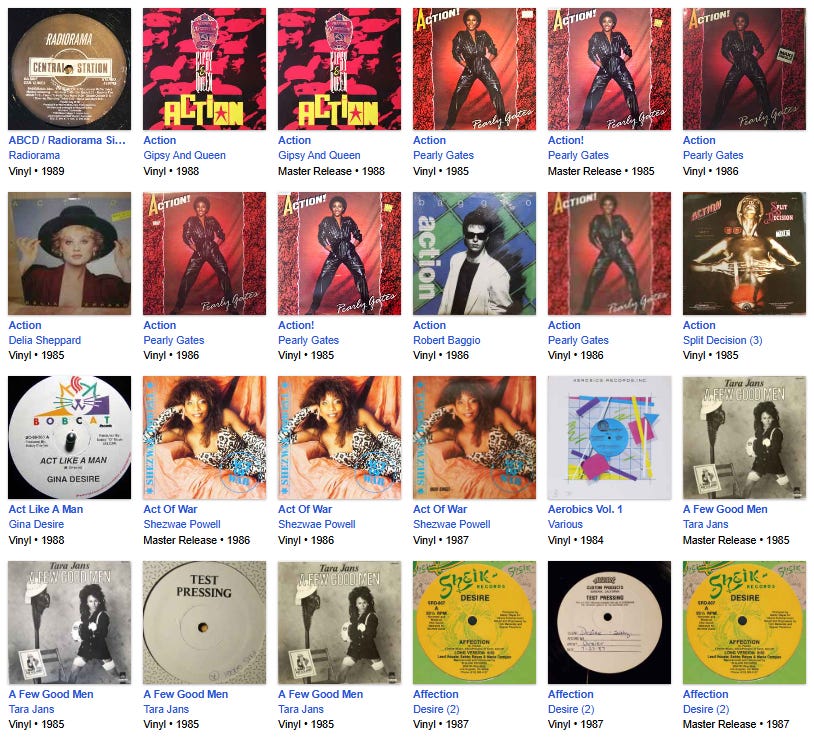
While I work, I keep the Discogs website open on one screen—an exhaustive database of nearly every record ever published. Sometimes I filter by italo disco, eurodance pop, hi-nrg dance floor bangers, whatever suits my mood. Sometimes I narrow it down to just the 80s or just the 90s. Then, I browse through search results hunting for artist names and song titles I’ve never encountered in my life. (And I can tell you: I have HUGE playlists.)
On another screen, I look up those records on YouTube Music—because unlike Spotify, it actually offers nearly everything that was ever released, not just what’s commercially viable. And I’m having an absolute blast. I find delightful old tracks with a few hundred plays, maybe a few dozen likes. Songs that nobody has ever recommended to anyone. Music that would never surface in a recommendation engine and that ChatGPT isn’t even aware of because these tracks barely register in its training data.
I listen to rare tracks just because they exist. Songs that practically nobody else is listening to. I watch the play counts tick up one by one and realize it’s probably only me doing the ticking.
And I couldn’t be happier.
I’ve closed the lid on the echo chamber.
I'm a seasoned founder, intrapreneur, and former CIO who builds maps and models for Solo Chiefs navigating sole accountability in the age of AI—informed by plenty of scar tissue. All posts are free, always. Paying supporters keep it that way (and get a full-color PDF of Human Robot Agent plus other monthly extras as a thank-you)—for just one café latte per month. Subscribe now.
My New Year's Resolution: Think for Yourself in 2026
Let’s skip the predictable hand-wringing about populism, the corrosive effects of social media on politics, or the dire consequences of the Chameleon Effect on the youngest generations. You’re already familiar with all of that. Let’s focus instead on something we can actually control: our own intellectual capabilities, our own worldviews, our own critical thinking.
I refuse to be the average of everyone I know.
I’m going to stop reading books recommended by friends and followers.
I don’t want to read Substack publications just because they’re on the bestsellers list.
I will not watch films or TV shows selected for me by the streamers’ algorithms.
I don’t want to read the same news articles everyone else around me is reading.
I want to consume only what I found and picked myself.
I’m closing the lid on the echo chamber.
I intend to inoculate myself against social contagion in an attempt to regain my sanity, widen my mental perspectives, and restore some semblance of critical thinking.
In 2026, I want to be less like everyone else.
In my mind’s eye, I’m picturing an entire Exactitudes page with just one photo: me.
Happy New Year.
Jurgen, Solo Chief
You’re an Ignorant Fool—The Law of Tragic Nuance

I Argue with Everyone. Both Sides Hate Me. Here's Why I Keep Going.
LLMs Are Like Politicians—Confidently Wrong

Politicians Lie. LLMs Bullshit. Here's How I Survive Both.

So refreshing to read on the first Saturday of 2026 - thank you. I just came off firmly pressing "NO" to what my feed was inviting me to waste my morning on. Instead, selected what i prefer to give my attention to. Saturday starting so much the better for this tiny difference that can set in motion a ripple of me engaging with the world through my preferences. Thank you. On a more serious note, your piece is being added to my collection for a piece I'm writing about accountability - individually and to the collective, and ethical fading. I'll be sure to cite your contribution.
Again Inspiration. This ist what the Internet ist good for. Not for people telling you whats good but for people inspiring oneself to try new paths.
The discogs idea is awesome.
Thanks for being inspirational and making me smile every once in a while.
Happy new year!