

Benchmark scores won’t tell you which AI to use. Your personality will.
Fifteen companies actually build their own AI models. Which one fits you depends on risk tolerance, data sovereignty, and whose servers you’ll trust with your recipes.
This week, I sat down with four AI assistants and asked them to explain each other to me. It went about as well as you’d expect.
The AI world has become absurdly crowded.
Every week there’s a new model, a new benchmark, a new press release announcing the dawn of intelligence that will change everything forever. And yet, most of us are wrestling with a much simpler question:
Which AI should I actually use?
I’ll be honest. I had no clue what the real differences were.
Sure, I know the big names. ChatGPT. Claude. Gemini—I use them all the time. But then there’s Mistral, DeepSeek, Qwen, Hunyuan, Kimchi (or Kimi, I always forget) and a growing list of models that sound like they were named by a committee of science fiction fans who couldn’t agree on anything.
So I did what any reasonable person with too many AI subscriptions would do.
I asked four AI assistants to explain the whole thing to me.
I gave ChatGPT, Claude, Gemini, and Perplexity a stack of research prompts and asked them to map the field of companies actually building their own foundation models. (I should probably note that asking AIs to explain the AI ecosystem is a bit like asking your bank to explain why you should trust banks. But here we are.)
After several rounds of synthesis and the occasional disagreement between my AI panel (they argue, by the way, with the passive-aggressive politeness of academics at a conference) we ended up with fifteen companies that actually build their own foundation models.
Then I did what any responsible LinkedIn influencer would do.
I turned it into a slightly unhinged personality test.
Go on. Find out if you’re a Chaos Agent or a Sovereignty Officer. I’ll wait.
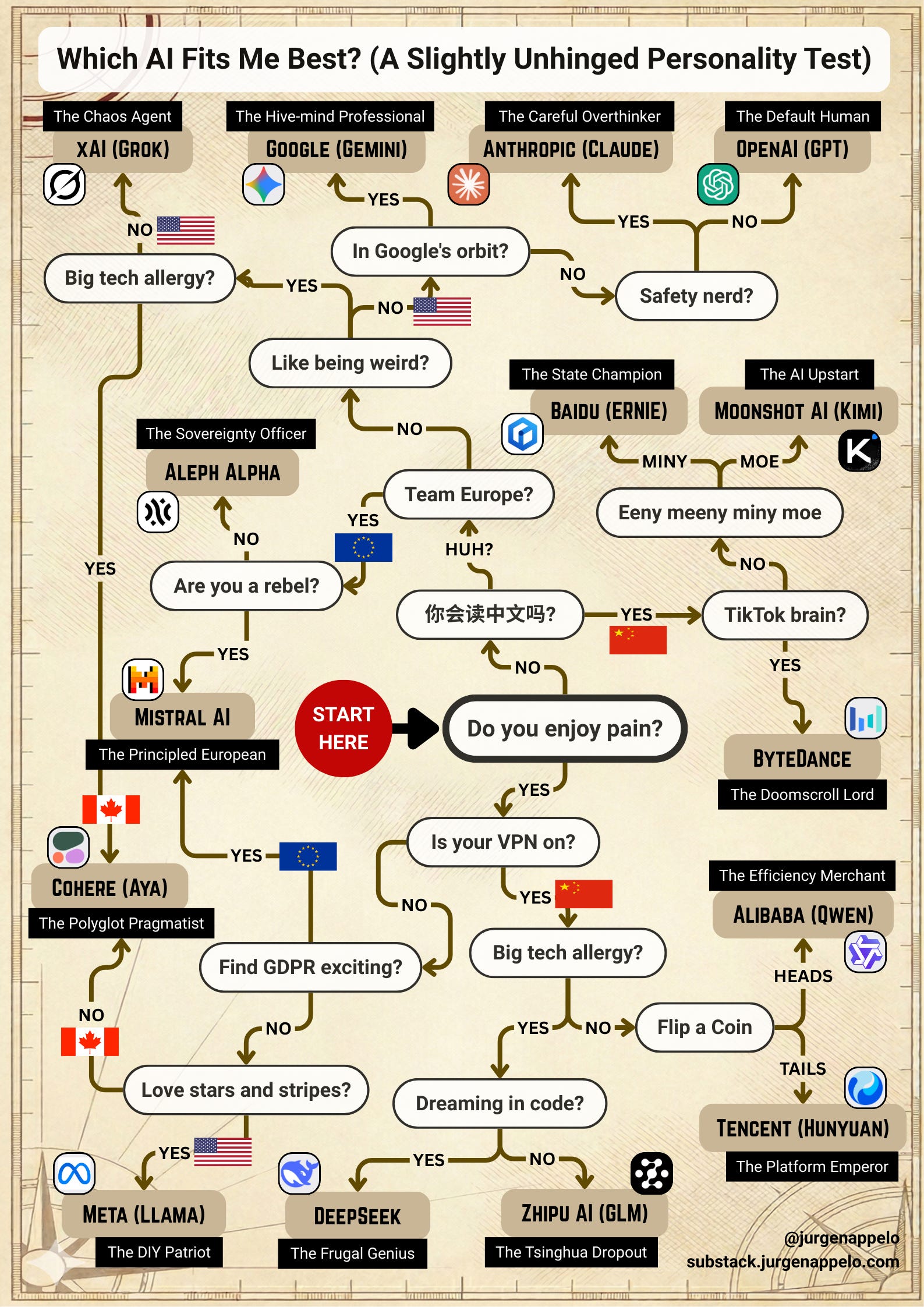
The decision tree is tongue-in-cheek, obviously. But there’s a real structure underneath the playfulness: geopolitical choices, business models, deployment preferences, and the very human question of whose AI models you’re willing to trust with your most embarrassing data.
So let’s translate the chaos into something slightly more useful.
Here’s a quick tour of the fifteen model builders shaping the AI world right now.
The Western AI Heavyweights
OpenAI (GPT) is where most people start, and many people stay. GPT powers ChatGPT and is embedded in more enterprise tools, APIs, and workflows than I can count. It’s general-purpose, multimodal, and deeply woven into the fabric of how business software is evolving. If you don’t know where to begin, you’ll probably begin here. It’s the default (which isn’t an insult). Defaults become defaults for a reason.
Anthropic (Claude) was founded by people who left OpenAI because they were worried OpenAI wasn’t being careful enough. Whether you find that reassuring or slightly alarming probably says something about your personality. Claude’s models are particularly good at long-form reasoning, writing, and document analysis. The company talks a lot about AI safety and responsible development, which appeals to organizations that want their AI with a bit more governance and a bit less chaos. The “Careful Overthinker” label on the infographic is affectionate, I promise.
Google (Gemini) benefits from something none of its competitors can match: Google already has you. If your work runs on Gmail, Google Drive, and Google Calendar (and whose doesn’t) then Gemini’s ecosystem integration is genuinely hard to argue with. The flip side is that you’re deepening your dependency on a company that already knows an awful lot about your professional life. A tradeoff worth thinking about.
xAI (Grok) is Elon Musk’s entry into the AI race. It integrates closely with the X platform and has a deliberately more irreverent personality than most corporate AI assistants. Grok attracts a particular type of user: someone who finds the safety guardrails of other models restrictive, who wants real-time access to what the internet is saying right now, and who doesn’t mind a bit of chaos in their tools. The “Chaos Agent” label isn’t entirely a joke.
The European Contenders
Mistral AI is France’s answer to American AI dominance. Their models can run through cloud services or locally on private infrastructure, which matters a lot to developers who don’t want their data leaving their own machines. Technically impressive, genuinely open, and carrying the quiet pride of a startup that’s punching above its weight class. If you like building your own stack and you have a slight allergy to Silicon Valley, Mistral is worth serious attention.
Aleph Alpha is German, which should tell you something. Their focus is on sovereign AI, models designed for governments, regulated industries, and organizations where transparency and data control aren’t optional features. Less flashy than Mistral. Considerably more serious about compliance. If your clients include regulators or you operate in healthcare or finance, Aleph Alpha deserves a spot in your research.
The Open-Model Ecosystem
Meta (Llama) helped ignite the open-weights movement. Meta releases the model weights publicly, which means a massive ecosystem of developers can run them locally, fine-tune them for specific use cases, and build entirely independent tools on top of them. This is very different from the cloud-dependent models above. If you’re technically inclined and want 100% control over where your data goes and who can see it, Llama is the family to explore. Meta’s motives for releasing open weights are, shall we say, not purely altruistic. But you can still benefit from them regardless of what Mark Zuckerberg is thinking.
Cohere (Command / Aya) flies mostly under the radar. Their focus is enterprise AI infrastructure and multilingual models, and their Aya family supports a remarkable range of languages. If your work spans multiple countries and languages, Cohere is worth knowing about. Don’t expect the hype. Do expect reliability.
China’s AI Ecosystem
China has built its own rapidly expanding AI ecosystem, and it’d be a mistake to ignore it. Five major companies are shaping this space.
Baidu (ERNIE) is the institutional backbone of China’s AI strategy, integrated into Baidu’s search, cloud, and enterprise products. Think of it as the OpenAI equivalent for China’s domestic market.
Moonshot AI (Kimi) is a newer startup known for models that handle extremely large documents and long conversations without falling apart. The “AI Upstart” label fits: they’ve got the energy of a company moving fast and making noise.
ByteDance (the company behind TikTok) is building AI capabilities at a scale most people haven’t fully registered yet. Their models power content creation, recommendation systems, and more across platforms with hundreds of millions of users. Whether “The Doomscroll Lord” as a label is funny or terrifying probably depends on your relationship with your phone.
Alibaba (Qwen) focuses on commercial and enterprise applications, integrating deeply into Alibaba’s enormous cloud and commerce ecosystem. If you do business within Alibaba’s world, Qwen makes obvious sense.
Tencent (Hunyuan) connects to WeChat, gaming platforms, and one of the largest consumer ecosystems on the planet. If Alibaba is the enterprise play, Tencent is the consumer and creator play.
DeepSeek grabbed global attention by producing high-performance models at surprisingly low cost. Their approach to efficiency made Western AI labs visibly uncomfortable. Popular among developers and researchers who want serious capability without serious price tags. The “Frugal Genius” label is genuinely accurate.
Zhipu AI (GLM) emerged from academic research at Tsinghua University and represents an important part of China’s AI research ecosystem, less commercially visible than the others, but technically serious.
I’m a founder, intrapreneur, and former CIO rethinking governance for the one-person business, navigating sole accountability in the age of intelligent machines—informed by plenty of scar tissue. All posts are free, always. Paying supporters keep it that way (and get a full-color PDF of Human Robot Agent plus other monthly extras as a thank-you)—for just one café latte per month.
So Which One Should You Use?
Honestly? It depends on things that have nothing to do with benchmark scores.
It depends on whether you care about data sovereignty or just want something that works. It depends on whether you’re building your own tools or using someone else’s. It depends on how you feel about tech billionaires, Chinese servers, and European bureaucracy. (All three camps have legitimate points, by the way.)
The infographic above maps these choices through a series of questions that are (let’s be clear) mostly designed to make you chuckle a bit. But I’d argue that the personality test framing actually gets at something real.
The AI you choose says something about your risk tolerance, your politics, your technical comfort level, and your relationship with control. That’s worth knowing.
Follow the arrows. Find out what kind of AI person you are.
And then, as with all maps: use it to think, not to stop thinking.
Jurgen, Solo Chief
P.S. Which endpoint did you land on? Chaos Agent or Sovereignty Officer?

Choose Your Technology Adoption Strategy: When to Migrate

Stop chasing every new tool. Stop feeling guilty about waiting. Learn where to sit on the technology migration spectrum.

»Aleph Alpha is German, which should tell you something.«
Hey, as long it’s not trying to invade other countries we should be cool about it 😅
Thanks so much for this post, Jurgen. It helped me confirm that my current choice is probably worth sticking with for now, and it introduced me to other options to consider if things change!