

AI can optimize bad targets all day; your people still have to question them.
I almost fell for a scam. Silly me.
The editor of a publisher reached out. They’d found my novel, loved my writing, and recommended I contact their preferred literary agent.
I was skeptical at first, so I consulted an AI, and we ran some background checks. Everything checked out: the editor, the publisher, all legitimate. Except that the email was sent from a private Yahoo account, not a company account. Still feeling doubtful, I forwarded the exchange to the editor’s official company address, which I’d pulled from their website.
Bingo!
The real editor replied: “Sorry, that’s not me. They’ve been using our names for weeks. Thank you for checking. I reported the abuse to Yahoo.”
I felt both sad and proud of myself. The scammers had studied my public profile better than most recruiters study a CV. Only my skeptical self saved me from further embarrassment.
It’s so easy to fall for a scam. Especially when it validates what you already believe. For sure, I’m a good writer. Of course, my work needs recognition. Hell yes, I deserve a publishing contract!
But in the age of AI, the number one skill is critical thinking. The talent to question everything, most importantly yourself.
In the age of AI, the number one skill is critical thinking.
What saved me was a habit of doubting my own conclusions (even the ones an AI had just confirmed for me). The AI background check endorsed the scam. My own dubiety caught it, not my tools.
Organizations need that same critical habit on a much larger scale, and most of them never build it.
Single-Loop, Double-Loop, and Triple-Loop Learning
The “learning organization“ became a thing when Peter Senge popularized the term in The Fifth Discipline in 1990. However, few people understand or consider the three different levels of learning. As a result, some kinds of learning happen a lot, while other kinds don’t happen at all.
Single-Loop Learning
In single-loop learning, an entity (worker, team, department, business unit) detects a mismatch between expected and actual results and changes its actions to close the gap.
When inventory falls below the minimum level, we crank up production. When the AI agent mis-routes support tickets, someone tweaks the prompt and moves on. When the delivery team risks missing its deadline, they work extra hours to catch up with the plan.
Single-loop learning is often compared to a thermostat detecting a temperature change and activating or deactivating a heater to balance around a pre-set target. In this process, nobody asks whether that target (threshold, deadline, or inventory level) still makes sense in the current environment.
Double-Loop Learning
In double-loop learning, a term business theorist Chris Argyris introduced in 1974, a team or organizational unit evaluates the mismatch between expected and actual results by examining its governing variables: the goals, beliefs, and assumptions that were used to set the target in the first place.
When faced with reality, an organization might want to change its minimum inventory level, extend the delivery team’s deadline, or ask whether that support queue should even exist now that agents answer most tickets. The organization can adjust the threshold, objective, or inventory level to reflect what is truly desirable and feasible given its circumstances.
With double-loop learning, the entity acknowledges that a goal is a hypothesis that needs continuous validation. The governing variables are always subject to critical examination to check whether the targets are still viable.
Triple-Loop Learning
At the third level, we find deutero-learning, or “learning how to learn.” This is the meta-process that a team or organization needs to figure out if the single loop and double loop are both working as intended.
At this level, the team decides whether to introduce after-action reviews, blameless postmortems, or agile retrospectives. It checks whether its red teaming, action learning, or scenario planning practices are working. And it discusses the pitfalls of rewards and incentives, power dynamics, or a non-transparent organizational culture.
At the meta-level, an entity analyzes its learning history, examines its learning patterns, and diagnoses counterproductive feedback cycles that hinder single- and double-loop learning. In this third loop, a team, department, or business unit deliberately refines its communications and behaviors to make future learning interventions more systematic.
Note: There is no consensus on the term “triple-loop learning”, which various scholars and authors have defined differently. I use it when “the third loop” is easier to understand and visualize than meta-learning or deutero-learning.
I’m a founder, intrapreneur, and former CIO who helps leaders diagnose and redesign their operating models for the age of AI—informed by plenty of scar tissue. This article offers the same lens I bring to keynotes, workshops, and advisory engagements, from a single team to a multinational. Want that lens on your organization? Let’s talk. And if you’re just here for the maps, subscribe—they’re free, always.
Triple-Loop Identity
In my previous post, “End with Why,” I wrote:
Purpose is best understood as a hypothesis you may state early, but then keep crafting and validating through actual collaboration.
Visualizing that with the simplified VSM model, it looks like this:
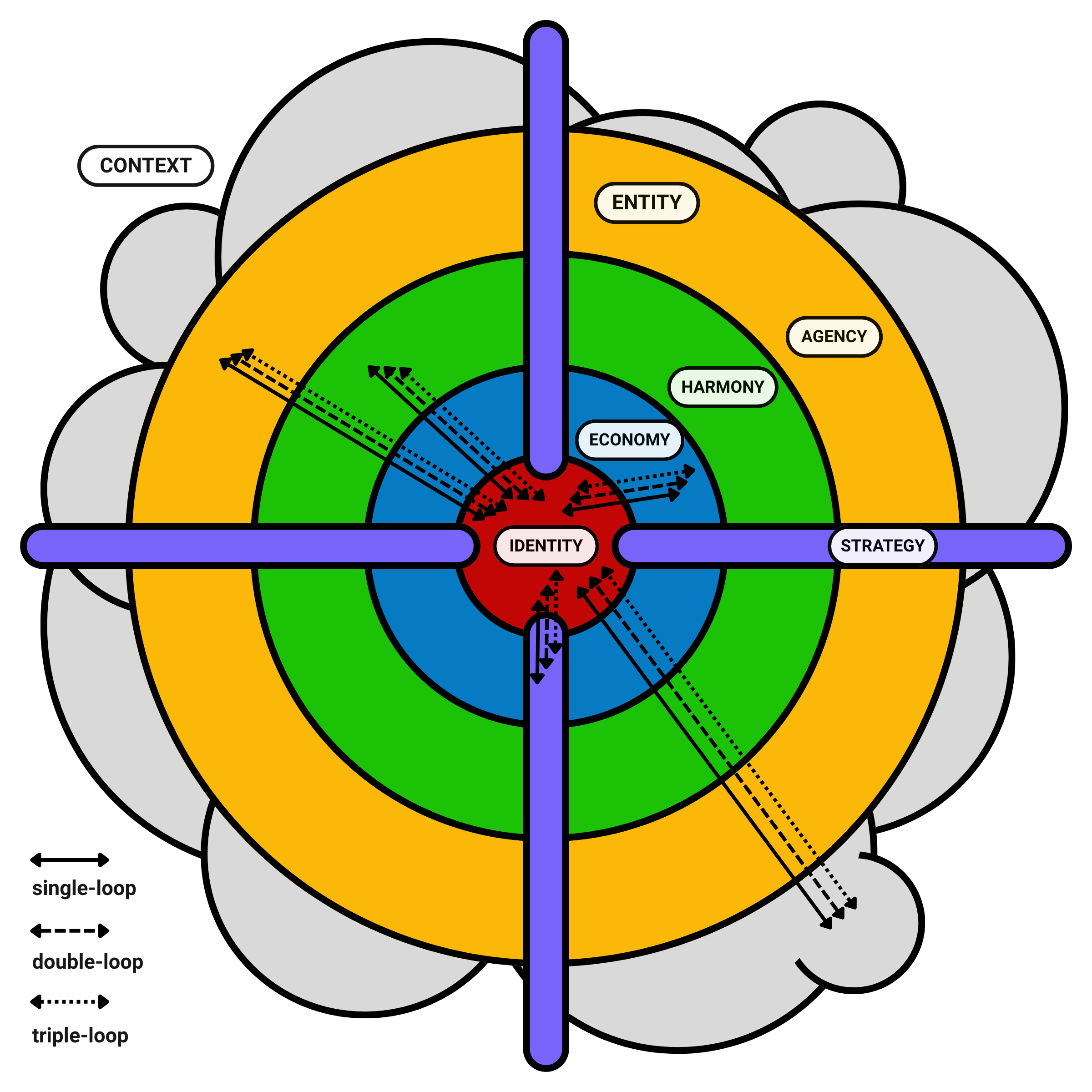
An organization should treat the Identity function the same as each of the other functions, with single-loop, double-loop, and triple-loop learning cycles that repeatedly validate whether its purpose, vision, mission, values, and principles are still the ones it needs. Probably not every day, but often enough to matter.
As I discussed last time, identity emerges from collaboration among the parts. The entity needs three things:
Single-loop learning between the Identity function and the other functions to ensure that what emerges from the team aligns with what the organization intended;
Double-loop learning to update the espoused purpose and values when the emergent identity requires a revision of the defined identity;
Triple-loop learning to guarantee that this happens consistently and deliberately, to ensure that the enacted and espoused purpose are always kept in sync.
Almost no organization has this.
Worth noting: the canonical diagram of the Viable System Model doesn’t distinguish between single-loop, double-loop, and triple-loop learning. It also doesn’t show a feedback loop between Identity (System 5) and what I call the Agency (System 1) and Harmony (System 2) functions. Still, Stafford Beer’s POSIWID (”the purpose of a system is what it does”) is the enacted purpose. Beer explicitly instructed diagnosticians to believe behavior over declarations. He just never drew the reconciliation as a loop. Other systems thinkers have formalized it since. Raul Espejo’s Viplan method, for example, distinguishes the declared identity from the identity-in-use (terminology he borrowed straight from Argyris), and treats the gap between them as a core diagnostic to investigate. What matters is not that you draw it. What matters is that you do it.
To translate the three learning loops into agile terminology:
Single-loop learning is a team continuously planning and replanning their work to achieve their Product Goal;
Double-loop learning is the team wondering if their Product Goal still makes sense and adapting it when necessary;
Triple-loop learning is the team discussing how they can always adapt their Product Goal to fit their ever-changing reality.
The Sixth Function Is Dubiety
The meta-learning loop, “learning how to learn,” is the most important learning cycle. Without the third loop, the double-loop might happen only occasionally, or might not happen at all. Without triple-loop learning, the double-loop collapses too easily into a single loop when nobody questions the effectiveness of a team’s learning practices. When not a single skeptical person asks, “Have our retrospectives ever led us to update our goals and values?” the retros might just be doing single-loop corrections, not double-loop reflections.
It’s the meta-loop that holds the other two loops in place through its continuous doubting and questioning.
I would even suggest adding Dubiety to my simplified VSM model as an important sixth function. Dubiety is the quality or feeling of being uncertain and doubtful. It describes the mental state of holding reasonable skepticism about things and remaining open to being proven wrong. Dubiety is the function of always questioning everything, especially one’s own beliefs and assumptions.
AI raises the stakes on all three loops. Agents now run the single loop at machine speed, around the clock, and they will cheerfully optimize a target that stopped making sense months ago. Doubting all targets remains a human job. It’s the one function of a networked agentic organization that you cannot delegate.
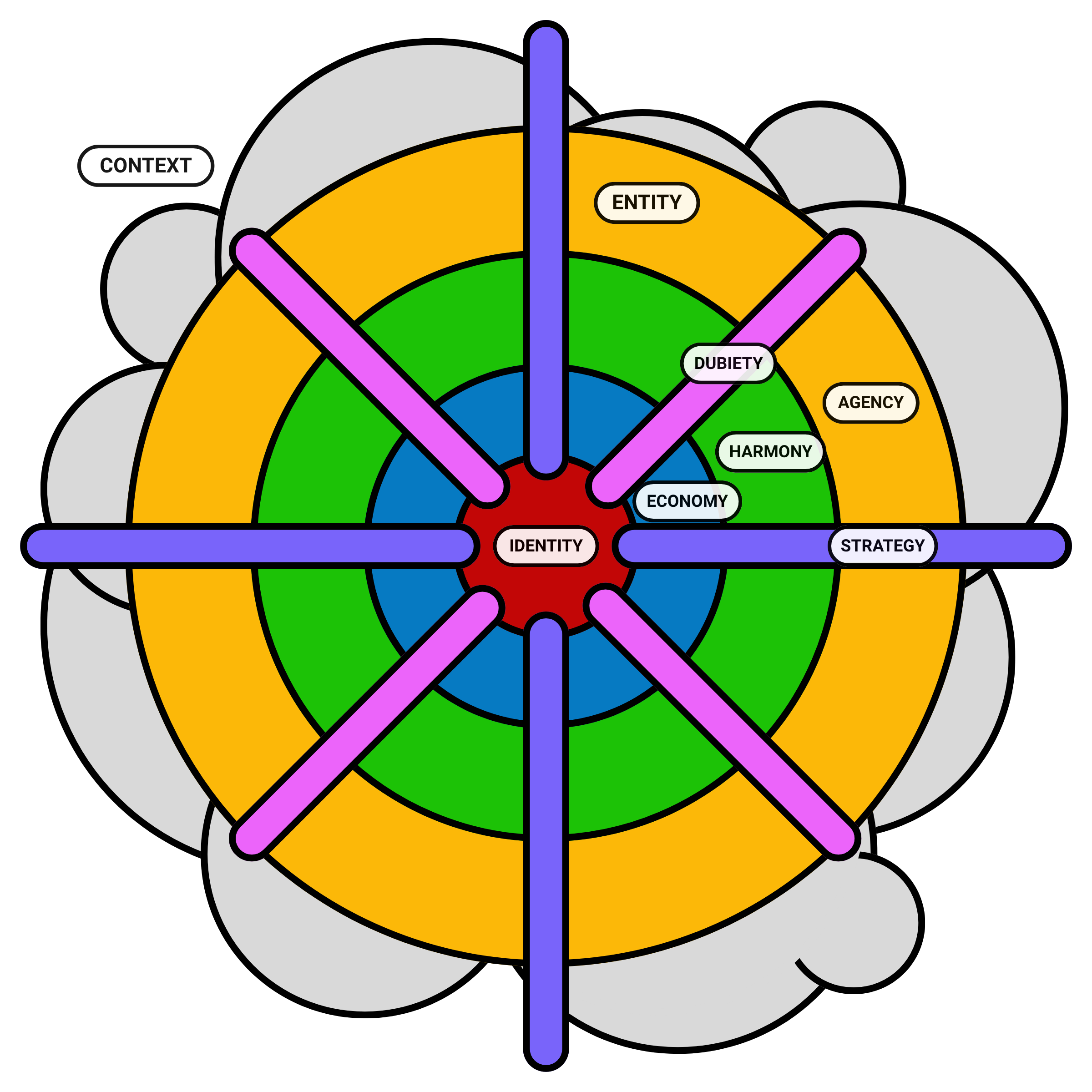
As a Solo Chief running a small network of AI agents, I’m training and practicing my own dubiety every day. I doubt everything, especially myself and my digital team. And it works. The AI cleared the scammers. I was the one who caught them.
Critical thinking is the number one skill in the age of AI. I continuously question the news items I see, the emails I receive, and the collaboration proposals I get. I question the books I read, the documentaries I watch, and the advice I get from my team of AIs. Most importantly, I regularly question the values I hold dear, the vision I have for my future, and the objectives I set for myself. It’s what every team, department, and organization should do, because a company that automates its actions but never questions its assumptions is just making the wrong things happen faster.
A company that automates its actions but never questions its assumptions is just making the wrong things happen faster.
The third learning loop is to question everything.
The sixth systemic function is dubiety.
Jurgen, Solo Chief.
P.S. When did you last doubt a goal instead of just chasing it harder?


The Ultimate Framework Makes a Comeback

Most org models fail because they turn work into jargon, then call the mess a transformation.
I probably overdo the doubting. I doubt my own goals and AI output so much that I built a small AI committee. The models challenge my decisions and each other’s work.
This is also why I disagree with the term AI slop. I am honestly sad to see how many people do not even read what AI produces before publishing it. Most of that is human slop. People still choose how to use and distribute AI artefacts.