


For a fraction of a second, I considered being dishonest.
Simon Sinek got it backwards. Purpose isn’t why great people join you—it’s what they build after you’ve paid them fairly.
I reluctantly informed a client that they’d made a double payment from two different departments. For a fraction of a moment, I considered waiting to see if anyone at that company would notice. (It was a significant sum!) But then I observed my own thoughts and intervened, “No. That’s not the person I aspire to be.” So I returned the duplicate transaction and ended up feeling aligned with myself. Why did I send the money back? Because I’d rather be poor but honorable than rich and dishonest.
Doing good was the byproduct. Feeling good was the motive.
I did that primarily for myself.
What’s In It for Me? (WIIFM)
Sociologists George Homans, Peter Blau, and Richard Emerson explained with Social Exchange Theory (SET) that human interactions follow a continuous cost-benefit analysis. Individuals take part in groups to maximize rewards (safety, belonging, recognition, reputation, etc.) and to minimize costs (time, effort, energy, expenses, and so on).
In my case, the (long-term) reward of boosting my reputation and the (short-term) feelings of integrity outweighed the immediate cost of returning the duplicate payment. It might seem cynical, but most people’s efforts at “doing good” are often just socially acceptable masks draped over things that boil down to return on investment calculations, or “What’s in it for me?” (WIIFM)
Economist Mancur Olson described something similar in The Logic of Collective Action (1965). People won’t act to achieve a shared goal unless there is some personal benefit, he wrote. Shared purpose, said Olson, is a public good: it is available to everyone for free. It costs nothing to just say, “Let’s save the planet!” What motivates people to action is what they gain individually from their contribution to the common cause, which can be compensation, reputation, belonging, or any other social or economic incentive.
From Prosci’s ADKAR to Kotter’s 8-Step Change Framework, the matter of “What’s in it for me” gets serious airtime in practically every change management model. Each one of us evaluates change and transformation through a lens of self-interest, and we resist when the ROI seems negative. If it doesn’t pay us, it doesn’t sway us.
Politicians probably know this better than anyone.
However, that doesn’t mean a grand purpose won’t work.
Why Should I Care? (WSIC)
The same George Homans (of Social Exchange Theory) argued that group dynamics typically has three components: activities (tasks and duties), interactions (verbal and non-verbal), and sentiments (feelings and emotions). These three components continuously influence each other, resulting—if all goes well—in a cohesive, self-reinforcing social unit with a strong sense of meaning. In other words, a group’s purpose emerges from their collaboration and is more powerful than any top-down directives imposed by management.
Social Identity Theory (SIT) by social psychologists Henri Tajfel and John Turner then takes over from SET and explains how individuals use group membership to derive self-esteem and pride. (If you want to see this in action, just watch any football fan’s reactions to their team’s results in the FIFA World Cup.)
People with “low organizational identification” do not yet internalize the group’s “Why.” They still require social exchanges—cost-benefit reciprocity and transactional rewards. We can call them social exchange dominant. But others with “high organizational identification” strongly identify with the group’s “Why.” They need social identity—purpose, vision, mission, values, and principles. We can call them social identity dominant. Crucially, continuous positive social exchanges turn the former group into the latter. Social exchange turns into social identity, not the other way around.
Psychologists Edward L. Deci and Richard Ryan offered us the same message through Self-Determination Theory (SDT). Purpose is real, but people usually internalize it over time. They don’t adopt it on day one. People typically enter an organization for extrinsic reasons (pay, security, opportunity) and only internalize an organization’s purpose as their own once the group meets their needs for autonomy, competence, and relatedness. Pay precedes purpose.
Pay precedes purpose.
Finally, political economist Elinor Ostrom’s Nobel-winning work confirmed that people solve collective-action problems not via a pre-existing shared purpose but through reciprocity, reputation, and trust that develop via repeated interaction and face-to-face communication. Humans are a mix of self-interest and the capacity to develop shared norms, but purpose is more often the output of collaboration rather than the input.
That’s a significant group of experts and scientists all suggesting the same thing: successful collaboration doesn’t start with why; it ends with why.
Why Start with Why Fails
In his bestselling book Start With Why (2009), inspirational speaker Simon Sinek argued that leaders who communicate a shared purpose (why) before their method (how) and product (what) inspire loyalty and improved performance. With his model of the “Golden Circle,” Sinek tried to give his ideas a neurological foundation. He related the inner circle (why) to the limbic system, where emotions would originate, and his outer circle (what) to the neocortex, where rational thought was suggested to emerge, using this as a biological justification for why “people don’t buy what you do; they buy why you do it.”
Sadly, the golden circle did not survive impact with the golden rule of scientific rigor: one must frame and execute models and theories so that others can independently reproduce, scrutinize, and potentially falsify them.
The problem was that Start With Why relied almost exclusively on anecdotes, with 235 mentions of Apple as the primary success template, while providing no scientific backing—no surveys, no control groups, and no longitudinal studies. Sinek provided zero evidence that Apple’s success at the time stemmed from a shared purpose rather than product quality, impeccable timing, or brilliant marketing. Critics noted that he cherry-picked confirming cases and omitted base rates and counter-examples. I was not impressed with the book either.
In addition, Sinek’s claim that the “why” never changes has been called out as axiomatically false. Shared purpose, vision, mission, values, and principles clearly do change as they continuously emerge and re-emerge from people’s activities and interactions, as social identity research confirms.
A shared purpose is what you get from successful collaboration. You don’t get successful collaboration from just sharing a purpose. It doesn’t start with why; it ends with why.
It doesn’t start with why; it ends with why.
Enacted vs. Espoused Purpose: Two Feedback Loops
Perhaps I should not be too dismissive of Simon Sinek’s work. He had a valid point: Research consistently shows that organizations with a credibly enacted purpose attract and keep employees who are already purpose-aligned. It’s a sorting effect. If you honestly have it, it improves your input.
On top of that, large‑scale studies find that companies that genuinely integrate corporate purpose into their strategy and operations outperform their industry peers on long‑term growth and profitability. It’s a growth effect, too. If you really have it, it improves your output.
So, what are we to make of this?
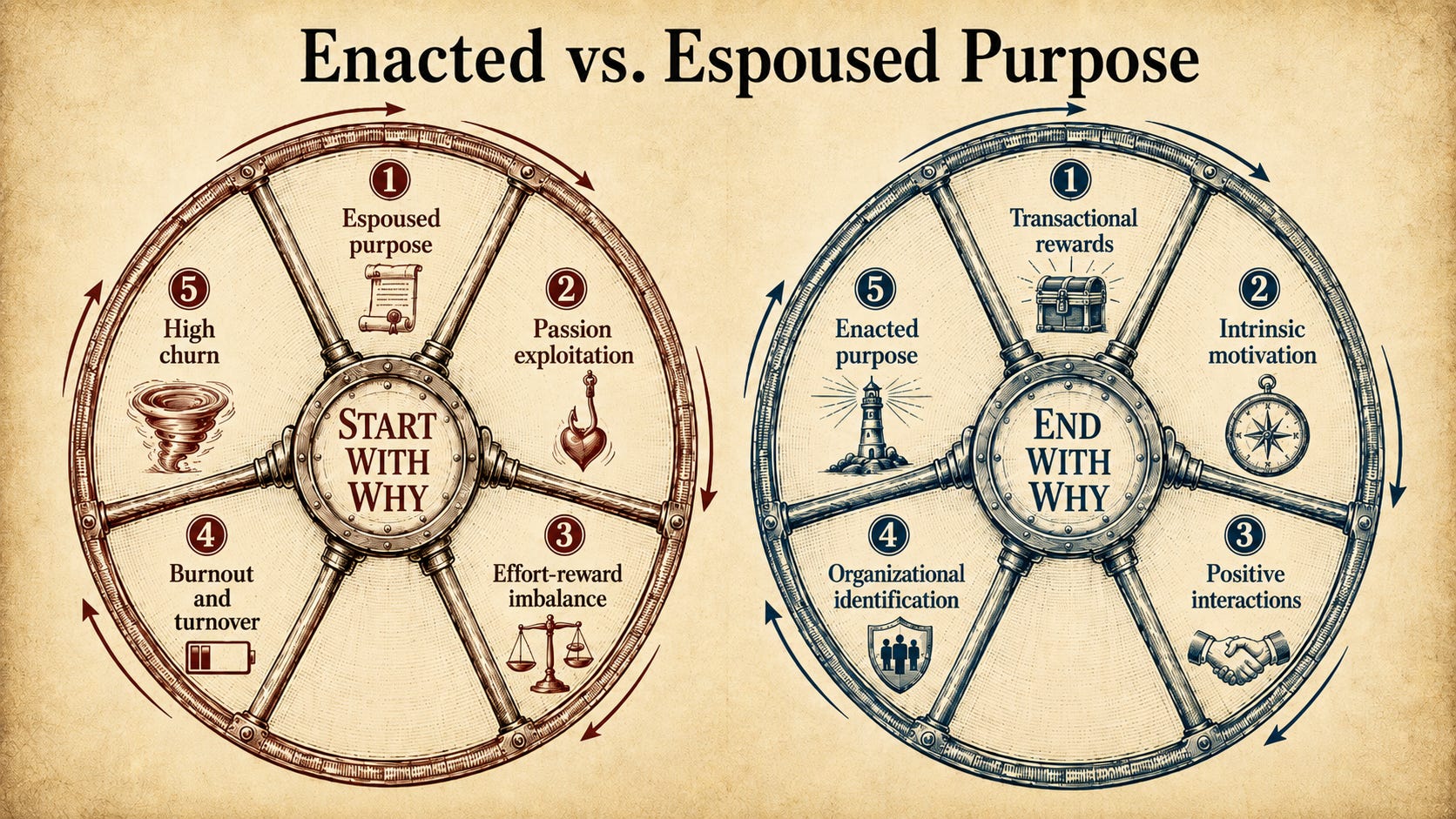
In an organization that ends with why, transactional exchanges followed by emergent purpose function as a beneficial virtuous cycle:
The organization provides fair, competitive transactional rewards that satisfy people’s individual economic and motivational needs (SET).
The organization nurtures intrinsic motivation by satisfying psychological needs for everyone’s autonomy, competence, and relatedness (SDT).
Shared activities generate frequent, positive interpersonal interactions, giving rise to positive sentiments of trust and care.
These sentiments stabilize into a strong organizational identification, allowing an authentic, shared “Why” to emerge (SIT).
This shared identity maintains employee engagement, boosts organizational performance, and attracts more purpose-minded workers.
Conversely, when an organization starts with a top-down or “made-up” why, the superficial purpose without social grounding triggers a destructive vicious cycle:
The organization espouses a marketing-driven purpose (not enacted through actual employee behaviors) to attract talent and consumers (“purpose-washing”).
Corporate governance remains bound to shareholder profits, while managers use this purpose to justify decreased pay and increased work demands (“passion exploitation”).
This creates a severe effort-reward imbalance, with the negative ROI failing to satisfy employees’ basic needs for autonomy, competence, and relatedness.
The unanswered question, “What’s in it for me?” leads to severe employee disillusionment, driving high rates of burnout, turnover, and quiet quitting.
The turnover forces the organization to rely even more on outward-facing purpose branding to recruit fresh, idealistic talent, cementing a high-churn cycle.
Does any of this sound familiar?
Did your organization discover or define its purpose? Was it embraced at the end or at the start? Do you have an enacted purpose with a feedback loop that lifts everyone up, or only an espoused purpose with a vicious cycle that grinds everyone down?
I’m a founder, intrapreneur, and former CIO who helps leaders diagnose and redesign their operating models for the age of AI—informed by plenty of scar tissue. This article offers the same lens I bring to talks, workshops, and coaching, from a single team to a multinational. Want it applied to yours? Let’s talk. And if you’re just here for the maps, they’re free, always.
The Tricky Paradox
And yet … When I evaluate job postings and potential client engagements, I constantly find myself judging organizations, what they contribute to their markets, and what they stand for in society. Oil and gas, freight and logistics, investment banking, social network services, or marketing and advertising? Meh. None of these give me a warm feeling. But arts and culture, education, healthcare, human rights, or entrepreneurship? Absolutely. Where do I sign up?
Doesn’t this contradict everything I stated earlier? Doesn’t this prove that, at least for me, it starts with why after all?
Research by psychologists Carsten De Dreu and Aukje Nauta found that self-interest and concern for others are independent motivational systems. People can score simultaneously high or low on both. They found the highest levels of sustained performance came from employees motivated by both self-interest and concern for others—not purely one or the other. It suggests that “start with why” versus “end with why” is a false dichotomy. You can have both reinforcing each other.
Similarly, research by Adam Grant found that combining personal motivation (WIIFM) with pro-social motivation (WSIC) produced a multiplicative effect on creativity and performance, stronger than either motivation alone.
“This hybrid engine of self-interest and concern for others serves a much wider circle of people than can be reached by self-interest or caring alone” - Bill Gates at the World Economic Forum
So yes, highly motivated people (such as yours truly) seek out opportunities by checking pay and purpose. But that’s only to start the conversation. The selected organizations should prove that they start the virtuous cycle with a transactional exchange and only follow with a purposeful identity later.
First, we want an answer to “What’s in it for me?” Only later do we have time for “Why should I care?”
That’s how the personal battery keeps recharging, not the other way around.
Purpose Is What You End Up With
Business theorist Edgar Schein’s foundational work on organizational culture established that organizational values are emergent and learned, not predefined and imposed. He defined culture as “a pattern of shared basic assumptions that a group learns as it solves its problems of external adaptation and internal integration.” Shared purpose, Schein said, is not a precondition for joining; it is the product of the socialization process that follows joining. Purpose is not what we start out with; it’s what we end up with.
Purpose is not what we start out with; it’s what we end up with.
Perhaps Karl Weick’s Sensemaking in Organizations (1995) is the strongest scholarly backing for “it ends with why.” Weick’s core finding: “How can I know what I think until I see what I say?” Weick showed that action creates commitment and shared meaning. Purpose is an “ongoing accomplishment” and continually remade. Identity should be espoused and enacted.
Make no mistake: a clear directional “why” (after it has emerged from successful group collaboration) is genuinely useful as a recruitment and navigation device. A shared purpose functions as a selective filter, presenting a story that helps an organization attract individuals whose personal values align with the collective vision. However, the “why” is merely an invitation to collaborate, nothing else.
Once an individual joins the organization, the operational logic must shift to transactional exchanges. For the new collaboration to survive, the firm must satisfy the new worker’s economic and motivational needs. It must first answer, “What’s in it for me?” Pay precedes purpose, and if it doesn’t pay us, it doesn’t sway us.
Only when the company successfully maintains a fair social exchange can the new employee transition from transactional exchanges to pro-social commitment. Through repeated positive interactions, they build group cohesion and internalize the organization’s purpose as a core part of their social identity. They become much more sensitive to “Why should I care?” And in a fast-changing environment, a stable “why” can be the one fixed point when the “what” and “how” keep shifting.
Purpose is best understood as a hypothesis you may state early, but then keep crafting and validating through actual collaboration.
Jurgen, Solo Chief
P.S. Does your organization have an espoused or an enacted purpose?
It's Not Always Cold in the True North

AI cannot interpret corporate bullshit or fill gaps with common sense like humans do.


"The problem was that Start With Why relied almost exclusively on anecdotes, with 235 mentions of Apple as the primary success template, while providing no scientific backing—no surveys, no control groups, and no longitudinal studies. Sinek provided zero evidence that Apple’s success at the time stemmed from a shared purpose rather than product quality, impeccable timing, or brilliant marketing."
Thank you! Thank you! Thank you! I recently left a company that used Sinek's "Start With the Why?" as the foundation of their "value statement" or whatever nonsense they called it. EVERYTHING in this company was anecdotal. Nothing was REAL. It was a house of cards. It has almost completely crumbled.
I love your ending paragraph: "Purpose is best understood as a hypothesis you may state early, but then keep crafting and validating through actual collaboration." I am engaged in some non-profit work, and I am coming around to this same conclusion. Stating my goals and cause early is valuable, but actual collaboration and discernment in my heart as well as my mind is essential to developing and maintaining the direction.
There are no easy answers! Thanks, Jurgen, for these insights.