

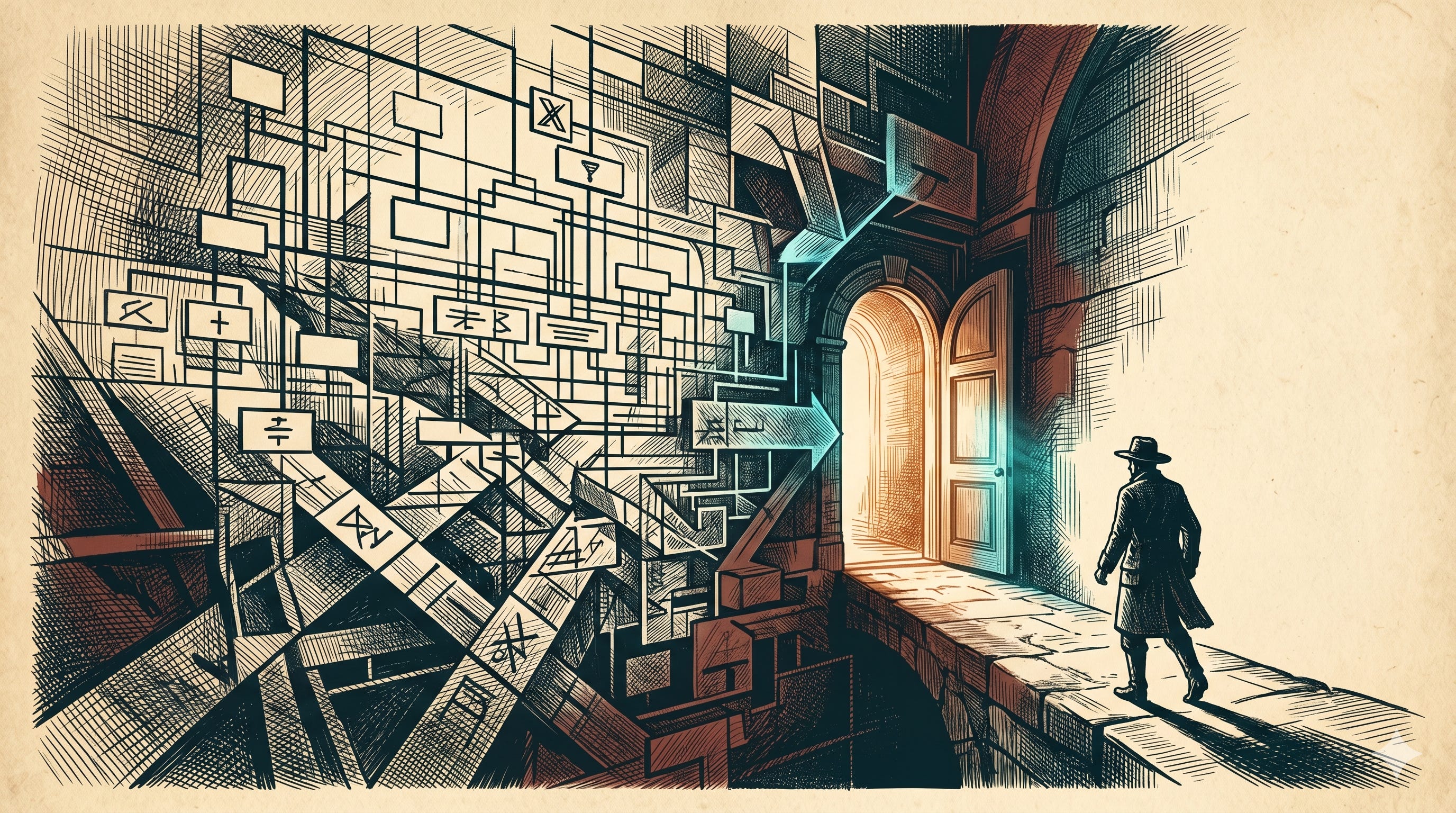
They didn’t hire you to attend meetings about meetings. They hired you to do your thing. Do you remember that thing?
I’m a founder, intrapreneur, and former CIO rethinking governance for the one-person business, navigating sole accountability in the age of intelligent machines—informed by plenty of scar tissue. All posts are free, always. Paying supporters keep it that way (and get a full-color PDF of my book Human Robot Agent plus other monthly extras as a thank-you)—for just one café latte per month.
Sometimes you realize you’ve done no actual work today.
You attended meetings. You replied to messages. You moved post-its across task boards. You waited for someone to approve something so you could send it on to someone else. You sat through an alignment session about an upcoming visioning session. And somewhere in the middle of all that, the part of you that’s actually good at something (the part that attacks problems and ships work that matters) sat quietly in a corner like a child the family overlooked when handing out the cookies.
That’s the org chart, choking your craft.
Your craft is the thing you can do that most people can’t. It’s the reason anyone hired you in the first place: the skill set you spent many years sharpening before someone put you in a box on a slide and labeled the box “Senior Director of Sticky Notes.”
Years ago, I was a manager who confused calendar density with purpose and meaning. I presided over status meetings where intelligent adults reported to me they were “on track.” I wrote quarterly objectives and annual plans that nobody followed, not even me. I escalated issues to people who escalated them right back. I probably organized meetings to determine whether we needed more meetings.
This is what the org chart does. It substitutes coordination for work, then declares the coordination is the work, then promotes the people who are best at coordination into roles where they coordinate the coordination. Eventually somebody has to actually get something done, and that somebody is exhausted, checked out, and quietly browsing job postings. For more executive leaders than will admit it, the org chart is killing their business in slow motion, one alignment ritual at a time.
Let me say this plainly so the people can hear it through the walls of their boxes:
The org chart was a useful diagram for a kind of work that is rapidly disappearing.
The Org Chart Was Built for a World That’s Disappearing
It was designed for an era when coordination was expensive and execution was cheap. It came in handy when you needed forty people to ship a product, twenty to sell it, five to run payroll, seven to handle legal and finance, and a whole department to pick up the phones. The chart told you who reported to whom because somebody had to keep an eye on this thing. The hierarchy was the operating system because the operating system was made of people, and people forget things, make mistakes, run in the wrong direction, and complain incessantly about lack of communication. This needed managing.
Now, that world is limping toward the exit.
What’s replacing the org chart is the absence of a static one. A solo operator with the right stack now does, in an afternoon, what used to require an entire department. I’m watching it happen in real time.
I run a publication, an advisory practice, a string of speaking gigs, and a Substack intelligence operation that would have needed twelve employees in 2019. I have zero teammates. Well, zero humans. My AI buddies all have names and respectfully call me Boss, Sir, or Chief, even when they leave no opportunity unexploited to tease me or correct me. But they get the work done. Clients get served. Bills get paid. The lights stay on. There’s no one to coordinate because there are no humans to coordinate.
What Replaces the Org Chart Is Not Another Chart
Forget productivity for a moment. Productivity is the org chart’s word for “how much can we squeeze out of you between 9 and 5.” What’s happening here is something more interesting. It’s the return of the craftsperson (the skilled individual operator) as the basic economic unit, augmented by tools their grandparents could never have imagined, connected to networks their parents would have killed for. And working alone, in a way that takes some getting used to.
Because the org chart did do one thing for you. It told you who you were. Senior Director of Sticky Notes is a sentence with a clear shape. Team of One is a term that sounds like a contradiction.
“Team of One” is a term that sounds like a contradiction.
But it isn’t.
A team of one is a person whose colleagues happen to be tools, agents, peers, clients, and a network they curate themselves, not through some overpaid coordination layer. It’s a person who stopped waiting for permission and started shipping. It’s someone who finally saw the chart for what it always was: a control structure wearing a clarity costume. And that control cost you the very craft you were hired to bring.
Why a Team of One Isn’t a Solopreneur Sales Pitch
I should be careful here, because this is where the rallying cries usually go off the rails. I’m not telling you to quit your job tomorrow. I’m not telling you that everyone should be a solopreneur. Most people shouldn’t. Many would be probably be miserable. Operational loneliness is a real cost, and anyone selling solo work as pure liberation is probably selling you a course or a Substack subscription. I’m not telling you that companies are bad or that managers are villains. I had managers I loved. I was a manager who was loved (on some of my better days).
What I’m trying to tell you is this: the org chart is no longer the only way to do serious work. For a growing number of professions, it isn’t even the best way. And if you spend your days doing coordination instead of craftwork, blame the box. It’s sabotaging the focus you were hired for.
You don’t have to leave tomorrow. But you should know there’s a door.
The people walking through it aren’t all heroes or hustlers or LinkedIn influencers selling stories about how to escape the matrix. The more interesting ones are quiet professionals who got tired of the coordination and decided to find out what their craft could do when nothing was choking it.
That’s the fight, dear reader. Not against your company. Not against your boss. Against the diagram.
The org chart is choking your craft.
You are a Team of One. You always were.
You just needed the courage to see it.
Jurgen, Solo Chief.
P.S. What box are you in?
The Sleepy Agent Boss

Most AI agent content is about building AI agents. That’s not a business, it’s a pyramid scheme.


I created a flat, circular org chart for a client back in the day. It named each person’s locus of responsibility, but anyone could flow over with ideas or assistance. It behoved people to be open to ideas because it would enhance their area’s function.
I love that section of the essay where you caution people that they may be miserable as a solo chief! Very true to your brand, avoiding making this into a sales piece for an "exclusive class to learn how to beat the system!" Thanks for calling out that kind of behavior. There is already too much of that going on in LinkedIn and Substack.