

I’m Writing for You
Customers, suppliers, colleagues, shareholders, partners … They’re all looking at you. You are the single wringable neck. And you wouldn’t want it any other way.
I gave myself a year to figure out what the hell I was doing on Substack. With two months left on the clock, I finally got clarity.
When I landed on this platform (March last year), I gave myself a year to figure out what the hell I was doing. What topics to write about. Which audience to focus on. I’ve got two months left on the clock, but it seems I’ve finally found clarity. At least for myself.
Last year, I explored topics like the future of work, the end of the agile industry, writing with AI, networked agentic organizations, M-skilled people, sociotechnical systems, hallucinations of humans and AI, and a dozen other rabbit holes.
But none of that tackled a concrete problem.
None of my articles addressed a Job-to-Be-Done.
That changes now.
Scratch Your Own Itch
Some people say that when you want to build a successful product or service, scratch your own itch. Solve your own biggest problem. Make your own work-life less miserable, then share your approach with everyone else who’s equally screwed.
Well, I am (and have always been) the single manager and leader of a creative business. I orchestrate tools, systems, humans, and now AI agents to accomplish what others attempt with an entire team of managers.
I am a Solo Chief.
And it’s frickin’ hard.
Recently, I realized the future of work is barreling toward a world with more Solo Chiefs. Solopreneurs are multiplying; single founders are becoming standard issue, and a growing number of intrapreneurs, business unit managers, and traditional managers find themselves solely accountable for the success of their unit.
Maybe you’ve got the same problem:
Customers, suppliers, colleagues, shareholders, partners … They’re all looking at you.
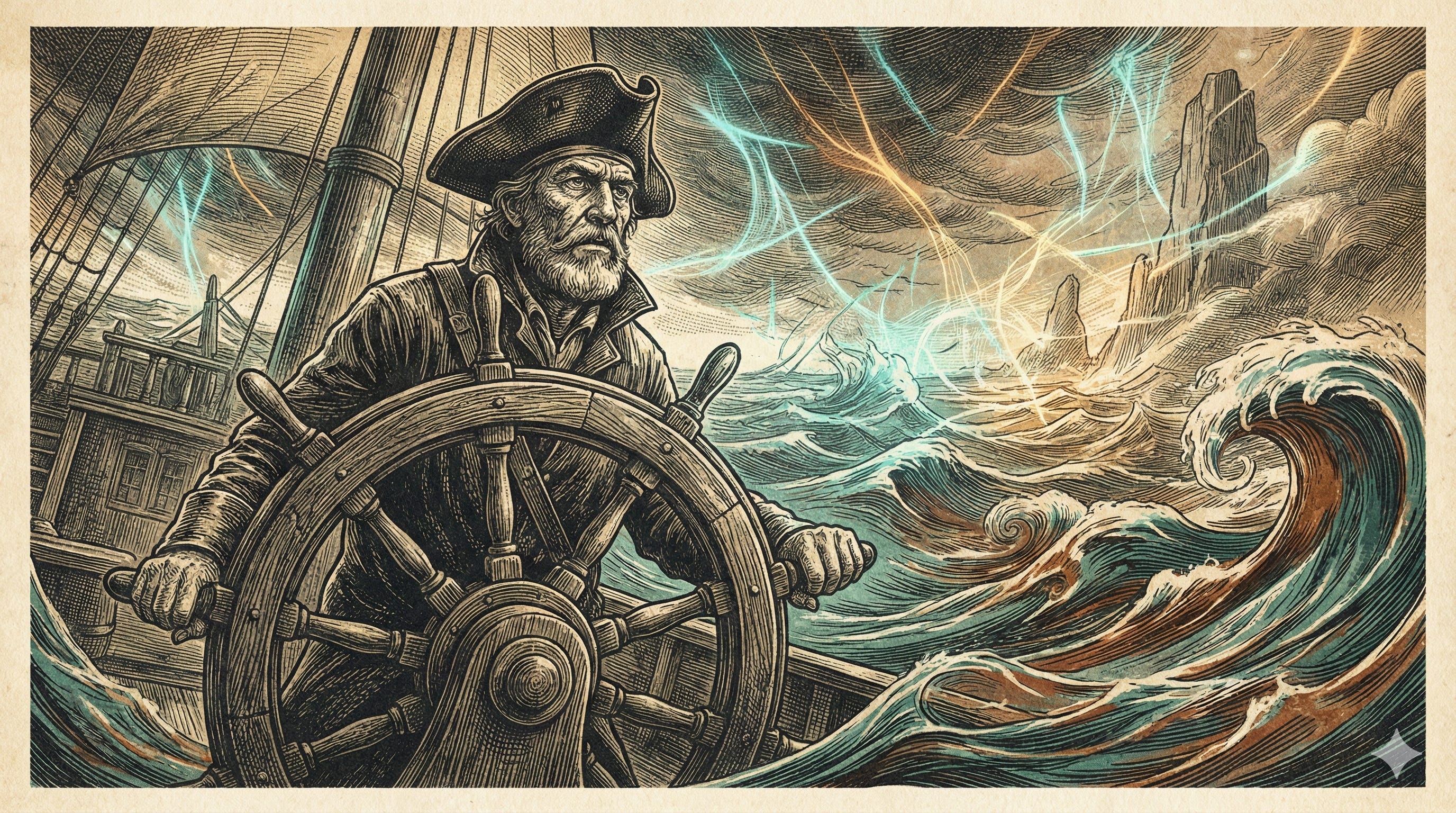
You are the single wringable neck.
And you wouldn’t want it any other way.
My brother-in-law, who runs his own web store as a one-person operation, told me over Christmas dinner, “Whatever goes wrong, I can only blame myself. I’m the only one who’s accountable. And I’m loving it.”
I want to write for people like me, who are accountable for their own organization. Doesn’t matter if it’s a one-person startup or a 100-person business unit, a single creator commanding an army of AI agents, or a lead intrapreneur hoarding colleagues and freelancers toward an objective. What matters is that their sole responsibility is brutally hard. They’re doing the best they can, but they wouldn’t have it any other way. Because nothing beats the feeling of, “I worked with many tools and people, and I got a ton of help, but in the end, I was the one who led this venture.”
For the past fifteen years, I’ve worked with several great teams on a variety of businesses. Management 3.0, Happy Melly, Agility Scales, Shiftup, and unFIX. It’s always been a pleasure to share the burden and achievements with a crew of professionals and enthusiasts. But no matter which way I turned it, each venture was still my little kingdom. My company. My business. Sure, teamwork is great. But in most contexts, “team” is just shorthand for “one person and all the help they can get.”
It’s a bit like being Prime Minister. Legally, you’re first among equals. And officially, you work as a team. But guess what? At the end of the day, everyone’s looking at you. Only one person can sit in the central chair. And from the perspective of owners, citizens, and shareholders, there’s only ever one head on the block.
Zed offered me the following suggestions for the Job-to-Be-Done:
“Guide Solo Chiefs in making better decisions when they are solely accountable for the success of their organization.”
“Reduce the cognitive and emotional load of being the single accountable leader, without taking away the autonomy that makes it worth it.”
“Help Solo Chiefs survive and scale the brutal responsibility of being the single wringable neck, using better thinking, better systems, and better use of AI.”
I’m not sure yet which version I prefer. For now, that doesn’t matter.
I want to offer a big thanks to the latest readers who’ve upgraded their subscriptions: Patric Palm, Oscar Mestre, Bas Geertsema, Alexandet Schön, Sean, Bazil Arden, Kurt Jäger, Bill Combes, David Morgan, Xavier, Tamuna and several others whose names I can’t find here in the Substack editor. You’re all making it worthwhile!
Sharper Focus, Same Territory
Thankfully, I can still write about all the topics I explored before, just with sharper focus.
The future of work is still relevant because Solo Chiefs need to learn how to survive the changing landscape.
Networked agentic organizations will emerge when Solo Chiefs collaborate in networks instead of hierarchies.
By definition, we Solo Chiefs are M-skilled people because we must juggle multiple skills to run our operations.
A deeper understanding of agentic organizations will only help when wrangling both humans and agents.
It’s essential for Solo Chiefs to grasp the risks and opportunities of AI to scale up our organizations.
And yes, the agile industry may be dead, but agile values and principles matter more than ever.
In a way, I’ve been writing for Solo Chiefs all along. I just didn’t realize it.
I’m a founder, intrapreneur, and former CIO rethinking governance for the one-person business, navigating sole accountability in the age of intelligent machines—informed by plenty of scar tissue. All posts are free, always. Paying supporters keep it that way (and get a full-color PDF of my book Human Robot Agent plus other monthly extras as a thank-you)—for just one café latte per month.
This means my newsletter won’t change much. I’ll still write about the same territory I’ve been exploring. The difference is that the exploration phase is shifting into execution. The divergence gets replaced by convergence. I now have a clearer picture of who I’m actually writing for.
I hope I’m writing for you.
Jurgen, Solo Chief
P.S. If you’re a Solo Chief, tell me about your greatest challenge. What are you accountable for? I’d love to know what to write about next.

Confessions of a Fearless Founder—From Crazy Bets to Safe Bets

The Best Founders Aren't Risk-Takers. They're Risk-Avoiders.

I think this absolutely the right direction, and as a Solo Chief myself this really resonates. I see the future of collaborative work much more like a network of loosely federated, interdependent individuals rather than formal organisations. This is how I’m operating with the engineers I work with. It all becomes about aligning incentives (although of course, it always was)
Jurgen, your “more Solo Chiefs are coming” point is right, but the more interesting future story is who they will be.
A big chunk of the next wave will be competence rich and status poor. People with real skills who got priced wrong by hiring freezes, credential inflation, automation, offshoring, or plain old corporate inertia. They will not become Solo Chiefs because they dream of being founders. They will do it because the job market stopped making sense.
That creates a different archetype than the usual solopreneur narrative: the forced pragmatist who wants independence, stability, and dignity. One person, tool leverage, a small trusted network, and systems that keep burnout and chaos out.
If you want a sharp series to execute on, write the on ramp for that person. How do you translate “I’m underused” into an offer, a cadence, and a decision system that compounds.