

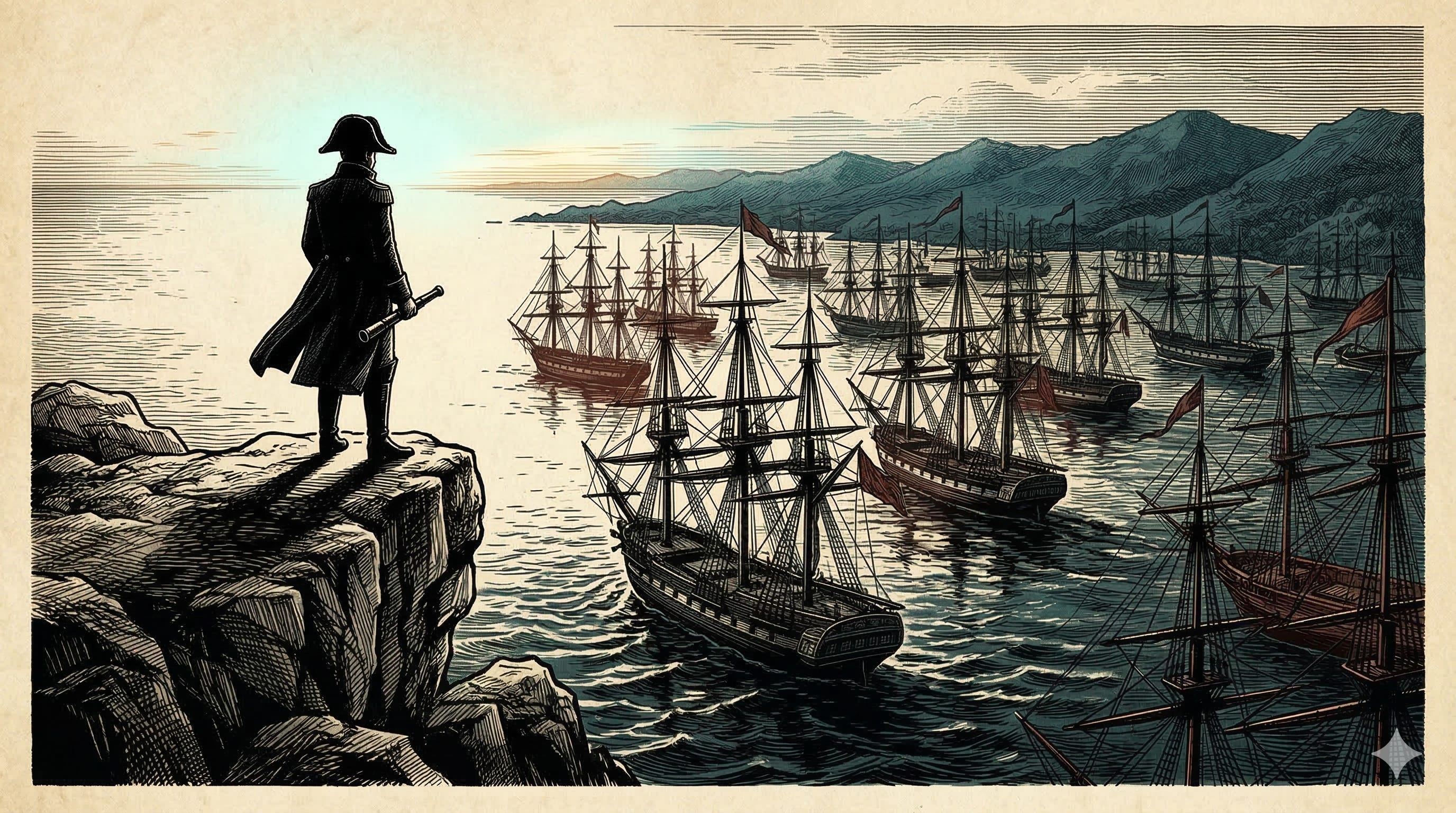
Your job isn’t your identity. Your story across all jobs is.
When roles keep shapeshifting, clinging to one title is a single point of failure. Be the admiral of your fleet, not the captain of one ship.
My role has collapsed.
Last Tuesday, I updated the tagline on my LinkedIn profile for the fourth time this year, and I stared at it for ten minutes trying to decide if this one would survive for longer than a month. Few people in my life fully understand what a fleeting role feels like. That’s not a complaint—it’s an observation.
It’s almost as if I’m not sure who I am anymore—a professional identity crisis that I wasn’t expecting at this stage of my career.
Do you feel like that too?
The global market for agile workshops has evaporated. Most conferences and companies have stopped paying for keynote speakers (at least in the agile space). And let’s not discuss the income from royalties on agile books and courseware when most of the world has moved on to YouTube videos, Substack Live sessions, and free self-paced courses.
Are you still a workshop facilitator when there are no workshops to facilitate?
One of my best friends is a copywriter—or maybe I should say he was a copywriter. I know coders and developers who’ve not written a single line of code these past few months. And my bookkeeper saw most of her clients disappear and expects there will soon be no more books to keep.
For most of my career, I knew who I was because of what I did. Author, speaker, entrepreneur. Each role came with its own feedback loop: people told me I was good at what I offered them; I cherished the positive feedback, and that became my identity. It was a comfortable arrangement while it lasted.
Then Covid hit. And the backlash on the Agile Industrial Complex. And then AI started eating the half-life of expertise for breakfast. The knowledge that made me “the agile management and leadership thinker” five years ago is now common sense or just obsolete. The roles keep shapeshifting. The mirrors that used to reflect back a clear professional self are breaking faster than a supply chain through the Strait of Hormuz.
When you derive the coherence of your professional identity from companies, communities, and credentials, you may have a problem.
“Who are you?” is a hard-to-answer question when technological progress is cracking all the surrounding mirrors.
The Ship of Theseus
Imagine you have a sailing ship you maintain continuously to stay operational. You replace one plank, then another, then the mast, then the hull. For how long is it still the same ship? At what point does it become a different ship? And when you’ve renewed every single part, could you reconstruct the original from the discarded pieces? Which one is then the real ship?
For most people, this is just a philosophy puzzle. For Solo Chiefs, it can be an everyday struggle.
Philosophers call this the Ship of Theseus, and many of us are living this question right now. Every month, we learn a new technology. Every week, we reinvent a task. Every day is an opportunity to recognize that the job we thought we had is actually not the same job it was before. We keep swapping out major pieces of our professional selves. New tools, new processes, sometimes a whole new deck or frame.
In the absence of a stable context—a company, a community, a credential—the solo operator’s greatest overhead is the psychological cost of unlearning. You can reframe constant replacement as routine maintenance. That’s a healthy way to think about it. But solo chiefs don’t always get to choose how it feels at 2am when something breaks and there’s nobody to call.
And even the maintenance of the ship ends when changes in the market have rendered the entire ship obsolete.
If that ship was your job, and your identity was that job, then who are you when the ship has retired?
The Professional Identity Crisis
The fundamental reality of the modern economy is that technical expertise has shifted from a career-long asset to a high-depreciation consumable. For the solo operator, professional survival is no longer about defending a specific title. It’s about maintaining a coherent overarching narrative while every underlying skill set is systematically replaced.
A significant number of people are soon at risk of not being able to tell a coherent story about who they are professionally. Does that mean we should just make up a new story? Spin a new tale for our future selves? Write a new tagline and then hope it comes true?
Bah. Not really.
Identity doesn’t come from storytelling alone. It requires doing and experimenting with possible selves first and then narrating afterward. Herminia Ibarra—who actually studied this properly rather than just having opinions about it—found that story follows action, not the reverse. You only know who you are when you can tell a story about what you did. You can’t write the chapter before you’ve lived it.
Not everyone is walking around feeling stressed about their professional identity. That’s worth acknowledging, so I don’t sound like I’m projecting.
A huge portion of professionals are not replacing the planks of their professional selves every month. Some readers have a stable ship. Same role, same license, same environment. The turbulence is in their tools, not their title. A civil engineer doesn’t wake up thinking, “My self is being reassembled like the Ship of Theseus.” They’re still a civil engineer.
Fair enough. This piece isn’t for them.
Others are pretty good at staying anchored even when everything around them is changing. A marketing manager using AI tools may not become a constantly reinvented polymath. They may simply remain “marketing manager,” with technological disruptions absorbing the skill churn underneath. The identity stays. The capability layer shifts.
Good for them, too.
But not all of us find ourselves in that stable environment with the steady company, community, and credentials. Not all of us have a clear job-to-be-done that remains constant despite the underlying technologies shifting every week. For people building careers outside a stable context, professional identity is becoming fluid. The only durable thread is the story that connects the transformations.
And then the question is: do you act your way into a new identity and then tell the story, or do you tell a new story and then force reality to catch up?
If you ask me, what holds it all together is the story we keep telling about ourselves across all the replacements and transitions behind us. The thread connecting the person who failed at one thing to the one now figuring out something completely different. That ongoing narrative creates cohesion when everything else keeps changing.
Even when we switch from one ship to another, we’re still the same captain.
Or better: when we have multiple ships sailing together, we’re still the same admiral.
The Fleet of Theseus
I’ve reinvented myself so many times that the Ship of Theseus feels less like a thought experiment and more like my LinkedIn profile.
But the more I think about it, the more I notice that some things have never changed. I’m still interested in management and leadership. I still work at the intersection of creativity and technology. I’m still the one who loves to teach and tell stories.
The tools, techniques, companies, and communities get swapped in and out. The titles they give me change every year. Yet I love discussing organizational change in the face of disruption now as much as I did thirty years ago. (Whether anyone is paying me for it is a separate question entirely.)
The Ship of Theseus assumes you stick with the ship, that the ship is the only thing you have. But some solo chiefs realize the ship is actually a prison, and the only way to survive is to switch to another ship entirely, leaving one thread of your story behind. For some solo owners, the honest move isn’t a thread of continuity at all—it’s a plot point: the pivot in a larger narrative.
I’m a founder, intrapreneur, and former CIO rethinking governance for the one-person business, navigating sole accountability in the age of intelligent machines—informed by plenty of scar tissue. All posts are free, always. Paying supporters keep it that way (and get a full-color PDF of my book Human Robot Agent plus other monthly extras as a thank-you)—for just one café latte per month.
For the ultra-prolific solo builder, identity is maybe not even one story but an epic. They aren’t sailing the Ship of Theseus; they’re operating the Fleet of Theseus. Their cohesion doesn’t come from a single narrative thread, but from a repeatable process of rapid experimentation and action, producing multiple parallel storylines in a life-spanning saga.
A static identity is a single point of failure—and that’s a very lonely place for the only person trying to live up to it.
My LinkedIn headline will change ten more times, I’m sure. Yet, the saga continues. The admiral doesn’t need to know which ship is next. They just need to know they’re still the one giving orders.
Jurgen, Solo Chief.
P.S. How many ships are in your fleet right now? I’m curious.
Confessions of a Fearless Founder—From Crazy Bets to Safe Bets

The Best Founders Aren't Risk-Takers. They're Risk-Avoiders.


What's one more ship, right? If you ask me the captain who can manage every type of ship in this hurricane filled ocean is the most important. The one with the most maps, most experience, and ability to take any ship and sail wins.
The “fleet of Theseus” metaphor is a helpful antidote to one‑job, one‑self thinking, but it also feels like it underplays how uneven the power dynamics are in who actually gets to curate that saga; many people experience AI‑driven role change less as reinvention and more as involuntary devaluation of what they’re good at.