

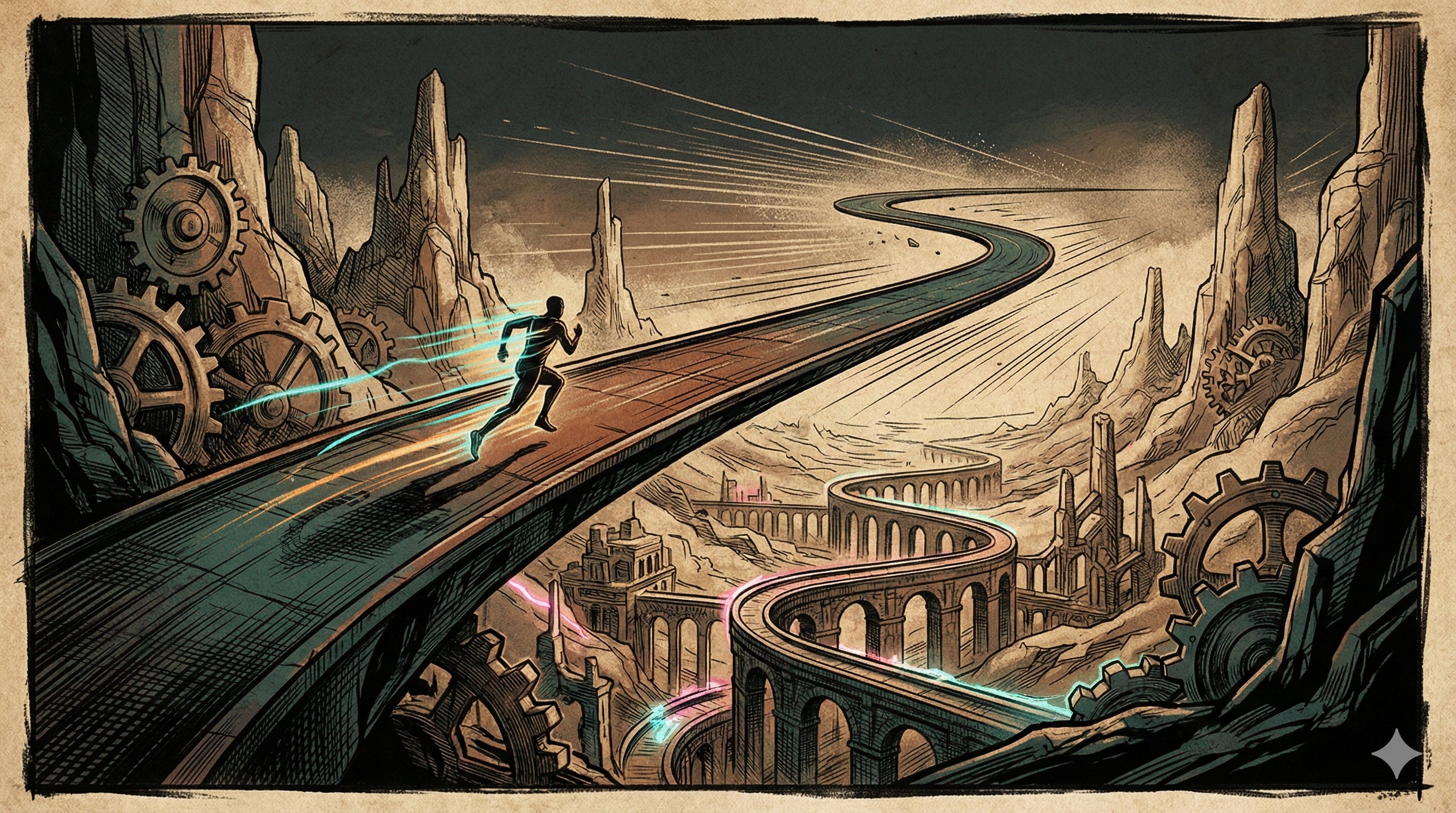
Stop Accepting Fixed Cadences
Technostress is a signal, not a disease. Pick one workflow, make it 10x faster, then move on.
Are you suffering from technostress?
Feeling anxious about the speed of change?
Worried you can’t keep up?
Good. That means you’re paying attention.
You’re not ready for the age of AI if you don’t occasionally think, “My God, last week I was so slow.” When you look back at your earlier professional self and don’t see a snail struggling up the Burj Khalifa, you’re not improving. That vertigo, the cringe of looking back at last month’s version of you, is actually the clearest sign you’re doing something right. The creatives and solopreneurs and fractional leaders who should be worried aren’t the ones with technostress; they’re the ones who feel nothing at all.
So, what to do?
First, don’t panic. You can’t enter every game and expect to win all of them. Olympic athletes don’t panic. They also don’t sign up for every event under the sun (or in the snow). They pick one race and work with a coach to shave off milliseconds. Every single day. They try to accelerate.
I’m no athlete—that would be hilarious—but I try to adopt the same mindset in my professional work. For example, I used to evaluate Substack stats and metrics in my dashboard every three months. I screenshotted 20+ tables and diagrams—Substack doesn’t offer a proper export, which is maddening—and dumped them into ChatGPT. It was slow. It was tedious. And it meant I had no way to respond quickly to trends and changes in my readership. No way to see the immediate effect of something I’d changed or improved.
That had to change.
This week, I discussed with Claude the metrics that actually matter (according to my ten steps in the user journey map). We settled on a baseline and devised a strategy for how to proceed. Being the perfectionist I am, I wanted to jump straight into building automations. But Claude pushed back: “Don’t rush into implementation. Do a few weekly iterations manually first. When we know which metrics actually matter and which to ignore, then we automate.” (That was smart pushback. Smarter than most human colleagues have given me, if I’m honest.) Over the course of a few weeks, I’m speeding up the metrics review process from every three months to every seven days.
That’s what acceleration looks like. (This is also where the Olympic analogy falls apart, because you’ll know an athlete went on quite an impressive amphetamines spree when they run the 5000 meters 10x faster.)
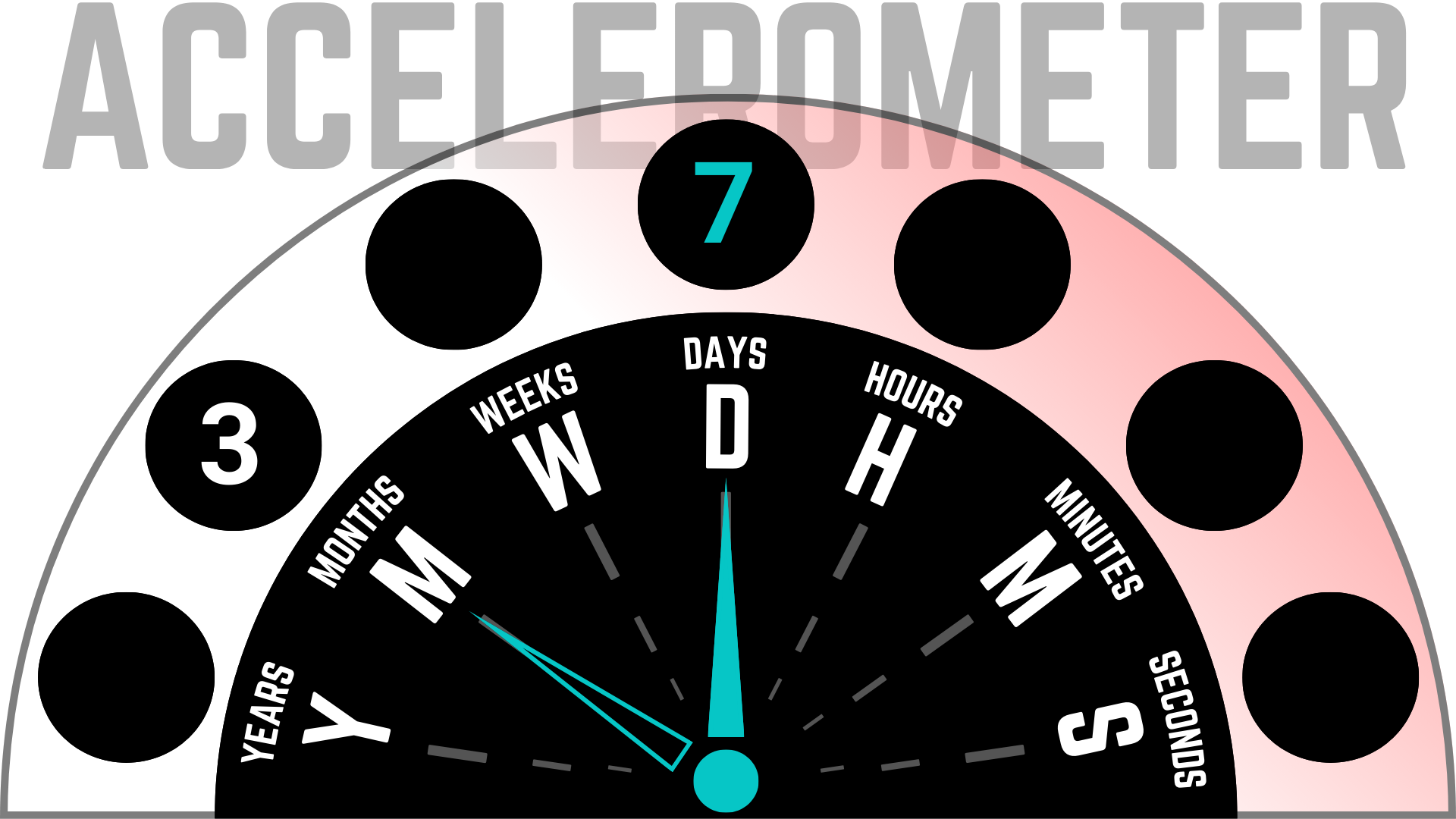
The Accelerometer vs. Fixed Cadences
One thing that’s always bothered me about popular methods and frameworks is how they settle on a fixed cadence, as if it were a law of physics: OKRs (quarterly), SAFe (8–12 weeks), Shape Up (6-weeks). It’s almost as if the authors of such frameworks gave up on continuous acceleration before they even published their works. As if the speed of work were something you decide once and then stop thinking about.
The age of AI calls for a different approach. It calls for the Accelerometer Method.
An accelerometer is a sensor that measures changes in velocity. Most people know it as the thing inside your phone that detects when you tilt the screen or drop it down a toilet. But in this context, I’m using it as a mental model: a persistent awareness of whether your workflows are actually speeding up or just staying in the same range. Using the Accelerometer Method means you treat acceleration itself as the practice. You measure it. You practice it. You don’t settle.
And acceleration shouldn’t feel like panic. A cockroach doesn’t sprint; it adapts. Anxiety comes from trying to speed up everything at once. Real acceleration—in the professional context—means picking one process or value stream and making it tantalizingly faster, then moving to the next. Every week should feel like you’re outpacing yourself, step by step, workflow by workflow. And we’re not talking about 5-10% improvements here. We’re talking 10x. There’s a reason the 10x engineer, 100x engineer, and hyper-productive team were among the buzzwords that surfaced in the AI glossary of 2026.
“Anxiety comes from trying to speed up everything at once. Real acceleration means picking one process and making it tantalizingly faster, then moving to the next.”
From Minutes to Seconds: Workflow Acceleration in Practice
Let me give you a concrete example.
You may have noticed that I like sharing quotes and insights from the articles I read on Substack, LinkedIn, and elsewhere. The practice helps me distill the core takeaway of an article, boost an author whose work I appreciate, and give something back to the community. Win-win-win. I also kept track of which publications I promoted in a large spreadsheet, not only because it’s typical for someone straying slightly across the spectrum, but also because I enjoy keeping an overview of which authors I appreciate most. (Those are the ones I might want to reach out to for collaboration.)
However, my process was a slog: select text, copy, switch apps, paste URL, open spreadsheet, tick a box. Two to three minutes per article, every time. 😣
Not anymore.
I’ve now automated the whole thing with Make and Fibery. I save a text fragment and the article link in one place, and the automation posts every insight to multiple social channels and logs the article in a central database. Total time per article: eight seconds.
From three minutes to eight seconds. My accelerometer is happy.
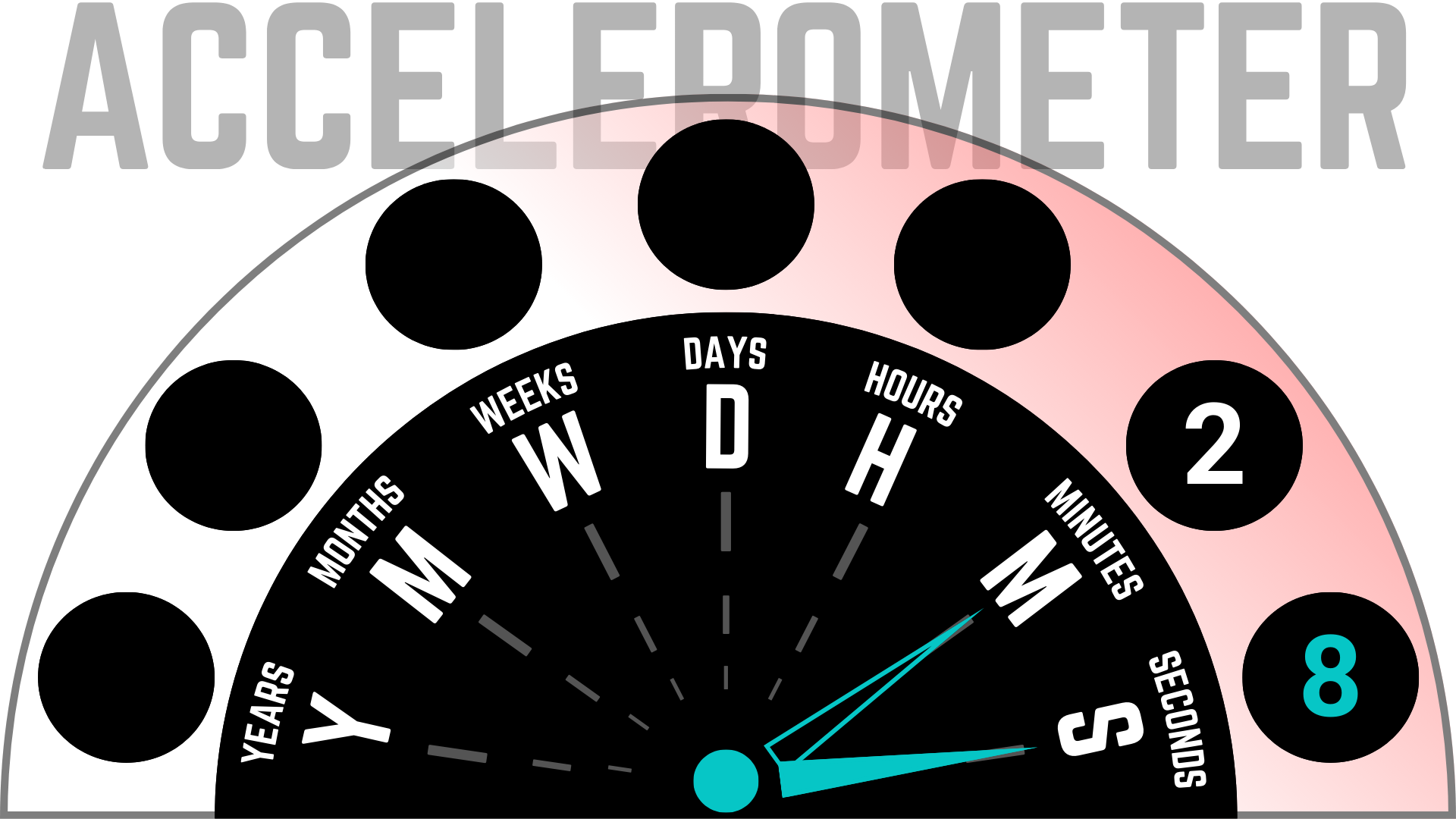
Accelerometer Thinking Everywhere
I have many more workflows that deserve this kind of treatment besides the weekly statistics review and the article notes: turning ideas from online meetings into drafts for blog posts, collecting insights from books I read and sharing them with readers, matching invoices in my mailbox with transactions on my bank account, collecting health data (sleep, exercise, nutrition) from various apps and discussing it with an AI health coach in a daily review. The list goes on.
In each case, I have zero interest in doing things 5-10% faster. That’s incremental thinking, and it was fine for 2019. I want to go 10x faster or more. I want to go from months to weeks, from days to hours, from minutes to seconds. That’s what a properly calibrated accelerometer should show you.
And without going insane. Without the anxiety.
In fact, the goal is to feel totally relaxed while everything around you is speeding up, including your own adaptation to the environment.
I’m a founder, intrapreneur, and former CIO rethinking governance for the one-person business, navigating sole accountability in the age of intelligent machines—informed by plenty of scar tissue. All posts are free, always. Paying supporters keep it that way (and get a full-color PDF of my book Human Robot Agent plus other monthly extras as a thank-you)—for just one café latte per month.
So, think about what you can do.
How can you speed up gaining new customer insights from weeks to hours?
Can you condense the time to create mockups and prototypes from hours to minutes?
Can you accelerate the deployment of new versions of your product from minutes to seconds?
The Only Fixed Cadence Is “Faster”
As Solo Chiefs, the last thing we want is technostress. We want a cockroach business, one that survives whatever the future of work throws at it. The age of AI is scary but manageable. We can handle it when we intentionally and persistently speed up the workflows around us and never accept any fixed cadence handed down by someone’s standard method or framework.
“Speeding up IS the method. The accelerometer IS the mindset.”
If you’re reading this thinking, “I can’t do all of that already,” take a breath. You have a single wringable neck. You can’t accelerate everything at once. Pick the one workflow that’s been bothering you most and make it ten times faster next week. When it’s done, move on to the next.
That’s the Accelerometer Method.
No fixed cadence. No panic. Just persistent, compounding acceleration, one workflow at a time.
Now, if you’ll excuse me, I have a spreadsheet to finish murdering.
Jurgen, Solo Chief.
P.S. Which one workflow are you going to make 10x faster next week?
From Revenue Funnel to User Journey: Mapping Experience, Not Extraction

You’re a Mapmaker, Not a Pirate

Stop Chasing AI Tools

The more ‘up-to-date’ you are, the more replaceable you become. Tool mastery is the wrong game.
Hi Jurgen, some sharp thinking here!
Your move to reject fixed cadences is a powerful challenge to the ‘standard’ way of working. I agree, when the work shifts rapidly, a team needs the freedom to respond immediately rather than waiting for a calendar event to catch up.
However, we shouldn't discard the shared pulse entirely. Just as you share insights to keep your community aligned, teams need a common rhythm to stay in sync. A fluid method is most effective when it tunes an internal heartbeat that provides simplicity, protecting the team from being tossed about by every external signal.
Regarding "the need for speed": while AI allows us to accelerate delivery, our core purpose must remain the driver. Speed without a clear 'why' eventually leads to burnout or a loss of direction. The goal isn't just infinite velocity, but viability—using a fluid pace to stay responsive while ensuring the team’s mission remains the primary governor of that speed.
Overall, great food for thought on moving from managing time-boxes to mastering the actual flow of work.