

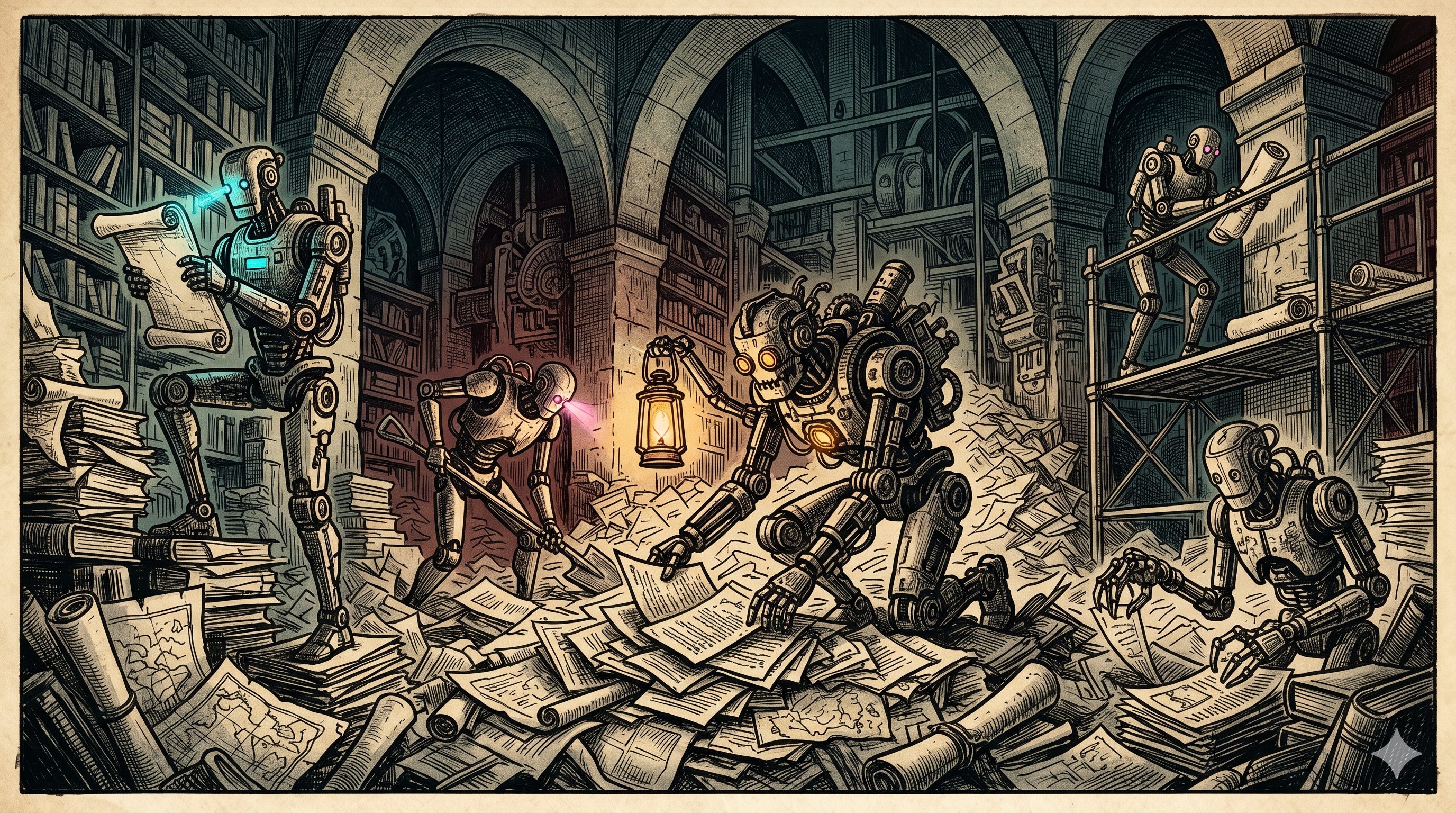
If ignorance takes ten seconds to fix, your writing needs a better starting point. AI can expose stale claims, bad takes, and recycled thinking before you publish.
People can be such ignorant fools.
Just last week, I received a forwarded message in a neighborhood group on Whatsapp. “Watch out!” it said, “The AIs will be able to read your private chat messages. Change this setting, now!”
It seemed rather fishy to me.
I decided to fact-check it, which took less than ten seconds. It appeared to be a chain letter full of misinformation freaking out millions. It fed the cognitive bias of everyone who believes AI Is Bad. It was AI that helped me discover the fact-checking page that someone had already written about it. AI helps humans distribute stupid messages, but it also helps me to be the sensible one.
Skepticism won another day.

Running a business alone usually means wearing too many hats. Sintra solves this by providing a team of 12+ specialized AI helpers that handle everything from marketing to operations.
And with their newly launched custom builder, you can now create your own specialized helpers to automate your specific workflows. It’s the most practical way to scale your output without adding to your headcount or your to-do list.
There was a time when not knowing something was a valid excuse and easily forgiven. I’d write something on, let’s say, the idea that most consultancy is performative nonsense with no impact on organizations, and some readers would cheer me on, some would criticize my claim, and perhaps one person might point at existing research on this topic that I clearly didn’t know about.
Even among the most celebrated thinkers and scientists who were far smarter than I am, this was common. It has happened all the time:
Isaac Newton developed the foundations of calculus in the 1660s but didn’t publish his work promptly, later discovering that Gottfried Wilhelm Leibniz had independently published a full calculus system first, starting a fierce fight over who was first.
Charles Darwin spent decades refining his theory of evolution, then was shocked when Alfred Russel Wallace independently sent him a manuscript with the same idea, forcing a joint presentation of their work.
Georges Lemaître derived the linear relation between galaxy recession speed and distance, which implied an expanding universe, but his 1927 paper was never noticed by Edwin Hubble who later rediscovered and popularized essentially the same relation independently.
I’ll be honest. It took Perplexity just a few seconds to come up with these three examples—and it had many more—even though I already knew them. I’ve been reading popular science books like crazy, and I found that science authors and biographers delight in these parallel inventions and discoveries. They know it’s often been impossible, even for the smartest people, to know everything happening in their field.
But this has changed.
If I hadn’t known about these examples, it still would have taken the AI only seconds to enlighten me. The same applies to everything else that we’re thinking and talking about. All it takes is a simple prompt to ask the machines what is already widely known about a topic, what the consensus is among experts, or what the conflicting viewpoints are on a tough problem.
Not knowing something is less easily forgiven than it was before.
In fact, ignorance is often the main problem in society, and we live in an age where this is easily fixed.
People point at social media and AI for many societal problems. But the real culprits are people’s ignorance and the malicious actors exploiting human stupidity. It takes less than ten seconds to not be ignorant anymore.
I don’t want to be stupid and ignorant. (Or maybe a bit less than I was before.)
Until a few years ago, it was forgivable to write something that had already been discussed and published by someone else. Google search queries often didn’t find the information you sought. And who had time to visit a library or dig into a scientific data bank to find the data to refute it or back it up for a simple 500-word blog post?
Not me.
But now, a simple prompt easily uncovers twenty existing angles on whatever I plan to write. That also makes it easier to stand on the shoulders of giants, to add something new to what already exists, and to not say the exact same thing as someone else, only with snarkier language and prettier pictures.
History has wasted a lot of human brainpower on duplication. Brilliant people have spent large parts of their lives discovering and inventing things that already existed, without anyone realizing it. Those days are now behind us. Instead of everyone doing the same deep thinking in parallel, we can now have everyone building something new on top of each other’s thoughts (as long as we keep an LLM-accessible digital trail).
Running a business alone usually means wearing too many hats. Sintra solves this by providing a team of 12+ specialized AI helpers that handle everything from marketing to operations.
That’s why my entire approach to writing is changing.
Every day, I use the deep research features of five different LLMs in parallel, compare the results, find the overlap and the differences, and make sure that the starting point for my own thoughts is in unexplored territory. Yes, I get the irony. I make the machines do the parallel thinking for me, so that I don’t have to waste the little brainpower I have.
I check what’s already known and then I write about what’s not.
There’s no excuse anymore to be ignorant.
Jurgen, Solo Chief.
P.S. This might be the last post I wrote without initiating deep research first.
LLMs Are Like Politicians—Confidently Wrong

Politicians Lie. LLMs Bullshit. Here's How I Survive Both.

The Truth About Writing with AI (And Why Critics Are Missing the Point)

Some readers are calling out authors for using AI in their writing.
Great ideas. I was using something similar, but rather simpler:
I am writing an article with this thesis:
[insert thesis or core idea]
Act as a rigorous fact-checker, research assistant, and skeptical editor.
Your job is not to agree with me. Your job is to prevent me from publishing something shallow, outdated, obvious, or wrong.
Check:
1. Is this claim factually accurate?
2. Has this already been said many times before?
3. What research, books, frameworks, or cases support it?
4. What research, books, frameworks, or cases challenge it?
5. What would an expert criticize in this argument?
6. What nuance am I missing?
7. Which examples are overused or weak?
8. Which part of the article is original, if any?
9. What should I remove, soften, or reframe?
10. What stronger version of the thesis could I defend?
Give me a clear verdict:
- Safe to publish
- Publish with caveats
- Needs more research
- Weak or misleading
- What kind of framing would fix the problems you found that I could read/research better