

Wake Up! For God’s Sake
More output, less impact. Your company wants acceleration, but all you feel is desperation.
You’ve probably seen this.
Your executives are suddenly “all in on AI.” They’ve been to a conference. They’ve nodded at a keynote. They now use the term frontier organization in sentences where it has no business appearing. They don’t really understand the tech, but they absolutely understand the vibe.
So now your team is “empowered” to use a tightly curated set of tools. Microsoft Copilot or some other half-assed platform that nobody in the world is raving about. Maybe an internal chatbot with a heroic name and a dashboard nobody asked for. You’re told this will herald a golden age of productivity!
But what you actually see is productivity theater.
Colleagues send AI note-takers to meetings they don’t attend. The bots generate summaries and task lists that no human truly owns. People auto-reply with polite, fluffy paragraphs that say less than nothing. AI-generated “deep research” reports multiply like TikTok videos. Slide decks bloom and die in shared drives. Spreadsheets appear with impressive formulas but zero decisions attached.
Nobody reads anything, of course. Everyone just summarizes the translations and translates the summaries. They reply to auto-generated requests with auto-generated responses.
And you sit there thinking, “Is this it? Is this the AI revolution?”
Even the executives can feel the hollowness. That’s why the media over the past twelve months were full of headlines such as Futurism’s “Majority of CEOs Alarmed as AI Delivers No Financial Returns,” The Observer’s “Over 80% of Companies Embracing A.I. See No Real Gains Yet, McKinsey Finds,” Harvard Business Review’s “AI-Generated Workslop Is Destroying Productivity,” and yesterday’s Fortune article, “Thousands of CEOs just admitted AI had no impact on employment or productivity.”
Everyone is very busy acting alarmed. Millions invested, benefits unclear. The analysts are warning about “AI workslop” clogging systems like digital cholesterol.
You look around in dread and feel yourself drowning in peak bullshit.
More output, less impact.
More automation, less ownership.
Your company wants acceleration, but all you feel is desperation.
It doesn’t have to be that way.
True Acceleration
You’re not crazy. The problem isn’t that AI doesn’t work. The problem is that your company is sprinkling it on top of broken workflows like parsley on a gas station sandwich.
Because when it’s used properly, the shift isn’t marginal. It’s violent. Entire workflows collapse from months to days, from weeks to hours, from hours to minutes.
Let me show you.
From Months to Minutes: AI Acceleration Across Industries
In pharma operations, Novartis shrank clinical trial site selection from weeks of analysis to a two-hour meeting. A classic bottleneck just… disappeared. (link)
In insurance, a large U.S. travel insurer processing 400,000 claims a year moved from three-week turnaround times to minutes, with more than half of claims fully automated. That’s not shaving time. That’s deleting wait queues. (link)
In law, AI contract review tools cut document review from three hours down to fifteen minutes, with over 90 percent reduction in manual clause reading. Lawyers go from scavenging text to making actual decisions. (link)
In architecture, Autodesk’s Forma platform helped MBH Architects reduce early-stage schematic design from two weeks to six hours, generating hundreds of building options instead of three. Time collapsed while exploration exploded. (link)
In construction, Factory_OS uses AI-optimized prefabrication to erect modular housing in roughly two weeks, replacing timelines that used to stretch close to a year. That’s not a tweak. That’s an order-of-magnitude shift in delivery. (link)
In software, founders using AI-first engineering approaches ship MVPs in six weeks instead of six months. Solo builders use tools like Cursor, Claude Code, and Lovable to create full-stack apps over a weekend that previously required small teams and serious runway. (link)
In creative production, Artlist used AI video generation to produce cinematic Super Bowl-grade ad concepts. Work that normally demands months, massive crews, and million-dollar budgets was reduced to just five days. (link)
In healthcare admin, startups like Claimable generate tailored insurance appeal letters in under 30 minutes. What used to be an exhausting multi-hour paperwork battle becomes something you finish before lunch. (link)
Even solo indie game developers now use AI for art, dialogue, coding, and QA, building polished games in months that once required entire teams and several years. (link)
And last but not least, in drug discovery, DeepMind built AlphaFold, which predicts protein structures in seconds. What used to take researchers months or years of lab work now runs as computation. That breakthrough was so fundamental it earned several researchers Nobel Prizes. This isn’t productivity theater. This is biology on fast-forward. (link)
Notice the pattern.
These workflows didn’t get “10 percent faster.” They didn’t become “slightly more efficient.” They completely imploded.
When years become weeks, and weeks become minutes, that’s real acceleration. And once you’ve seen it done properly, the productivity theater back at your office feels even more absurd.
The Solo Operator Advantage
Y Combinator (the startup accelerator that funded Airbnb, Stripe, Dropbox, and about a thousand other companies you’ve heard of) has been blunt for years: product MVPs should be buildable “in weeks, not months.” The age of AI can shrink that to days. (link)
Now here’s the part that should make you furious (or hopeful, depending on where you sit). Most of those examples are solo operators, small teams, indie builders. Not Fortune 500 departments with twelve-month timelines and steering committees. The biggest accelerations are coming from people with the least bureaucracy and the most skin in the game. People who can’t afford productivity theater because their rent depends on real impact.
“The biggest accelerations are coming from people with the least bureaucracy and the most skin in the game.”
Sleepwalking Leaders and the AI ROI They’ll Never See
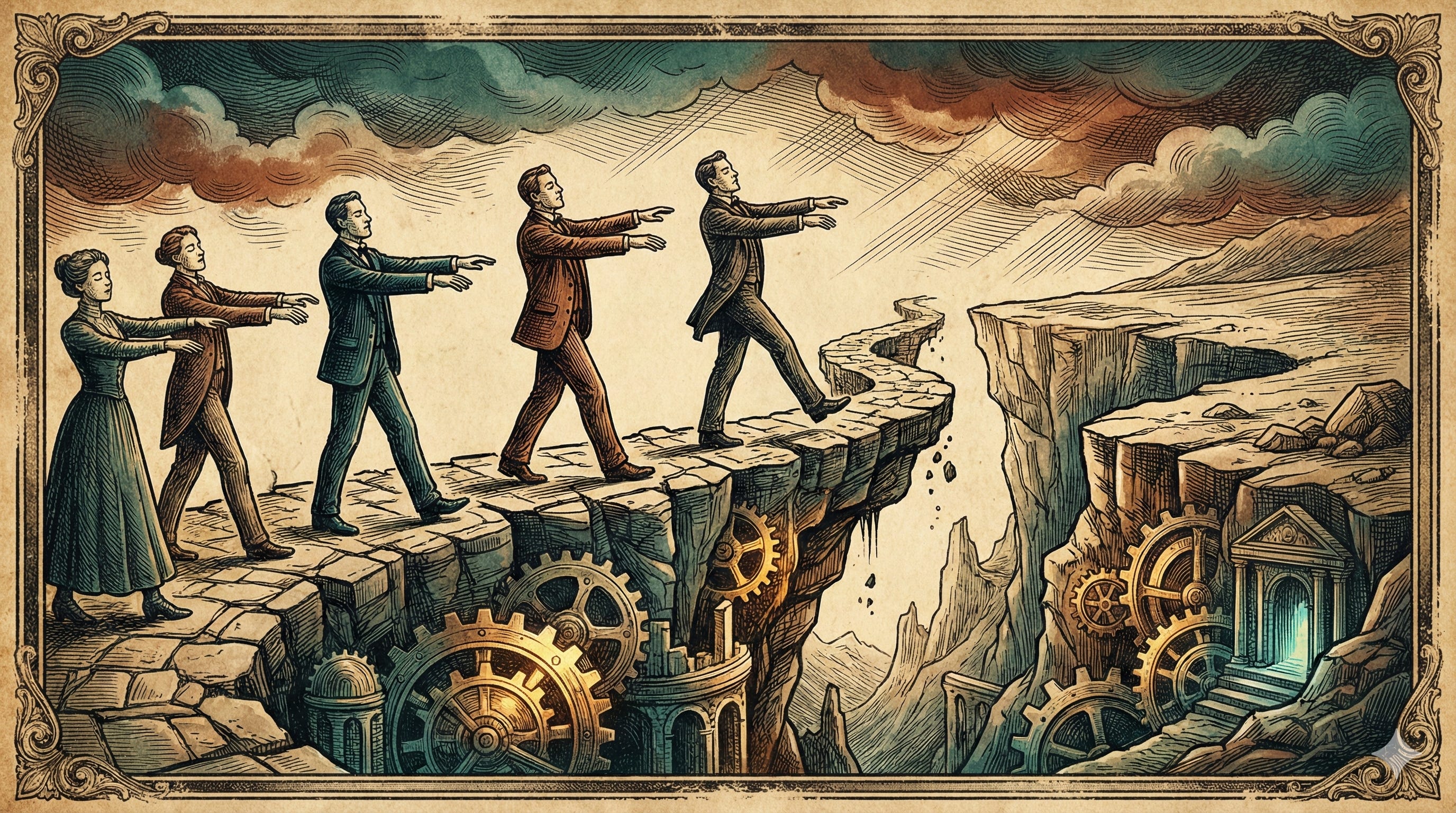
During the 2008 credit crisis, I once had to grab my CEO by the shoulders. Literally. The company was heading straight for a financial wall. Revenue dropping. Runway shrinking. Everyone could feel that things were going badly. And he just… froze. Like a deer in headlights, calmly preparing to sleepwalk the entire business off a cliff through inaction.
I told him, “Wake up, for God’s sake! Our runway is evaporating. We have to act.”
He did.
Later, he thanked me.
I think about that moment a lot when I hear an executive say, “AI isn’t generating returns.”
Of course it isn’t! Not the way you’re doing it.
Look at all the examples where weeks collapsed into hours. Where months turned into five-day sprints. Where entire bottlenecks evaporated because someone decided to redesign the full value stream instead of sprinkling AI on top of whatever mess was already there.
If you treat AI as a note-taking assistant, you’ll get fancier notes. If you treat it as a workflow reinvention engine, you can compress a multi-week process into a single day. You can turn hour-long value streams into minute-long decisions. But that requires imagination. And permission. And the freedom for people to experiment without sending their ideas through three committees and an administrative review board.
So ask yourself honestly: are your colleagues compressing value streams?
Or are they turning AI-generated slide decks into AI-generated task lists?
I’m a founder, intrapreneur, and former CIO rethinking governance for the one-person business, navigating sole accountability in the age of intelligent machines—informed by plenty of scar tissue. All posts are free, always. Paying supporters keep it that way (and get a full-color PDF of my book Human Robot Agent plus other monthly extras as a thank-you)—for just one café latte per month.
Wake Up! For God’s Sake
Yesterday, a friend (who shall remain blissfully anonymous) messaged me:
“Our management asked us to brainstorm AI ideas. We have to make a list and submit it to administration so they can maybe implement some of them. My God. I’m wasting my time here.”
That’s not acceleration. That’s desperation offered as a suggestion box.
This is why so many Solo Chiefs exist in the first place. Not because they hated working. Because they couldn’t stomach watching another year evaporate inside a system designed to convert urgency into slide decks and meeting summaries.
If your leadership turns AI into a governance workflow and a brainstorming exercise, they aren’t being cautious. They’re sleeping. And sleeping leaders during a technological shift don’t just cause organizations to stagnate. They walk them off a cliff.
Someone has to shake them awake before they drop into the gorge.
If you still like your job, it has to be you. If you don’t, maybe it’s time to stop drowning in other people’s peak bullshit and move some place where the sleeping leaders can’t take you down with them.
Or become your own solo chief, as I did.
Jurgen, Solo Chief
P.S. Is your company actually compressing workflows—or just generating fancier slide decks?
Escape Velocity—How AI Will Achieve Peak Bullshit Work

We might be heading toward a bullshit work singularity.


Agree. The danger is not AI output, it’s AI output replacing human ownership. When leaders outsource responsibility, you get higher risk, higher liability, and slower delivery dressed up as ‘acceleration.’ AI should compress the work, not dilute accountability
This nails the core problem: most enterprises are sprinkling AI on top of broken workflows, then acting shocked when the ROI is zero.
Until executives give teams permission to redesign value streams end‑to‑end, all the Copilots and internal chatbots in the world will just generate nicer-looking workslop...