

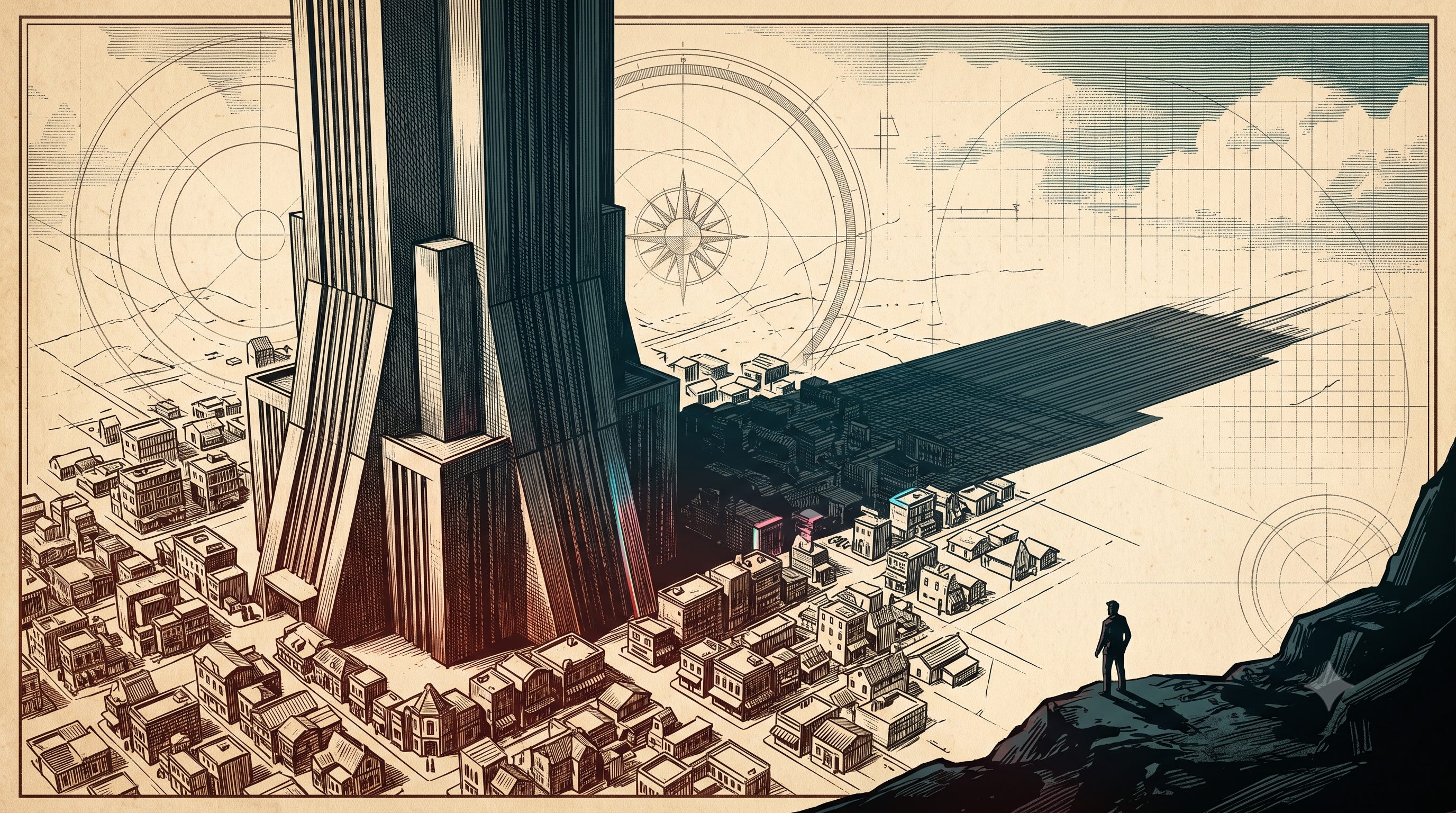
AI makes small teams look clever, but it doesn’t erase the reasons corporations exist.
As someone running a one-person business and often collaborating with other independent workers, I cannot help feeling amused when I see large, hierarchical enterprises struggling with artificial intelligence. The traditional firm doesn’t seem fit for the age of hyper-acceleration. Some authors even think multinational corporations are on their way out, to be replaced by networked agentic organizations (NAOs).
Is that true? Or is it wishful thinking?
In the age of AI, do we even need traditional corporations?
Can we not replace them with networks of contractors and AI-native entrepreneurs?
Are the people with standard employment contracts laboring away on rapidly shrinking ships?
It’s a fascinating thought, I admit. I understand why some of my peers are hoping for the imminent demise of the global enterprise, especially when they find themselves, as an entrepreneur, independent freelancer, or one-person business, battling excessive corporate greed, misconduct, or just plain bureaucracy. One of my friends said to me, “I hope they all die!”
But let’s not smirk and gleefully rub our hands together yet. My team of AIs was able to dig up ten different reasons for saying, “Nope. The standard multinational enterprise will hang around for a little while longer.” And because even solo chiefs need customers both large and small, it helps to understand why. Because even when dynamic networks do take over from corporations at some point in the future, they will inherit a long list of requirements for which the standard firm was created in the first place.
1. Economies of Scale
Whenever I worked on teams, I often let my teammates handle video editing, social media updates, and administrative work. I did all the writing; they handled the customers. We were running on David Ricardo’s Law of Comparative Advantage—stick to what you do best and leave the rest to others. It just worked faster that way.
In his famous work, The Wealth of Nations (1776), Adam Smith gave us the oldest reason for humans collaborating in organizations: to benefit from economies of scale. He showed that dividing labor multiplies output. Seven multidisciplinary doctors working separately can never be as productive as seven specialist doctors operating as one crew. When people work together, the organization can capture the benefits of improved efficiency.
“Economies of scale” is also a fancy way of saying that work gets cheaper when you crank up the volume. Ten thousand chilli sauce lamps are cheaper to make than just one. The principle thus works on two levels at once: People get increasingly good at narrower tasks through sheer repetition (the experience curve effect) and supplies and machinery get cheaper the more you use them (dilution of average fixed costs).
Herbert Simon added to this idea with his concept of bounded rationality: Our brains have limited cognitive capacity. We can only think about so much. Therefore, organizations spread decisions across a group so multiple people make better decisions about different things. The organization exists because one human brain is not sufficient when coordinating complex work.
But! Artificial intelligence has a significant impact on economies of scale. AI gives many of those complementary skills straight to one person, which rewrites how we distribute cognitive load. The economies of scale argument still holds, but instead of distributing the work among humans, we distribute the thinking across AI agents. AI doubles down on economies of scale and shifts the concept into a digital dimension.
And that’s exactly why I now work alone, with a rowdy bunch of LLMs. The thinking is cheaper, and thus we are doing more of it. We are operating in Jevons’ Paradox, cranking up the scale to a new level.
2. Transaction Costs
There’s just one nagging issue with working solo: hiring subcontractors can be a pain-in-the-ass. In the time I spent searching, negotiating, contracting, and evaluating freelancers (such as copy editors, book designers, and online marketers), I could have written a second book. This staggering opportunity cost highlights exactly why solo operations hit a wall.
In The Nature of the Firm (1937), Ronald Coase pinpointed the core problem: if markets are so efficient, why does anyone employ anyone? Why not just contract out every single task peer-to-peer among freelancers and one-person businesses? Indeed, that’s what some of us independents would like to know. Corporations? What’s the point?
Coase’s answer at the time was that taking part in the market costs money (searching, negotiating, contracting, enforcing), and when those costs are higher than the cost of doing the work with a fixed set of workers, the activity moves inside an organization. Vice versa, the organization should stop growing at the point where one more transaction handled inside gets more expensive than just buying a service from the market.
Here again, new technologies change the equation. Cheaper negotiation, contracting, and coordination flatten hierarchies, and AI is the biggest communication-cost cut in history. The management burden shifts from human-to-human toward agent-to-agent. When software monitors operations in real time, reads performance data, and reallocates resources, you no longer need humans relaying messages up and down hierarchical layers.
Human networks scale terribly because of Brooks’s Law—as a group grows, the lines of communication explode exponentially. Hierarchies were just human routers built to manage that complexity. Algorithms, however, can process such bandwidth effortlessly. Gig work platforms discovered that revolution years ago, and now algorithmic management is eager to take over the traditional enterprise.
This means that AI-first agencies can stay loose networks or tiny companies for longer than their pre-AI peers, because algorithms have shrunk the routine work and communication hassle that once forced everyone to build a coordinating hierarchy. The pyramid flattens into something closer to an adaptive, software-run network. This is the ultimate realization of Malone’s Electronic Market Hypothesis (1987), which predicted that cheap information technology would inevitably disintegrate corporate hierarchies in favor of fluid, network-driven markets.
“Hell, yes,” I hear some of my friends say. “Bring it on!”
But … It only works when we are happy to let the AI agents do the searching, negotiating, contracting, and evaluating for us. And even I am not sure if I’m ready for that.
3. The Hold-up Problem
Did you ever get annoyed at a supplier—I am not talking about one of my earlier book designers, of course … ahem—for creatively interpreting an agreement (to their own benefit, obviously) because you couldn’t specify every little detail in advance, but you were nevertheless stuck with their work? That’s the hold-up problem in a nutshell.
In his 1975 book Markets and Hierarchies, Oliver Williamson emphasized that when parties make relationship‑specific investments, they create a strategic dependence and scope for opportunistic “hold‑up” once the investment is sunk.
Let’s face it: we can’t think through every contingency. (There’s the bounded rationality, again.) Incomplete contracts mean not all future contingencies are specified, so after initial agreement the parties are “locked‑in” and vulnerable to additional bargaining and renegotiation. Whoever owns the assets and “residual control rights” has control over that negotiation. Economists call this the Grossman-Hart-Moore Property Rights Theory—and it explains why my book designer held all the cards when the project was ‘nearly’ done.
Vendors and customers act in their own interests when they can. That gives you the hold-up problem, and it’s the reason firms (and thus long-term collaboration) replace one-off market deals. When two activities depend on each other, common ownership beats staying separate. To solve the hold-up problem, you move the work inside the organization. For some kinds of work, writing extensive market contracts becomes so risky that firms are best off absorbing the activity and running it all by authority instead.
The advice: keep inside the organizational boundary the assets and workflows where incomplete contracts, trust, or downside risk dominate: your proprietary data, customer relationships, intellectual property, workflow contexts, and anything else where renegotiation is expensive. Push outside the boundary everything that is modular, fast-moving, and easy to swap: commodity foundation models, burst compute, temporary specialist labor, etc.
AI thins out some supervisory layers, but it doesn’t make the hold-up problem vanish around physical assets, sensitive data, or intellectual property. The only other way to address it is to extend what game theorist Robert Axelrod in The Evolution of Cooperation (1984) called “the shadow of the future”—insisting on long-term relationships with your vendors. When a supplier knows there is a long pipeline of future work, the temptation to exploit an incomplete contract vanishes. Like finding the perfect book designer and telling them there will be more books to come!
I’m a founder, intrapreneur, and former CIO who helps leaders diagnose and redesign their operating models for the age of AI—informed by plenty of scar tissue. This article offers the same lens I bring to talks, workshops, and coaching, from a single team to a multinational. Want it applied to yours? Let’s talk. And if you’re just here for the maps, they’re free, always.
4. Team Production Theory
When we collaborate as independent contractors in a network using AI agents for negotiation and contracting, and when we aim for long-term engagements between vendors and clients, are we done? Can we then finally get rid of corporations?
No, not really. Because it might be impossible to agree upfront and afterward on how much we should all be paid.
When multiple people collaborate on a product, it’s challenging to figure out who is contributing how much. And because this may change over time, defining compensation before you start or after you’ve finished could be the last thing you want.
Armen Alchian and Harold Demsetz tackled this team-production puzzle in 1972. When the output is genuinely a team effort, it triggers the Ringelmann Effect—a psychological law showing that individual effort naturally drops as team size grows. You can’t measure each person’s individual contribution, which may tempt everyone to slack a little (often referred to as social loafing or the free-rider problem). The fix is a dedicated monitor who keeps watch and gets to keep the leftover profit in return for the effort of figuring out who did how much.
Guess what? That monitoring role is the manager in the capitalist firm. They have a reason to exist when the gains from team production outweigh the cost of monitoring it. Formal structure helps when several parties collaborate to produce something joint that you cannot carve up by a project contract.
Margaret Blair and Lynn Stout turned it into a theory of corporate law: a lot of modern work is “nonseparable.” The team makes something together, and you can’t cleanly measure who contributed what. If you define the compensation in advance, you get shirking—people trying to do less than they should. If everyone fights over the revenue after the fact, you get rent-seeking—people claiming more than they actually did. Blair and Stout’s answer: the team hands control to a neutral referee, which is the manager or board of directors. Their job is not to be a loyal lapdog for shareholders. It’s to protect the contributions everyone made: the employees, the suppliers, the shareholders, and so on. Grow the joint pie, don’t just defend one slice of it.
And what about AI?
Well, on the one hand, AI makes management cheap. With new technologies, you can measure, log, and audit contributions and output per keystroke, which immediately collides with Goodhart’s Law—the moment you turn a simple metric like keystrokes into a target, people find ways to game it, meaning the referee’s job actually gets more complex, not less.
On the other hand, AI gives you a whole new principal-agent challenge. This is the alignment problem shifted into the workplace: the AI agents are themselves participants whose goals can drift from yours. Monitoring humans gets cheaper, while monitoring AI agents becomes a new job. The firm simply ends up with yet another variable added to the equation. People managers morph into AI agent orchestrators, but the monitoring job—and the corporation—is not going away.
5. Legal Personhood
Okay, I might be just a one-person business, but I’m still incorporated. Like Shell and Unilever, but without the fancy office, the greenwashing, and the ethical acrobatics.
Corporations exist because a legal entity can own things, sign contracts, and shield its members behind limited liability. Lawyers call this legal personhood, and it isn’t a metaphor: as far as the courts are concerned, the company really is a person. Without that legal shell, complicated multi-year deals between strangers would quickly fall apart, because there would be nobody left to hold accountable. It would be like lending money to Dory, the blue tang fish, who suffered from short-term memory loss. (A loan? What loan?)
Michael Jensen and William Meckling (1976) reframed the firm as a “legal fiction,” a nexus where contracts between shareholders, managers, employees, suppliers, and customers all come together. When a principal hands decision rights to a representative who wants something slightly different, they incur agency costs because they must address the principal-agent problem. Legal structures and governance are the tools we have for keeping those costs down.
Most people, if they think about incorporating, think “limited liability,” or owner shielding: the company’s debts can’t come after their personal property. It’s how anyone restricts their liability for what their representative or organization does. If Claude bankrupts my business, I don’t want the creditors “piercing the corporate veil” to carry away my sci-fi book collection.
But Henry Hansmann, Reinier Kraakman, and Richard Squire made the counterpoint, which they call entity shielding. It protects the firm’s assets from the owner’s personal mishaps. If I somehow go bankrupt myself, my creditors can’t march in and sell off the company’s IP and computers. This lets strangers lend to a company without worrying about every owner’s private mess.
Finally, the corporation, as a legal person, enjoys perpetual succession—it outlives all its stakeholders. That means the organization can sign contracts, sue and be sued in its own name, hold property, and persist after earlier founders are long gone. These multi-sided protections lower the cost of credit and solve the joint-ownership problem in one move.
If anything, the new legal dilemmas around AI (liability for autonomous agents, copyright in AI outputs, where the training data came from, etc.) make the case for the corporate form stronger, not weaker. The EU AI Act, GDPR, and the AI Liability Directive all assume an identifiable legal person standing behind any Al’s behavior. The courts will simply revert to the ancient doctrine of respondeat superior—let the master answer. Somebody has to own the AI decisions. There’s currently no route for an AI to be a legal person in its own right. You can’t tell a judge, “It wasn’t me. Claude did it!” So, better be prepared (and incorporated).
Continued in Part 2
That’s it for today. It’s 32 degrees Celsius in my little home office and I desperately need a break.
In the next edition, we discuss five more reasons for corporations to persist in the age of AI: the resource-based view, the knowledge-based view, institutional theory, collective action, and network effects.
Jurgen, Solo Chief.
P.S. The corporation persists, but its form is evolving rapidly. What’s your take?


I do believe corporate employees are arranging the deck chairs on a sinking ship
I'm not sure where the form will end up but we seem to be iterating towards more flexibility on everything. If the export control drama is resolved, I would expect legal personhood for AI agents to be on the agenda of AI lobbyists...with all liability capped at $1. I'm just enjoying watching this all move a bit faster than expected, but still too slow...