

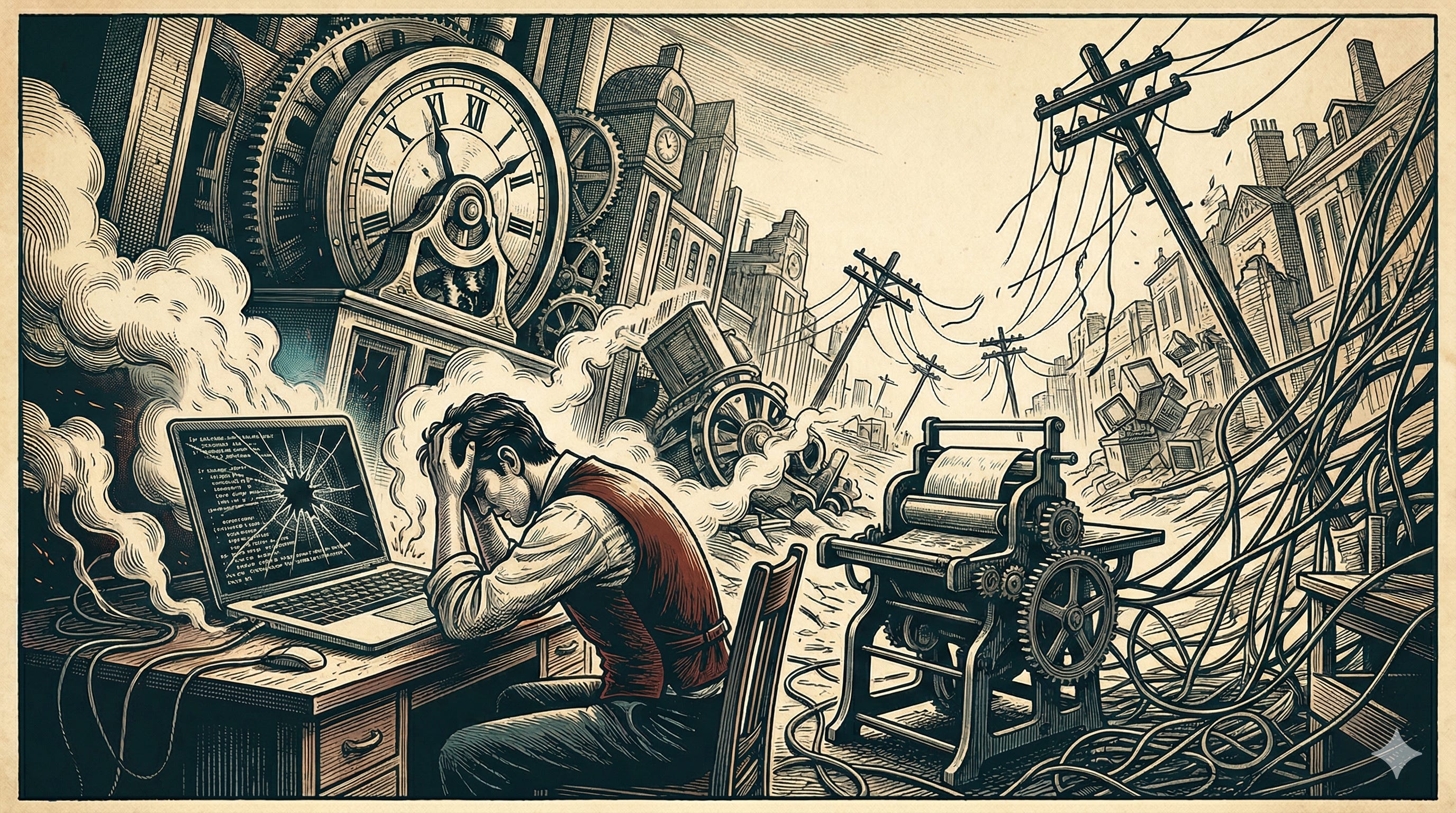
The future of work isn’t AI taking your job. It’s software updates stealing your morning.
Solo operators pay the full cost of endless tool churn themselves. When vendors move the buttons, your leverage collapses back into hand work.
I’m a founder, intrapreneur, and former CIO rethinking governance for the one-person business, navigating sole accountability in the age of intelligent machines—informed by plenty of scar tissue. All posts are free, always. Paying supporters keep it that way (and get a full-color PDF of my book Human Robot Agent plus other monthly extras as a thank-you)—for just one café latte per month.
I woke up this morning looking at two failed automations and an error log overflowing with warnings. My OpenAI credits maxed out, two scenarios stopped, and one of my automatic imports (which worked flawlessly for months) has now wrecked 2,000 contact records.
Welcome to the future of work.
If you’re a Solo Chief, you know the feeling. You start the day intending to do real work, and by lunch, you’re elbows-deep in tokens, credits, permissions, migrations, hidden settings, broken workflows, vanished buttons, and help pages written for a version of the product that deprecated last week. By dinner, you’ve moved data from A to B, upgraded C to D, reconnected E to F, re-authorized G and H, and reformatted the output twice because some vendor decided your old workflow needed a “better experience.”
People call this learning.
Sometimes, it’s just maintenance with better PR.
And yes, I know the counterargument. Ethan Mollick found that people using AI can finish faster and with better results. I’ve seen that too. LLMs often help me cut through the fog.
Until they don’t.
Because the problem isn’t only that the tasks are hard. The problem is that the ground keeps moving while you’re standing on it. The model says, “Click the menu item on the left,” and the menu item now lives in a floating panel on the right, unless you’re on the new version, unless your account is in the old rollout group, unless Google had one of its little morning moods.
That’s why so much work feels fake-busy. Your effort goes into re-learning surfaces instead of compounding skills. Many jobs will be disrupted in five years, and the half-life of some technical skills has dropped below 2.5 years. You don’t need a consultant to tell you what that means. It means you can finish a course today and toss away your certificate tomorrow.
Then the management crowd arrives with a pep talk. Stay adaptable. Keep experimenting. Be a lifelong learner. All true. Some say the illiterate of the 21st century aren’t those who can’t read and write, but those who can’t learn and relearn. True enough. Also incomplete. For solo operators, all that learning and unlearning has a cost, and you pay all of it yourself.
That’s the part the gurus skip.
Solo Operators Pay the Full Churn Tax
In a company, tool churn can be spread around. One person checks release notes. Another handles migrations. Someone in ops fixes the workflow. Someone in IT resets access. In a one-person business, congratulations, you’re all of them! The same brain that has to sell, deliver, invoice, write, and think also has to play part-time plumber for a leaking pile of half-finished software. A sane person can absorb only so many “small updates” before their brain starts filing a complaint.
And it gets worse at the exact moment you need leverage most. Solo work scales through stable patterns. Templates. Checklists. Automations. Workflows. A reliable sequence you can run without re-deciding everything each time. When a vendor moves the controls, kills an integration, changes the API, or sunsets a feature, your leverage collapses back into hand work. When you spend your executive function deciphering a new interface, it can’t also do your best thinking.
The Lindy Effect as a Survival Strategy
Some people escape the treadmill by refusing to join it. Some of us do very well by keeping a small, boring stack and ignoring shiny new toys. That’s the Lindy Effect doing its magic: the longer a tool has been around, the better chance it’ll still be around next year. Boring tech has better manners.
So the future of work isn’t one thing. It depends on whether you’re building your business on bedrock or quicksand.
But for many Solo Chiefs, the struggle is real because the market now rewards speed while the tooling punishes continuity. We need systems to save time, but the systems themselves keep demanding our time. We need tutorials, but the tutorials expire like supermarket sushi. We need AI to help us catch up, but that same AI sometimes hands us directions to a room that got demolished last night.
Progress Has Two Enemies
That leaves you with an awkward truth. Progress now has two enemies. One is ignorance. The other is churn. Everyone talks about the first one because it sounds noble. Read more. Learn more. Adapt more. No disagreement from me. But the second enemy is nastier because it looks like productivity while it actually steals your day as you’re fighting technological entropy to get your automated workflows back into submission. Everything worked fine last night. You can only pray it all works again before dinner.
It’s easy to confuse motion with progress because the screen is busy and your brain feels hot. I keep telling myself I’m building capability, but often I’m just paying a tax for renting my business on other people’s ever-moving tech stacks.
Welcome to the future of work.
Bring curiosity, yes. Bring grit too. But bring suspicion. If a tool changes faster than your business can benefit from it, you’re not using the tool. The tool is using you.
Back to work. I have 2,000 contact records to fix.
Jurgen, Solo Chief.
P.S. How many hours did your tools steal from you this week? I’d love to hear.
Choose Your Technology Adoption Strategy: When to Migrate

Stop chasing every new tool. Stop feeling guilty about waiting. Learn where to sit on the technology migration spectrum.

Don't Panic!—The AI Job Apocalypse Is Coming (But Humans Will Always Have Work)

The Last Time a New Technology Killed Almost Everything, It Created Humans
This is what prompted my whole approach. I was stuck in analysis paralysis for a really long time, and I also noticed many tools were hard to integrate with AI and also came to the realization that I had no idea how quickly any of the tools I used might become uneconomic or obsolete. So I stopped.
Then I just said - what's the minimum that I need as a technical solo chef to build what I want. I needed a foundation model (I use claude - but don't tie myself to claude specific features so I can do council of elders, pick the right lab/model for the job and have business continuity if one foundation lab falters. I needed transcriptions (I picked granola as non-intrusive and good enough - better now it has an API and raised another round). I needed a place to store the git repo with all the prompts and skills and slow changing shared context - GitHub for now - we'll see if they keep having 500 errors. I needed emails and calendar (a google for work account - one for me, one for each primary agent) and I needed a relational database as my system of record for tasks, research, content, contacts, companies, pipelines and everything else. For now I'm on supabase, but (other than blog storage) I'm not using any deep supabase features so I could port to any other hosted postgres in a day.
That's my stack. No shiny object syndrome. If I see something cool I send it to my agents to review - not to see whether I should trial it, but to ask them if there are any patterns they could extract for my own orchestration harness.
You need to be technical and you need to have good technical judgement and a solid sense of good practices for reliable distributed systems. But if you are, it's not that hard.
For me it's been transformative.