

Most AI agent content is about building AI agents. That’s not a business, it’s a pyramid scheme.
Here's how I want to become an agent boss: by building and managing AI agents for real value, not meta-content recursion.
It’s 4 AM. I’m staring at the ceiling again, and somewhere in the dark I’m doing the mental arithmetic of how many AI-generated playbooks some author on Substack sold this night while I was busy thinking about something more meaningful—and not getting anything done.
Do you feel a bit anxious when your competitors use Cursor, Codex, Claude Code, or Antigravity to launch one vibe-coded app after the other, funneling market attention toward their throwaway solutions and away from your lovingly handcrafted, far-too-long-in-development product?
Do you sense a Fear of Becoming Obsolete (FOBO) when other solopreneurs have a legion of OpenClaw AI agents iterating rapidly on a dozen business models in parallel while they’re sleeping, and while you only have a smartwatch reporting each morning on your restless night?
Don’t worry. I feel the same.
Sleepless Over the Bestseller Badge
Reading Substack is like doomscrolling through your Instagram feed, noticing that each and every influencer sliding down your screen is better-looking and more successful than you are.
Just look at those leaderboards, bestseller lists, and screenshots of rapidly climbing subscriber stats, embellished with the inevitable humblebrag note, “Thanks to my subscribers. I could not have reached this milestone without you! Here’s what you get when you upgrade. [insert upsell here]”
Swiping as an author across the Substack feed can be an inferiority-inducing anxiety trip. So many others are doing so well! They’re posting and sharing and hustling and playbooking themselves into stardom. It makes you feel ugly. Unpopular. Inadequate. The Quasimodo of creatives.
Few people talk about what it actually feels like to scroll through a Substack leaderboard after midnight when your own subscriber count metric looks like the sun setting over a windless ocean. I’m sure some founders, freelancers, and solopreneurs feel more alone than ever as they measure themselves against leaderboards, whether on Substack or anywhere else.
And yet, no matter how many of those self-congratulatory wins, comments, bestseller badges, and “download-my-framework” posts I see, the only thing I can think is … No.
That’s not how I want to play this game.
The hustle approach doesn’t fit me. (It never did, honestly, but FOBO has a way of making you question your own instincts.)
I Want to Be a Sleepy Agent Boss
But then … what is my approach?
Before we get into that, let me share the thoughts I’m endlessly mulling over while my smart ring is busy recording yet another sleepless night.
I envision a Substack Publishing assistant (let’s call it Lenny) that helps me grow my Substack publication. Lenny does all the work I have no time for, like cross-linking my posts, recommending other authors, scrutinizing the statistics dashboard, and comparing the results with LinkedIn metrics and Google Search Console reports. Lenny is smart enough to share with me only what matters, considering the objectives we’ve agreed upon together. While I’m producing, Lenny is optimizing.
I dream of a Nonfiction Reading assistant (let’s call it Marie) that monitors the English-language nonfiction book market for me, notifying me of new books that seem to satisfy my needs and taste. Marie keeps track of the books I read, the ratings I give them, the ones I didn’t finish, and the backlog I still have. She will sternly push back on my tendency for tsundoku when I’m tempted to order an author’s latest work when their previous two books still sit untouched in my reading queue.
I want a Finance & Admin assistant (let’s call it Warren) to take care of my monthly invoices: collecting receipts from my mailbox, digging them up from the billing catacombs of three dozen online services and digital platforms, and then matching the documents with the transactions on the credit card statement it retrieved from my bank. Warren will also politely hunt down any unpaid invoices and will suggest how to set aside the surplus balance in my bank account—if I ever have any.
I need a Mind & Body assistant (let’s call it Jane) to monitor the streams of health data collected by my smartwatch, smart ring, and the nutrition app I use to track my daily food intake. Jane will follow my exercise regimen, vitamins, minerals, caffeine shots, step count, and sleep stages to give me tips on how to prevent waking up at 3 AM with a brain that keeps generating mental images of unrealized subscriber counts.
I absolutely want various digital assistants helping me invent and build out business ideas that result in actual value generated for customers, not some “exclusive access” to prompt libraries, courses, and AI-generated playbooks targeted at people like me who are unlikely to ever hit the bestseller leaderboard.
At 4 AM, as I turn around yet another time, I dream of a personal staff of AI agents specialized in niche contexts such as Public Speaking, Personal Branding, Board Work, Fiction Reading, Fiction Writing, Travel & Vacations, Friends & Family, Personal Finance, Home & Living, Food & Cooking, and more.
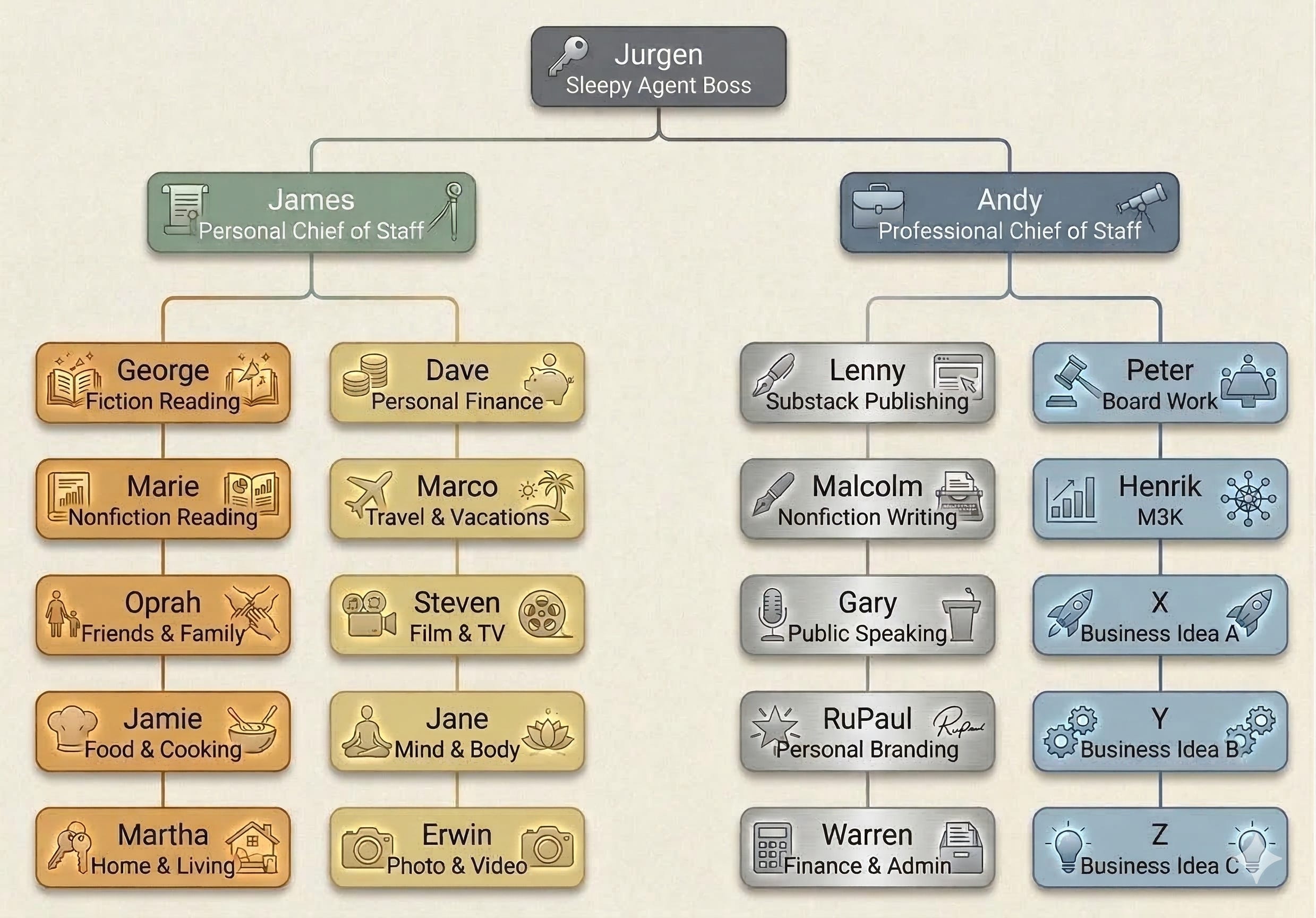
And I need two Chiefs of Staff (let’s call them James and Andy, one for personal matters and the other for professional jobs). They’re familiar with all the specialized assistants and can query them directly about ongoing work, backlogs, commitments, calendar items, and deadlines. When I tell Andy I want to use a dedicated credit card for all my nonfiction book orders, Andy will work with Warren and Marie to make it happen. When I tell James we’re out of milk, James will work with Martha and Jamie to find an alternative for my morning cappuccino.
That’s the dream I have when I lie awake.
I want a personal AI agent architecture. The last conscious thought I have, just before I finally fall asleep at 5 AM, is I want to be an agent boss. One that can actually sleep.
None of that exists, though. So it’s time I started building.
But what I don’t want is to spend two years building an architecture so elegant it belongs in a museum, while everyone else shipped products to actual humans. I’ve made that mistake before. More than once. (Maybe three times. Fine, four.)
I’m a founder, intrapreneur, and former CIO rethinking governance for the one-person business, navigating sole accountability in the age of intelligent machines—informed by plenty of scar tissue. All posts are free, always. Paying supporters keep it that way (and get a full-color PDF of my book Human Robot Agent plus other monthly extras as a thank-you)—for just one café latte per month.
1) Only in the Cloud, Not on My Computer
I almost hear you hopping up and down excitedly, saying, “That sounds great! You can use Claude Code, OpenClaw, LangChain, CrewAI, …”
Wait, wait, wait! #soundofpullingthebrake
Before anyone helpfully suggests I just fire up OpenClaw or CrewAI and call it a day, here’s the part that actually matters.
First and foremost, I want nothing running on my local computer. Ever. Nada. Zip. Null.
With me frequently traveling for work and moving weekly between homes in Rotterdam and Brussels, the last thing I want is for my digital assistants to work with local files that may or may not be in the right file folder, and may or may not properly synchronize across multiple computers that may or may not actually be turned on.
I’ve already struggled these past few weeks with Claude Cowork getting confused because of out-of-sync skills files, and insisting on a local home folder on my PC that is not the home folder of Google Drive or Dropbox. (Neither can be easily changed.) And copy-pasting local files from one home folder to another is an excellent way of inducing a migraine and another sleepless night.
Let’s not go in that direction. I will happily pay for tokens and credits when it means I don’t have to worry about the infrastructure. I’ve spent enough years of my life juggling with deployment environments to know that the cheapest thing I can buy is to make this someone else’s problem.
All my assistants must live in the cloud.
2) Real Use Cases, No Selling Spades to Gold-Diggers
I want my digital assistants to do real work. Not work about work.
You probably know the category. E-books about writing e-books, podcasts about making podcasts, YouTube channels about how to grow your YouTube channel. We can call this type of business model monetized recursion engines: the endless parade of make-money-online (MMO) schemes offered by meta-content creators.
It’s the equivalent of selling spades to gold-diggers, or tickets to lotteries, or online courses for crypto speculators. Monetizing other people’s desire for fame and money is an all but guaranteed path to profits. (It’s also the business model equivalent of a snake eating its own tail, but I suppose snakes don’t need a Substack leaderboard.)
I don’t want to earn revenue from people who hope to earn revenue. For every successful creator, there are a thousand who can only dream of being similarly successful. If the successful one is successful only because they charge the thousand unsuccessful wannabes for hope and illusion, they don’t have a real business. They run a pyramid scheme.
“I don’t want to earn revenue from people who hope to earn revenue.”
I refuse to write a Substack about how to build AI orchestration around Substack. I want my AI agents to handle real business use cases. The kind where actual value gets exchanged with actual humans for actual reasons.
3) Context Isolation, No Cross-Contamination
One only needs to read a few Substack posts discussing OpenClaw to see the horror stories of AI agents ruining a job, a data repository, or even someone’s reputation, when given unlimited and unconstrained access to someone’s personal computer.
I don’t want Marie to know my credit card numbers, or Warren to have access to my health data, or Jane to see my customer notes. Last time I checked, I counted at least 20 personal and professional contexts and each of them should have its own dedicated AI agent specialized in that and only that. My travel details are irrelevant to the AI agent managing my home improvements. And I don’t see the need for the Personal Finance agent to have access to my online dating profiles.
Think of it like biological cell membranes. Each cell has a clearly defined boundary, lets only the right molecules through, and doesn’t randomly share its DNA with the cell next door. Without that membrane, you don’t get a functioning organism. You get cancer. I want my sleepy agent boss architecture to work the same way: strict context isolation, preventing cross-contamination of contexts.
This will definitely slow me down. But it should also keep me safe.
4) Layered Architecture, Lasagna Instead of Spaghetti
Call me old-fashioned, but I’d rather have lasagna than spaghetti, and I’d rather understand the layers than inherit a bowl of someone else’s noodles.
I’m no fan of the idea of a swarm of AI agents autonomously coding an entire tech stack all by themselves without any insight into how the various layers of the product connect to each other. I’ll be happy to let the assistants help design and build the various parts of my agentic architecture, but I want to stay in control. I want to own the interfaces between the layers.
There’s a lesson from systems theory here: in any complex adaptive system, the interfaces between subsystems are where most of the interesting (and dangerous) behavior emerges. If you don’t own those interfaces, you don’t own your system. You’re just renting it.
“If you don’t own those interfaces, you don’t own your system. You’re just renting it.”
Is that slower? Yes. Is that more responsible? I think so, yes. Will I regret this principle in six months when I’m still debugging layer two while some 22-year-old has shipped fifteen agentic products from a hammock in Bali? Probably. But I’ve watched enough cowboy architectures collapse to know that speed without structure is just expensive failure with better marketing.
5) Multi-Platform, No Vendor Lock-in
Last but not least, I prefer to run a business that’s not intimately tied to one company’s agentic architecture.
It’s hard enough not to rely on Google for everything these days. I have no intention of making things worse by building the entire stack of my agentic workflows through a single supplier. I want MyClaw and Claude Code and AI Studio and Make, just like I use (and pay for) the top five cloud LLMs precisely because I don’t want to be dependent on any single one of them.
Different contexts require different persistence layers, too. For some data, Fibery is perfect. Other things are better stored in Notion, Trello, Google Drive, or Roam Research. Trying to cram everything into one tool is like trying to store wine, cheese, and laundry in the same closet. You can do it, but you probably shouldn’t.
Instead of going all-in with one specific vendor, I want to go deep in my understanding of how not to tie the future of my business to one exclusive technology.
Yes, all these requirements mean I’ll probably be the last Solo Chief on my block to have a fully functioning agent stack. I’ve made peace with that. (Okay, mostly made peace with that. Ask me again at 4 AM tomorrow.)
It’s going to slow me down, but it will also increase viability.
The Future Agent Boss
It’s time to feel less anxious about the future and start building it around ourselves. We should stop comparing us with others who only seem to be more productive and successful, but who are really running monetized content recursion engines and don’t share our strict requirements for a viable business: a cloud-first architecture, context isolation, layered design, and supplier independence.
I haven’t built any of this yet. I’m describing the map I’m drawing, not territory I’ve conquered. Some parts of the map are probably wrong. I’m okay with that. Maps are supposed to get revised. That’s what separates a map from a manifesto.
In the future, I want to tell Taylor (my future Personal Branding agent) to update the photo, tagline, and description across all my social media profiles, once every three months, to reflect the most important thing I’m working on at that time. If Taylor sees a need to employ a specialized agent per platform, I’d probably say that’s a smart move.
In the future, I want to tell Johanna (my future Nonfiction Writing agent) to check my entire archive of articles and make a proposal for turning the strongest posts with the best engagement into a book. Johanna will have to collaborate with Lenny on that because Johanna will only have access to my books, while Lenny will own just my Substack archive.
In the future, I want to tell George (my future Fiction Reading agent) to find me the ten best novels on dystopian parallel universes. George will probably have its own team of subagents for checking which books I’ve already read, reading reviews to match books with my taste, and ordering hardcover copies that won’t break my bank.
And when I have an idea for a new business model that needs a new context, I’ll be working with Andy to see which new professional agent to create or hire.
And I’ll be the sleepy agent boss: someone who builds, delegates to, and manages AI agents to amplify their impact, working smarter, scaling more deliberately, and taking control of their career in the age of AI. Not a hustle-bro with a leaderboard screenshot. Not a meta-content creator selling gold-digging spades. A sleepy agent boss with a map, a lasagna architecture, and a smart ring that records a good night of sleep.
I’m starting to build now. I’ll share what I learn, including the parts where it blows up. Especially those parts, actually. Those tend to be the ones worth reading.
Jurgen, the Solo Chief
P.S. If this reads a bit like me rambling, it’s probably because I just crossed the Atlantic and I am a little sleep-deprived.


That sounds like a great plan. I'm on this as well: building my own infrastructure for everything that will come. If you want to brainstorm about, let's have a virtual coffee any time.
The context isolation principle took me a while to realize. When I started building agent fleets, my first instinct was to give every agent access to everything. It was like putting everyone on every Slack channel.