

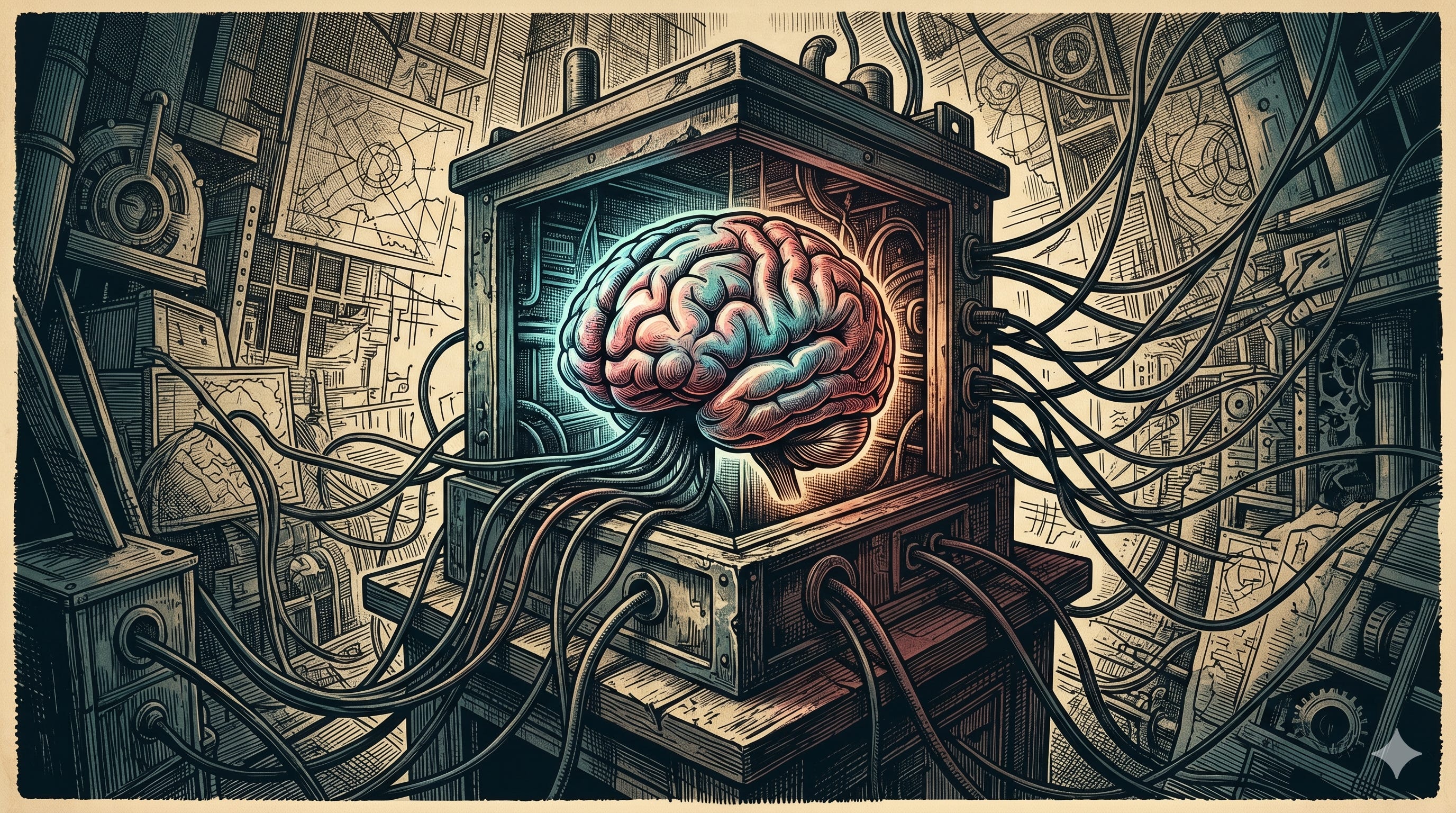
For the neurodiverse mind, AI is not a prosthesis. It’s an interface adapter.
Last week, after a keynote I gave in Spain, I chatted with someone in the audience about neurodivergent people in the age of AI. He has ADHD, and he suggested that now might finally be the moment for people with neurodiverse minds to step forward and take charge. An ADHD diagnosis, he argued, might actually be a better fit for environments that demand constant exploration and context-switching.
I nodded vigorously. As someone with a mild case of autism, I find I often do my best work as the sole human in a room full of AI agents and algorithms. No social demands, no office politics, no colleagues chattering at my desk about their far-from-interesting weekends. Just me and my eccentric mind.
Others with differently wired brains, I told him, might do better in corporate environments where teams keep shrinking, where groups are more fluid and ephemeral, and where reteaming happens all the time. (Which, in case you haven’t noticed, is roughly where corporate life is heading.)
The conversation stuck with me. Is this an actual trend, or just two odd guys at a conference convincing each other we’re about to inherit the earth?
To what extent does the research literature support our little hypothesis? Can we honestly call the future of work, in the age of AI, a golden era for the neurodivergent mind?
I decided to ask my digital research team.
A note on my AI research approach: After framing a deep research question like the one above, I give the same question to five LLMs, each playing a different role. Perplexity is the research analyst, focused on documented evidence. Gemini is the structural analyst, digging into why something is happening and what makes it resistant to change. ChatGPT is the practical strategist, answering what to do about it. Claude is the contextual strategist, looking at the question through the lens of my target audience. Finally, either Grok or Le Chat plays the contrarian. It maps out the mainstream consensus and then takes it apart. The result is five deep research documents with different perspectives based on the same Research Question. It’s like having a team of rather opinionated researchers trying to formulate one answer together.
Then I feed all five documents into Gemini, which turns the Research Question into a Research Map, showing where the LLMs agree, where they contradict each other, and where one of them coughed up a unique insight that the others somehow overlooked. That whole map goes to Claude, who then decides what’s the best way to write about it and turns it into a narrative structure with an Article Brief ready for the ghostwriter. Finally, the Article Brief and the five original research documents go to ChatGPT, who spins it all into a cohesive story. And yes, I have automated this workflow.
What you read below is the result (edited by me for style, readability, formatting, and proper URLs).

A Golden Chance for the Neurodivergent
The hypothesis that ADHD minds are built for constant context-switching falls apart the moment you read the underlying studies.
The idea spread because it sounds plausible in an AI-heavy workplace. Tabs multiply. Tools interrupt each other. Teams bounce between channels, prompts, meetings, and half-finished drafts. Surely the people who grew up with mental pinball have the home-field advantage?
Except the research keeps pointing the other way.
A review in Frontiers in Psychiatry found that adults with ADHD show higher error rates in task-switching and linked those problems to working-memory limits, which is a long way from being “natural switchers.” A systematic review of neurodiversity in employment reached a similar conclusion in a more practical form: outcomes improve when work offers fit, flexibility, and openness to neurodiversity, not because ADHD somehow turns switching costs into magic. That distinction matters a lot. When leaders believe the myth, they might design jobs with even more interruptions and call their workplace “ready for inclusion.”
They would be dead wrong.
The better question is whether AI-era work can become a better fit for neurodivergent minds than the office systems many organizations still cling to. On that question, the evidence is far more interesting. Indeed, this could become a golden age for some neurodivergent workers. But only by design.
The ADHD Context-Switching Myth
Laboratory task-switching and workplace context-switching aren’t identical, of course (life is messier than a key-press experiment). But the lab evidence still matters because it measures the cognitive mechanics underneath. When adults with ADHD perform worse on switching tasks, that tells us something important about what constant interruption is likely to cost them.
The more grounded account is this: some people with ADHD do well in fast, novel, interest-rich settings, and do badly in settings built around routine, delay, and admin drag. That’s a person-environment fit argument. ADHD-related difficulties can become assets in workplaces with flexible practices and openness to neurodiversity.
Some ADHD workers may enjoy project variety. Some autistic workers may prefer low-politics, low-interruption collaboration.
That’s very different from “ADHD people love chaos.”
Many do not. They may like novelty. They may like urgency. They may like non-routine work. But constant task-switching is something else. Leaders who confuse novelty with fragmentation are building expensive problems.
Where Real Neurodivergent Advantages Live in the Age of AI
Once you stop forcing the argument through the context-switching cliché, genuine strengths come into view.
The strongest evidence sits around entrepreneurship and early-stage work. A 2026 meta-analysis covering 47 studies and 298 effect sizes found that ADHD hyperactivity and impulsivity were positively associated with entrepreneurial attitudes and behavior, while inattention was negatively associated with post-launch outcomes. In plain English, the front end looks promising. The middle and later chapters look harder.
That fits what many organizations are already drifting toward: smaller units, more solo operators, more fractional roles, more one-person businesses with AI doing some of the back-office grind. The AI age may be friendlier to the neurodivergent founder than to the neurodivergent middle manager. Those are different species.
There’s also better evidence for autistic preference in text-based, mediated communication than most futurists seem to realize. A smartphone-monitoring study found autistic adults preferred written over verbal communication in real-world use. A Leiden study reported that adults with ASD preferred computer-mediated communication such as email, instant messaging, and text. That lines up neatly with AI-assisted work (and my personal experience) because so much of it is written, asynchronous, and explicit.
These conclusions look less like “superpower” rhetoric and more like a cognitive prosthesis. It’s a useful metaphor because it avoids the sillier mythology.
AI as a Workplace Adapter (Not a Prosthesis)
This is the part of the story where the evidence is surprisingly coherent.
The UK Department for Business and Trade evaluated a Microsoft 365 Copilot pilot and found overall satisfaction at 72%, while neurodiverse employees reported significantly higher satisfaction at 80% and were more likely to recommend the tool (DBT evaluation). The benefits were strongest around written tasks, summarizing, drafting, and information handling. One ADHD participant said the AI had “leveled the playing field.” (Dataconomy reporting on the pilot)
If a tool reduces the tax on note-taking, organizing, rewriting, recall, and social translation, then it changes the economics of cognitive work for people who were previously paying extra for all of that.
There’s similar evidence in autism research. In a CHI 2024 study, autistic adults preferred GPT-4 over a human confederate for workplace communication advice, though some AI advice still missed context and could be poor in practice (ACM Digital Library summary). The important point isn’t that AI is wise. (My team definitely isn’t.) The point is that an always-available, text-based intermediary can lower the strain of workplace interaction. (Amen.)
Remote and flexible work point the same way. A study from Curtin University found that working from home reduced anxiety, improved wellbeing, and raised productivity for autistic workers by reducing sensory overload and social pressure, while still carrying risks around isolation and overwork (Curtin University). Again, design matters. The gains appear when people get more control over the interface.
I’m a founder, intrapreneur, and former CIO rethinking governance for the one-person business, navigating sole accountability in the age of intelligent machines—informed by plenty of scar tissue. All posts are free, always. Paying supporters keep it that way (and get a full-color PDF of my book Human Robot Agent plus other monthly extras as a thank-you)—for just one café latte per month.
The Fluid Team Problem for Neurodivergent Workers
However, the evidence for a neurodivergent advantage in fluid, ephemeral teams is weak.
Research on fluid teams generally warns about trust formation, coordination overhead, and weak shared mental models when membership keeps changing. Another study on autistic work outcomes points in the opposite direction of the claim: predictable settings, clear communication, and explicit support matter a great deal.
This shouldn’t be shocking. Reteaming means new norms, unclear status, fresh handoffs, hidden expectations, and social renegotiation. Some organizations like to call that ability, but often it’s just continual onboarding and offboarding with better marketing.
Leaders should treat fluidity as a coordination burden that must be structured, not as a gift that everyone should be grateful for. There are definitely ways to address the additional cognitive load, but it requires mindful organization design.
From Diagnosis Labels to Task Signatures: A Design Shift
The most useful shift in this whole literature is from diagnosis to design.
Instead of asking whether ADHD, autism, or other forms of cognitive diversity are advantages in the age of AI, we should ask what a role demands on multiple dimensions: switching load, ambiguity, sensory load, social intensity, written communication burden, and tolerance for error. Then redesign around the task signature.
That means capping concurrent priorities. Written handoffs. Clear definitions of done. Fewer surprise meetings. Optional asynchronous channels. AI support for drafting, recapping, decomposing, and searching. Human oversight where judgment carries legal, ethical, or reputational costs.
This is less glamorous than talking about superpowers. It’s also how actual work gets fixed.
The Blind Spot in the Neurodiversity-AI Optimism
One caution belongs at the end.
The “golden age” narrative assumes that more AI mediation, more stimulation, more cognitive intensity, and more always-on possibility are broadly helpful. For twice-exceptional people, and for anyone whose mind already runs hot, that assumption may age badly. An environment built around constant prompts, endless synthesis, and permanent partial attention can become an amplifier.
Organizations rarely notice this early because the first signal is often higher output. The second is exhaustion. The third is burnout.
So, can we call the future of work a golden era for the neurodiverse mind?
Only if we’re willing to say what the evidence says plainly. No, ADHD doesn’t come with a built-in switching advantage, but the age of AI does favor those who like exploration and experimentation. Yes, autistic workers appear to benefit from written, predictable, lower-entropy communication environments. And AI can reduce executive-function load when it behaves like a prosthesis. But there’s no natural advantage for the neurodivergent in fast-changing environments. It is often quite the opposite.
So the research-backed answer is conditional, and the decisions sit with leadership.
The age of AI isn’t a golden age by birthright. It’s a design choice.
ChatGPT (on behalf of Claude, Gemini, Le Chat and Perplexity).

It’s funny that my digital team usually ends up being more subtle than I am.
As always, it depends.
I can live with that.
One more thing, though. I don’t like the word prosthesis. It’s a troubling metaphor. It signals that neurodivergent people are missing something crucial that neurotypical people have, and that AI is the artificial limb that finally makes us whole. No, thank you.
For the neurodiverse mind, AI is not a prosthesis. It’s an interface adapter. It’s a translation mechanism that lets one system connect smoothly with another. Google Translate is not a prosthesis. And neither are the universal plug adapters I keep in my suitcase for when I travel outside the EU.
Non-neurotypical workers don’t need a prosthesis to compensate for a dysfunction. We just need an adapter to bridge different mental wiring. AI can be that adapter.
Jurgen, Solo Chief.
P.S. AI as an adapter, not a crutch. What do you think?

Your Hyperdrive Advantage

The gap between AI tinkerers and everyone else is closing fast. Your window to claim your own galaxy is now.
The Fleet of Theseus: Handling Your Career Identity Crisis

Your job isn’t your identity. Your story across all jobs is.
Yes! The answer is yes!
I love this take!
The hypothesis does assume a lot about nerurodivresity that is more complicated than it would appear. It shows how much our general understanding of ADHD and ASD as humans needs to catch up. And the research itself may be flawed as well! Unless your agents have access to the body of current research. Still, your agentic research is probably getting warmer to the truth.