

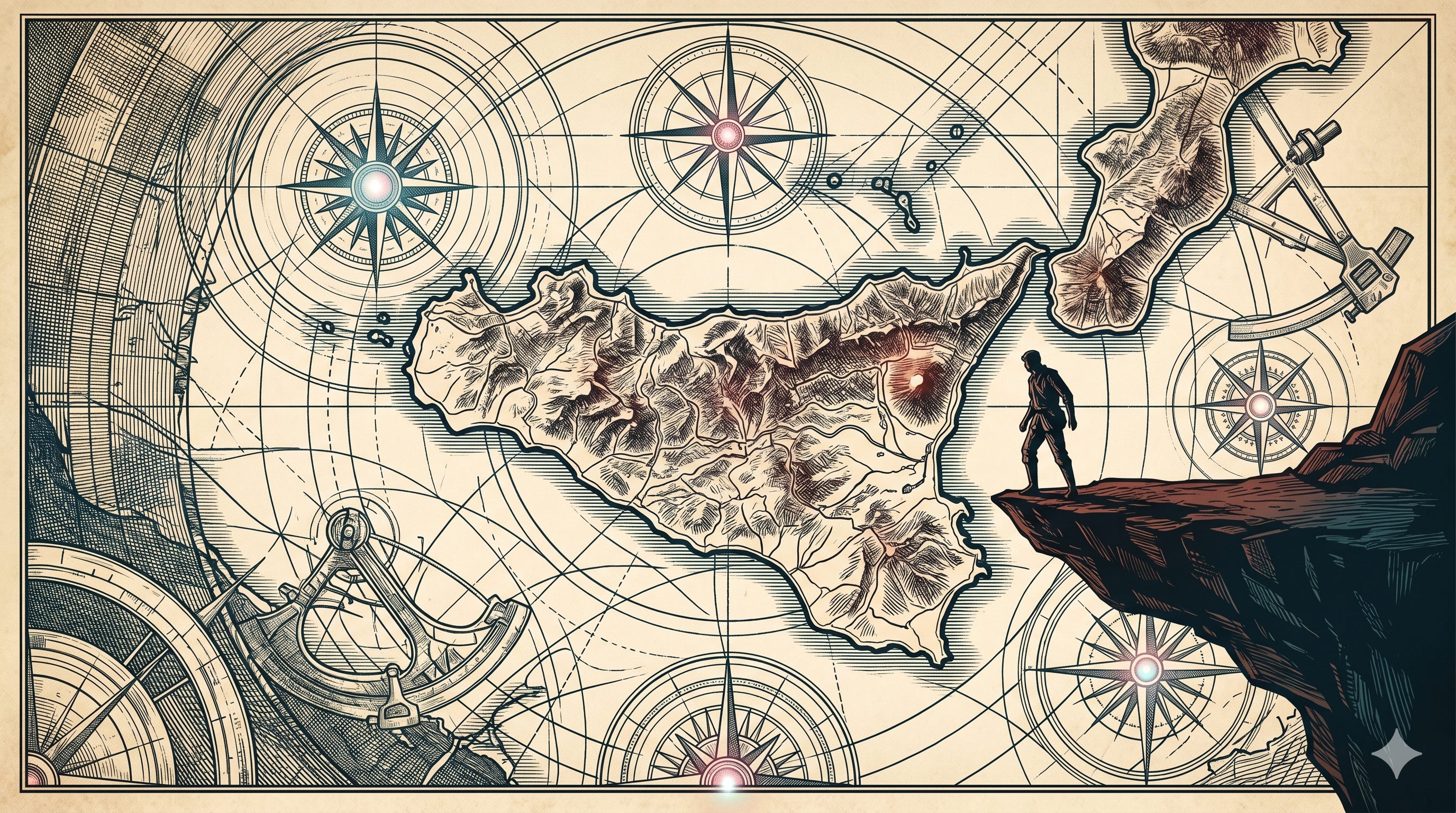
Your problem isn’t the problem, your story about it is.
In Sicily, reframing means swapping your cappuccino for a macchiato, and maybe your whole attitude toward your problems.
Be 100x More Productive with This Free Claude Code Guide

Sponsor message presented by Iwo Szapar
Every Solo Chief hits the same wall: too many decisions, not enough you. I hit it last year and rebuilt my workflow around one constraint: Claude Code has to be able to do anything I can do, from one brain.
Today, it runs five jobs in parallel. drafts emails in my voice, sends the weekly newsletter, handles sales follow-up, prepares my morning briefing, watches my numbers.
Team output. Solo overhead. That's the shift.
If you want to see how it's built, the free guide walks through the first skill end to end.
I’m changing my coffee habit.
Normally, I only drink cappuccinos and cafe lattes, one after breakfast, one after lunch, and one after dinner. But I’m traveling in Sicily now. Everyone tells me that Italians frown upon the idea of ordering milky coffees after 11:00, especially on its more conservative southern island. Of course, I could just ignore the warnings, order my regular cappuccino at 4 pm like the average dumb tourist, and shrug off the local chuckles and eye-rolls behind my back. I’m a paying customer. Who cares what others think?
But that’s not what’s actually happening. Instead, I took this as a chance to get out of my comfort zone and test my adaptability to the local culture and customs. Also, they tell me this is the home of the mafia. I’d rather not find out what happens to disrespectful tourists. So, after lunch, as long as I’m in Sicily, I only order a cafe macchiato, like a decent Italian. And the macchiatos are not so bad, actually. After two weeks of traveling, I might even get used to the reduced milk intake and take the new habit back home. I’m turning the problem into an opportunity.
We call this reframing, or flip-thinking.
We have a great word for it in Dutch: omdenken (coined by Berthold Gunster).
I’m a founder, intrapreneur, and former CIO rethinking governance for the one-person business, navigating sole accountability in the age of intelligent machines—informed by plenty of scar tissue. All posts are free, always. Paying supporters keep it that way (and get a full-color PDF of my book Human Robot Agent plus other monthly extras as a thank-you)—for just one café latte per month.
Reframing or flip-thinking is a way of thinking and acting in which you don’t shy away from problems, but use them as a source of energy for new possibilities. Instead of resisting reality, you accept it as it is, so you can build creative solutions from there.
Reframing is not the same as rethinking. With rethinking, you ask, “What is the truth here, and how can I understand this better?” It involves taking apart old assumptions and redesigning your approach. The problem doesn’t go away; you just try to find a different angle to tackle it.
With reframing (omdenken), you ask, “How else can I interpret this?” The facts of the situation don’t change, but your story about them does, and so does your emotional response. A situation is only a problem when that’s how you decide to see it. The moment you stop treating something as a problem, it might become an opportunity.
For example, you might have been looking for a job for a year, writing a hundred cover letters and sitting through a dozen interviews, all in a hyper-competitive job market where both recruiters and applicants are using AI to ruin the hunting game for everyone. Is this a problem? Maybe. Maybe not. Perhaps you can reframe it as a chance to offer a new job-matching service and disrupt the job market forever.
Or you might have struggled for a year to grow your Substack newsletter. You followed all the advice, tried every growth hacking trick on the planet, and the subscriber count hasn’t budged an inch. Is that a problem? Only if you think it is. Maybe you can reframe yourself as one of those rare authors blessed with a stable and persistent readership. Perhaps you can even teach others how to gain such a loyal following.
Or perhaps you’re one of those creatives who has worked with teams, both startups and corporate, for several decades, and you’ve realized that you do your best work alone and find teamwork increasingly stressful. Will you despair and call yourself antisocial? Will you sign up for online courses on networking and how to make friends? Or is this a perfect opportunity to learn how to run a one-person business with only AIs as your teammates?
I’m flip-thinking my way through life right now.
I’m reframing things every day.
Never let a good crisis go to waste. When life gives you lemons, you make lemonade—or limoncello.
In an increasingly uncertain environment where things rarely go as planned, I have to adjust my mindset all the time and keep wrapping my head around a newly discovered reality that wasn’t the reality I was aiming for. But the older and wiser I get, the less I want to waste my time seeing everything as a problem to solve.
Some might call it “taking things as they are” or “making the best of a bad situation.” A few readers might point to the psychological concept of cognitive dissonance, which is all about reinterpreting an undesired situation in a new way so that it suddenly seems to be exactly what you needed. It’s a basic mental survival skill, or else we would all get very depressed very fast.
But reframing (omdenken, flip-thinking) goes a step further. It’s like enthusiastically embracing cognitive dissonance. We’re not just reinterpreting a situation and shrugging our shoulders with the comment, “Oh well, it’s actually not so bad.” Instead, we go the extra mile by owning our new perspective and taking advantage of it. We say, “All right, given this is what I was dealt, this is how it’s going to pay my bills.”
Stoic philosopher Marcus Aurelius wrote that the obstacle is the way. The impediment to action advances action. What stands in the way becomes the way.
Every Solo Chief hits the same wall: too many decisions, not enough you. I hit it last year and rebuilt my workflow around one constraint: Claude Code has to be able to do anything I can do, from one brain.
Today, it runs five jobs in parallel. drafts emails in my voice, sends the weekly newsletter, handles sales follow-up, prepares my morning briefing, watches my numbers.
Team output. Solo overhead. That’s the shift.
If you want to see how it’s built, the free guide walks through the first skill end to end.
by Iwo Szapar
I’m in the city of Noto right now. The old city of Noto (Noto Antica) was destroyed by the great Sicily earthquake of January 1693. Afterwards, the authorities chose to abandon the original site and build a new Noto a few kilometers to the south, on a safer, more suitable plateau where they could design a modern Baroque town from scratch. They reinterpreted the problem of complete destruction as a rare chance to pick up the entire town and move it somewhere better.
That’s omdenken.
That’s flip-thinking.
That’s reframing a problem by turning it into an opportunity.
Jurgen, Solo Chief.
P.S. Ever ordered a cappuccino after lunch in Sicily? How did it go?
The Org Chart Is Choking Your Craft

They didn’t hire you to attend meetings about meetings. They hired you to do your thing. Do you remember that thing?
Is the Age of AI a Golden Era for Neurodivergent Workers?

For the neurodiverse mind, AI is not a prosthesis. It’s an interface adapter.
I'm So Tired of All the Attention-Grabbing Bullshit

Going online is like walking onto a bazaar where everyone is poking you, luring you, and yelling at you.