

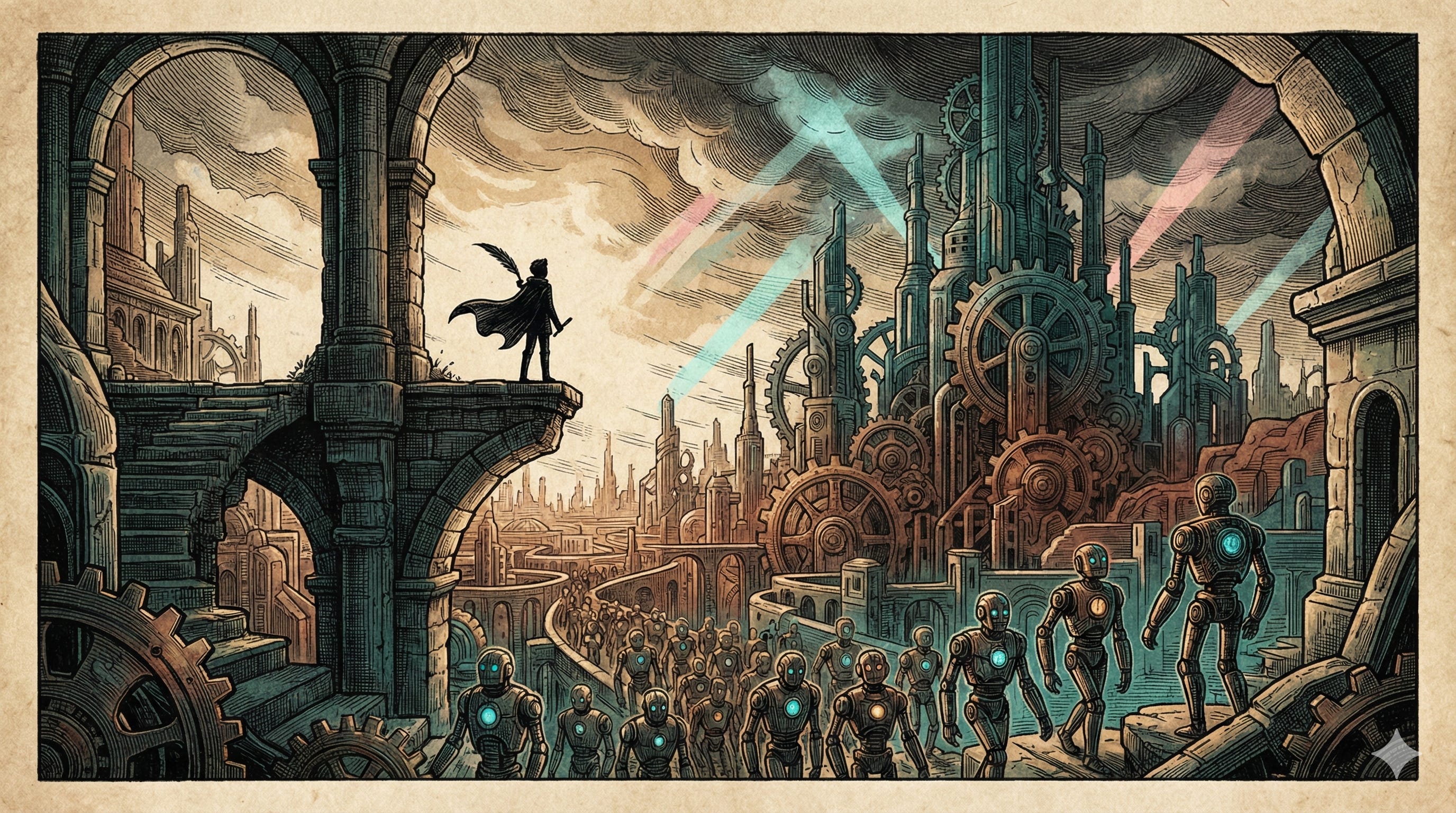
It's okay to collaborate with AI. Here's how.
Stop wrestling with your artistic conscience. Here's a 2x2 matrix to help you embrace AI as a creative partner without losing your vision.
Attention all artists, writers, and creative souls! Are you tired of writer’s block, creative ruts, and the constant pressure to produce a masterpiece? Well, grab your favorite beverage and settle in because I’m about to share an opinion that seems controversial among a group of hardcore creatives:
It’s okay to collaborate with AI assistants in your creative process.
I know, I know. Some of you might be clutching your pearls and pens in horror, but hear me out. Your artistic integrity is not about to retire – we’re just giving it a high-tech sidekick.
The Open Secret of Creativity
Let’s be honest: None of us are creative superheroes. We all have our strengths and weaknesses. Allow me to illustrate this topic in the context of fiction writing. (I have some experience there.)
Some authors write prose that could make Shakespeare jealous, but they find that plotting feels like solving a Rubik’s cube blindfolded.
Others create worlds so immersive they should come with a “you’ll never find your way out” warning, but their characters have less personality than a cardboard cutout.
Some novelists craft lovable characters and vivid settings but would rather complete a financial accounting course than figure out how to end their story.
Here’s the truth: Perfection is as rare as a typo-free first draft. Readers are a diverse bunch. Some swoon over flowery language, others only care if your main character could survive the next zombie apocalypse.
Take Cixin Liu’s “Three-Body Problem,” for example: mind-bending plot but characters thinner than a French pancake. Or Patrick Rothfuss’ “Kingkiller Chronicles” – prose smoother than silk, but its pacing makes Joe Biden look like a marathon runner. Or take any of Brandon Sanderson’s books: fantastic, imaginative worldbuilding, but the prose feels as if it was churned out by a machine per square meter.
Your AI Partnership: A Model for Creative Collaboration
Imagine a two-by-two matrix of your creative tasks.

Here’s how AI can spice up your creative life without stealing your thunder:
1. “I love it, but I struggle with it.”
Let AI be your supportive coach. Terrible at plotting? Let the algorithms suggest story structures while you focus on crafting those beautiful sentences. (For example, I am now using AIs to help me craft character descriptions. I enjoy the creativity, but AIs help me bring it to another level.)
2. “I love it, and I’m good at it.”
Use AI as your enthusiastic beta reader. Get constructive feedback without having to wait weeks for human input. (For example, I’m pretty good at writing imaginative prose, but I still use AI to confront myself with its critical evaluation.)
3. “I don’t like it, and I suck at it.”
It’s time to delegate! Let AI handle the tedious bits while you focus on the parts of creating that you actually enjoy. (For example, I don’t care much about punctuation, and—I expect—neither do my readers. I happily accept wherever the AIs tell me to put my commas, dashes, spaces, ellipses, and semicolons.)
4. “I don’t like it, but I’m good at it.”
AI’s your new assistant. Use it to streamline these tasks, getting the same great results with less personal effort. (For example: blog posts, newsletters, interview questions … I’m pretty good at marketing copy, but I’d rather spend my valuable time writing my next book.)
The Benefits of AI Creative Partnership
By embracing AI as your creative partner, you’ll:
Spend more time on the aspects of creating that you genuinely love
Get feedback and improve without having to wait for available humans
Have more time to develop your craft (or perfect your coffee order – I won’t judge)
As the insightful AI expert Ethan Mollick puts it:

In other words: You can let AI handle the parts you don’t like, so you can shine where you want to. In other cases, you can do things with AI that otherwise would have cost you far too much time.
I’m a founder, intrapreneur, and former CIO rethinking governance for the one-person business, navigating sole accountability in the age of intelligent machines—informed by plenty of scar tissue. All posts are free, always. Paying supporters keep it that way (and get a full-color PDF of my book Human Robot Agent plus other monthly extras as a thank-you)—for just one café latte per month.
For example, for my next novel, I now use ChatGPT, Claude, and Midjourney to map out family trees with pictures of all characters, their families' coats of arms, and a visualization of their family holds. It’s a lot of fun!

Thanks to my digital helpers, my creative process feels more dynamic and inspiring. And guess what? I still feel that I’m the creative force behind it all.
Of course, there’s a line. Delegating EVERYTHING to AI would likely result in a story with all the personality of a robot composing elevator music. AI should be your helpful assistant, not your full-time ghostwriter.
Why Creatives Should Embrace AI
Some creatives will resist the AI revolution, and that’s okay. But while they’re wrestling with their artistic conscience, you could push your creative boundaries and producing your best work. AI doesn’t replace your creativity; it enhances it, like a pair of super-powered glasses for your imagination.
So go ahead and explore this AI-assisted frontier. Let the algorithms handle the parts you struggle with while you focus on what you do best. As long as your work captivates your audience, does it matter if an algorithm helped you brainstorm and fill in the details? At the end of the day, it’s not about the tools you use; it’s about the stories you tell and the art you create.
As a Solo Chief, your time is your most precious resource. AI doesn't threaten your creative vision—it protects it by handling the work that drains you.
Leonardo da Vinci worked with a team of helpers and apprentices on many of his art pieces. Does anyone really care? The answer is a firm no.
Leonardo da Vinci worked with a team of helpers and apprentices on many of his art pieces. Does anyone really care? The answer is a firm no.
Likewise, your audience just wants a great experience as they appreciate your work. As long as the creative vision is all yours, people couldn’t care less which toe, finger, or muscle was sculpted by you and which ones were done by your assistants.
Jurgen, Solo Chief
P.S. If da Vinci had ChatGPT, do you think he'd have used it? I think yes.
Map of 15 Story Structures

Welcome to my explorations at the intersection of AI leadership, algorithmic management, and the future of work. In this age of AI, I focus on how networked and decentralized organizations can thrive with agentic AI, gig work models, and new approaches to AI management. If you're curious about the evolution of networked organization structures and the role of gig workers in tomorrow’s economy, you’re in the right place.

