


Everyone saw it. Nobody named it.
Understanding your weird brain matters more than getting a certificate for it.
My classmates were throwing my schoolbag around as if they were playing beach ball until one boy failed to catch it. My bag hit the street, the chocolate milk carton inside it burst open, and I spent the next hour in the changing room using napkins to wipe tears off my face and chocolate milk from my schoolbooks. For the rest of that school year, the brown-stained pages in my books were a daily reminder of my social status in our class.
It was just one of the many humiliations I had to endure as a teenager. The boys called me names, ruined my belongings, and casually threatened me with violence. And it was no secret why they did that.
I was weird.
I had significant problems in social areas because my social intuition was less well-developed than it was for other kids my age. In every break between classes, I walked the streets alone, always trying to evade the ones who were out to taunt or hurt me. When I interacted with others at all, I preferred one-on-one conversations, which felt much less threatening—less overwhelming. It probably didn’t help that, while the boys talked about girls and sex, I could rattle off the entire Dutch Top 40 plus the pop charts of the competing radio stations off the top of my head. Numbers fascinated me more than humans.
At night, I cried myself to sleep, afraid I would never have friends or romantic relationships. Nobody would ever like me.
I had to accept I wasn’t normal.
I’d have to remain solo for the rest of my life.
My outlook didn’t look so bleak a few years earlier at primary school. I was one of the smartest children in our class—unstoppably creative, good at analyzing problems, great at recognizing patterns. My Rubik’s Cube was the love of my life, even though it took me a while to solve it, a pattern that would repeat endlessly throughout my life. One comment from the head teacher stood out in my final report: “Jurgen is slow because of his preciseness.” The intelligence came at a price: my brain needed extra time to match the other smart kids in our class.
I had a Mercedes brain with a Tuk-Tuk engine. Brilliant, but with baggage.
So, I was socially awkward, always on my own, the first at seeing patterns, good at solving puzzles, and precise in everything I did, but also a tad slow in my thinking. It’s funny how those around me saw all the symptoms, but nobody named the problem.
None of that held me back, though.
Socially isolated as I was, my sluggish but determined mind got me through high school with flying colors—8 out of 10 across the board at my final exams and a perfect 10 for mathematics. My 9.45 score in English Language was the highest among 120 fellow graduates. I only left Dutch Language and Literature behind me with a meagre 6 out of 10, because, seriously, who in the world cared? Not me. The ability to focus includes letting go of what was irrelevant.
I was slow and weird, but not stupid.
Everything changed when I went to the Delft University of Technology to study Information and Computer Science. Suddenly, I wasn’t the only freaky person in class anymore. It seemed everyone around me was somewhere on the spectrum from slightly odd to completely bonkers. At the Faculty of Mathematics and Computer Science, analysis and problem-solving was the goal. Preciseness was a virtue. Social awkwardness was the norm. I was literally among like-minded people, and for the first time in my life, I had friends.
I was happy.
Making my way through my studies (slowly but diligently, as always) I used every talent I possessed to compensate for six years of loneliness. I needed to know that I mattered after all. I wanted people to need me. I craved being liked. So I started exploiting my superpowers.
My excellent attention to detail allowed me to be a writer and editor on two yearbook committees. With my hyperfocus, I offered myself as a cartoonist to illustrate the faculty’s official publications. If someone needed marketing posters, they usually called me. When the bar needed coupons, they would always ask me. I probably spent more time in the faculty’s printing room than in any of my computer science classes.
On top of that, I used my talent for specialization to teach myself not only coding, writing, and drawing but also bookkeeping when I became the treasurer of the student society. And because I didn’t like our accounting software, my perfectionism drove me to write a near-flawless bookkeeping program—30,000 lines of code—entirely crafted by me.
For five or six years, I was everyone’s creative machine.
And still, nobody suspected that something was off.
After I finished my studies, my life swung back and forth between triumph and disaster, prosperity and loneliness, when I ventured back into the real world and started doing business with normies—those afflicted with neither my superpowers nor my shortcomings.
Whenever I worked on teams, the people I collaborated with inevitably came to judge my openness and straightforward comments as considerably rude or downright hurtful. My radical frankness and criticism were often a challenge for my coworkers, even by Dutch standards. My first manager said I had the uncanny talent of cutting into other people’s souls, without even being aware of it. I had the dubious talent to bring a few team members to tears with my honest assessment of the quality of their work. And I didn’t understand it at all. I was merely stating the facts. 🤷🏻♂️
On the other hand, those who could withstand the lashings of my tongue appreciated my unmatched ability to think outside the box. I had business ideas that nobody else had. I could focus intensely on a limited number of subjects. For thirty years, my mind was like a laser, targeting value and cutting through crap, which helped many colleagues and business partners earn a decent living—some of them hitting a jackpot thanks to me—as long as they forgave me for being reclusive, unreserved, and eccentric.
In my romantic relationships, a few partners likewise had to cope with a long list of peculiar quirks. I have no fondness for small talk, meaning my brain automatically tunes out when someone’s noise-to-signal ratio is too high, and I’d rather spend my time thinking about tomorrow’s puzzles and challenges. I am under-sensitive to sensory stimuli, meaning my mind ignores most environmental cues and changes. I don’t notice someone’s new haircut, do not see they’re wearing different glasses, and remain blissfully unaware that someone redecorated the entire room until they literally point it out to me. If the building is on fire, someone will have to drag me out, because I probably wouldn’t notice. Worst of all (and a quite challenging aspect in any love life, I suppose) my brain seems to show no interest in other people. (There’s emphasis on the word ‘seems’ but, nevertheless, it’s a pretty tough thing having to deal with for someone in a relationship with me.)
In between relationships, there were a few times when I thought it would be less stressful for everyone if I just stayed alone.
Fortunately, that didn’t happen. I found someone who’s been willing to suffer it all for twenty-five years and counting.
For our wedding fifteen years ago, I designed a symbol depicting a dog and a cat, symbolizing the nature of our relationship. I’m the cat, of course. I might travel the world and live countless adventures, but I always, always return. My home is where my spouse is.

I’m loyal.
How could I not be?
It’d be easier to discover an oil well under my house than to find someone else willing to put up with my abnormalities.
Two years ago, as I was pondering my strangeness and unwillingness to conform to the norms of the world, I wondered if maybe I was on the spectrum. I’d never seriously considered myself autistic before. That was certainly because we have a few severe cases of autism in our family, and I could not possibly compare myself to my two aunts—both are lovable as apple pie but also crazy as a doormat. For me, they were my reference cases of what autism meant. Autism implied an inability to cope with the demands of society. Sure, I was weird, but not that weird.
However, autism is hereditary.
When it runs in the family, it can run wide and deep, in many forms and variations.
So I did an online test. And a second one. And a third. (Neurodivergent red flag! 🚩 The fact that I studiously completed three different questionnaires should tell you something about the very traits I was trying to investigate here.) Each of the tests provided the same answer:
“There’s a strong probability that you are autistic.”
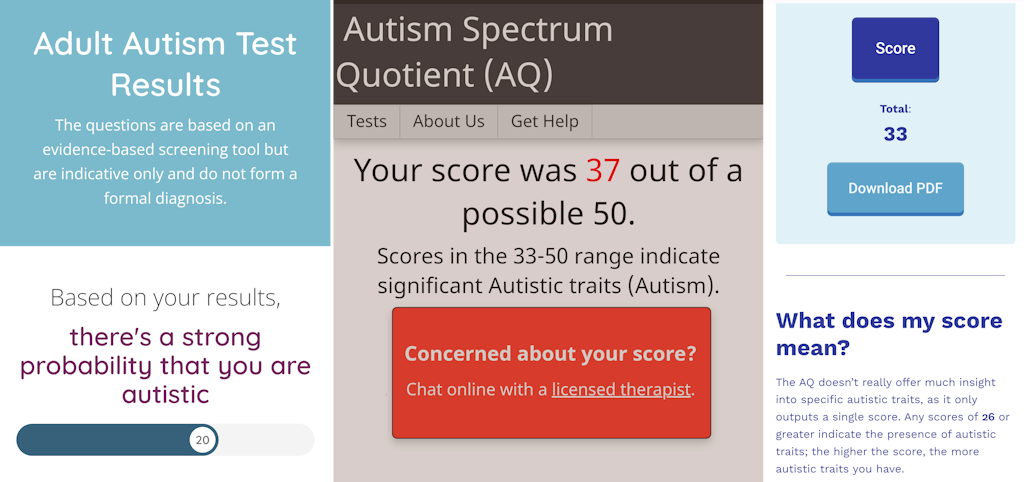
I shared the results with my husband, who calmly replied, “Are you surprised? I always suspected you were somewhere on the spectrum.”
Great. Thanks for sharing, sweetheart.
Now, I’ll be transparent. These were three self-assessments, not the result of an official clinical test by a trained mental health professional. But frankly, I have little interest in being awarded an official certificate. What would be the point? It’s unlikely that would give me an enviable three-letter acronym I could add to my LinkedIn profile. I already have what I wanted: understanding.
I’m a founder, intrapreneur, and former CIO rethinking governance for the one-person business, navigating sole accountability in the age of intelligent machines—informed by plenty of scar tissue. All posts are free, always. Paying supporters keep it that way (and get a full-color PDF of Human Robot Agent plus other monthly extras as a thank-you)—for just one café latte per month.
The three online tests cleared up a few mysteries I’d never been able to resolve.
The autism assessment explains why I couldn’t pass that speed-reading exam I attempted in my twenties. My autistic brain has difficulty maintaining an overview, which is exactly the skill you need when trying to skim through a dense text while developing an understanding of its message.
Being on the spectrum also explains why I hate escape rooms or solving puzzles with someone standing beside me with a stopwatch. The slower processing of information in my mind prevents me from getting anything done within the allotted time box. And the fear of failure sabotages any attempts at analysis and problem-solving.
Autism also explains why family and friends know they must announce any suggestions for social coffees, lunches, and dinners, preferably twenty-four hours in advance. I have difficulty with unexpected change, and I absolutely hate it when someone’s spontaneous idea completely ruins my plans for the day.
I finally understand.
I’m on the spectrum.
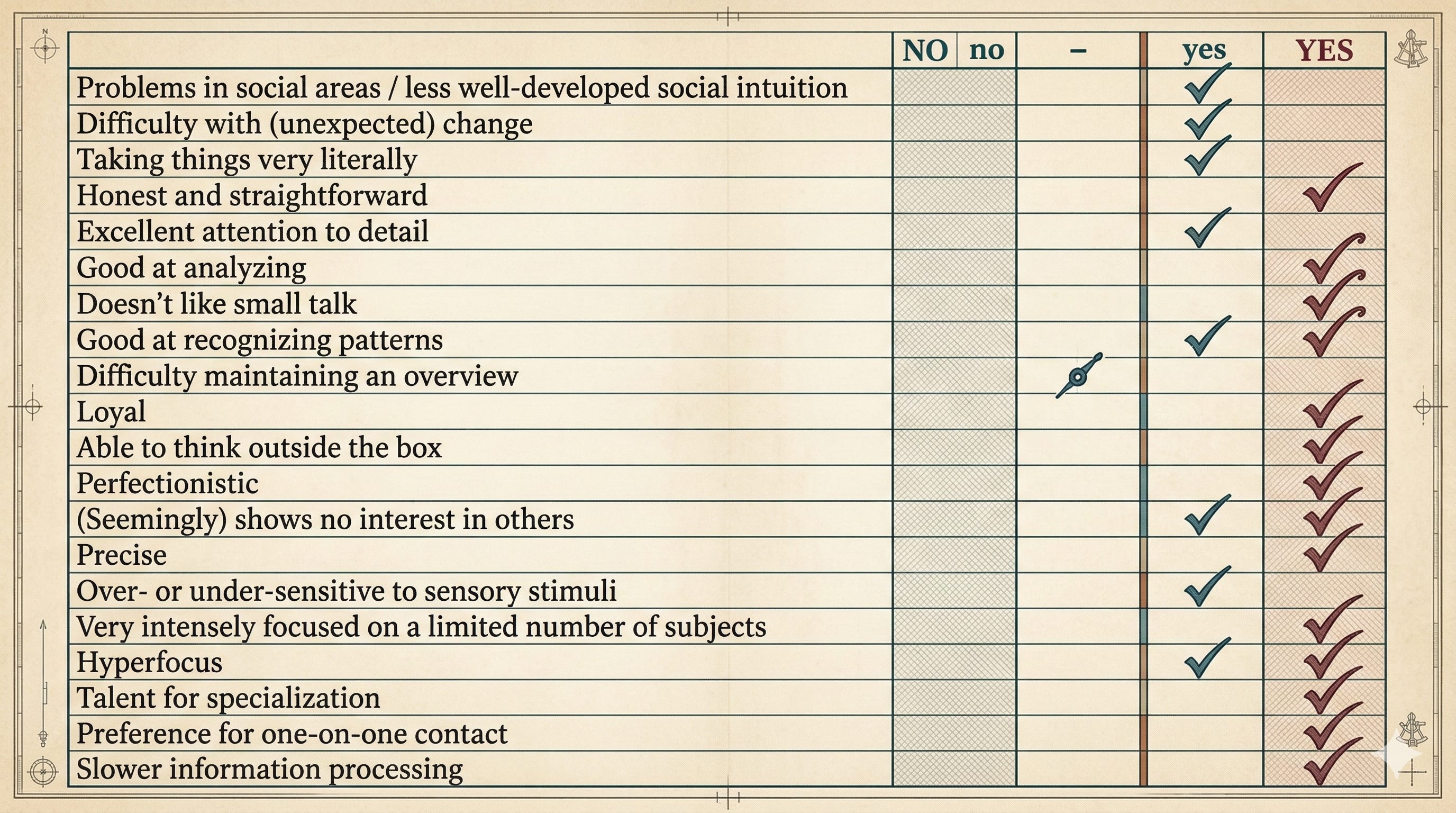
Being on the spectrum saddled me with tremendous opportunities and useful talents, but it also frequently got me into trouble with other humans.
It’s all one package, though.
You can’t have superpowers without the risk of kryptonite.
One of my readers asked me how I’m able to cope with the world. I think it might be the wrong question. The better way to phrase it is, “How can I help the world cope with me and with others like me?”
I’ve already accepted my brain as it is, blessings and curses included—and that’s exactly why I do some of my best work alone, as a Solo Chief. What I can do is let people know what they can expect from me, advantages and dysfunctions included. I’m happy the way I am, and wouldn’t want it any other way.
Acceptance makes everything much easier.
Autism is my superpower and my kryptonite, though I don’t expect anyone to stand in line to make an Avengers movie out of my life. Half of it would show me sitting by myself in a coffee bar, furiously typing away at a keyboard. It’d be a challenge to turn that into a blockbuster film.
Jurgen, Solo Chief
P.S. I couldn’t sell my schoolbooks with those chocolate milk stains in them. But the marks they left on my soul only gave it more color.


I love your post. This post is really personal, and you mention few difficulties and the positive experiences
I think this post can empower many of us who are on the spectrum or caring or living together with kids and adults on the autism spectrum.
Happy to read more sharing about this topic.
I particated in an open space unconference in November with techies. We had every day topics about neurodivesity, burnout, social challenges, toxic leaders, dyslexia etc. It was a super experience how people opened up and tried to listen, help each other.
Beautiful post. Thanks for sharing your story. I respect that you seem to have avoided the shame that some feel when given the label of "autism." I have children on the spectrum, at different levels and capabilities. Thanks for speaking up and normalizing this diagnosis.