

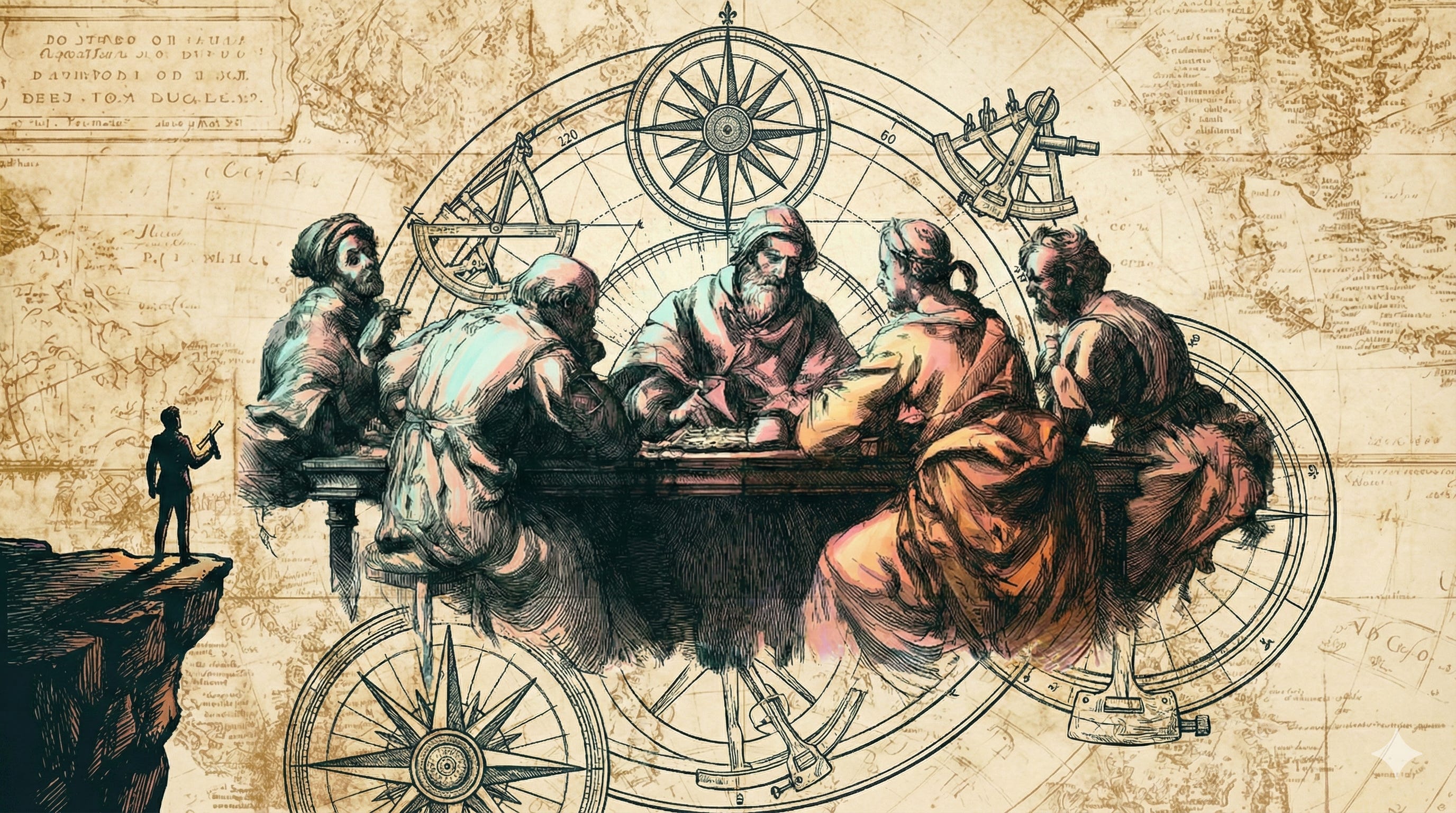
Big consulting is doomed, but advisory work is not.
If you're an advisor, consultant, or board member wondering whether AI just made your role obsolete—it didn't. But it did make the old version of it worthless.
I lobbed a grenade at McKinsey yesterday. Not because I enjoy picking on consultants (though I’ll admit it has its charms), but because they’re the clearest example of a business model that’s entering its death rattle. A model built on vanity metrics, confidence theater, and the kind of intellectual cosplay that passes for strategy when executives can’t be bothered to think for themselves.
Before the pitchforks come out, let me clarify: I’m not saying consulting is dead. I’m not claiming AI will replace human judgment. And I’m certainly not one of those tedious accelerationists who think disruption is inherently virtuous.
The Old Consulting Model Is Finished
What I am saying is this: the specific flavor of consulting that sells scale, abstraction, and PowerPoint charts to leaders too busy (or too scared) to look under the hood is cooked. Done. Finished.
Bragging about “25,000 agents deployed” or “millions of charts produced” tells people nothing about value created, decisions improved, or organizations made more resilient. Any competent systems thinker could have told you this decades ago, but AI is now making the gap between appearance and reality too obvious to ignore.
“The specific flavor of consulting that sells scale, abstraction, and PowerPoint charts to leaders too busy (or too scared) to look under the hood is cooked. Done. Finished.”
But the charade of productivity theater doesn’t spell the end of advisory work. In fact, it does the opposite. As AI takes over analysis, synthesis, and execution at inhuman speed, the weight of responsibility shifts the other way. Someone still has to ask the right questions. Someone still has to decide what actually matters. Someone still has to hold the long-term view when every dashboard is screaming for short-term optimization.
That role isn’t disappearing. It’s crystallizing.
What Advisors Actually Do in the Age of AI
The advisors who survive this transition won’t be valued for how many slides they can crank out, how many frameworks they can recite, or how many juniors and managers they can cut from an organization. They’ll be valued for judgment, ethics, pattern recognition, sense-making, and the willingness to sit with leaders when decisions are genuinely uncomfortable. When there’s no safe answer and the stakes are real.
“Advisors will be valued for judgment, ethics, pattern recognition, sense-making, and the willingness to sit with leaders when decisions are genuinely uncomfortable.”
Advisory work is about to become less industrial and more human. Which is funny given how much energy we’ve spent automating humanity out of everything else.
The Governance Questions AI Can't Answer
This is precisely why I signed up for the Board Program at ScaleUpNation. In a class of about twenty people, we’re going to wrestle with what it actually means to be an advisor, a board member, and a steward in fast-moving, AI-saturated organizations. Not the sanitized LinkedIn version of these roles, but the messy, high-stakes reality.
The questions I hope we’ll be tackling look something like this:
What decisions absolutely must not be delegated to AI?
Where does accountability land when systems, agents, and humans are entangled?
How do advisors add value when knowledge is available 24/7 and synthesis happens in milliseconds?
What does “good governance” even mean when execution is automated and the feedback loops are faster than human cognition?
These aren’t the kinds of questions you can workshop away with sticky notes and a facilitator. They’re structural, philosophical, and uncomfortably real. Which makes them exactly the kind of questions worth sitting with.
I’m a founder, intrapreneur, and former CIO rethinking governance for the one-person business, navigating sole accountability in the age of intelligent machines—informed by plenty of scar tissue. All posts are free, always. Paying supporters keep it that way (and get a full-color PDF of my book Human Robot Agent plus other monthly extras as a thank-you)—for just one café latte per month.
The Future of Consulting Is Human
Advisory work isn’t dying. It’s shedding a costume that never fit right in the first place. The future advisor won’t sell certainty because certainty is a con game in complex systems. Instead, they’ll help leaders navigate uncertainty. They won’t bury teams under mountains of artifacts and deliverables. They’ll help them tackle wicked problems that don’t have neat solutions. They won’t compete with AI because that’s a fool’s errand. They’ll design it, question it, and when necessary, restrain it.
That’s a role worth reinventing. That’s work that matters!
What I’m curious about now is how the advisory role is actually changing, what outdated assumptions we need to unlearn, and what new responsibilities come with advising in a world where intelligence is abundant but wisdom remains stubbornly scarce (as evidenced by the endless stream of non-critical slop on LinkedIn). These are the conversations I want to be having. Not with the old guard clinging to their outdated consulting playbooks, but with people willing to rebuild advisory work from first principles.
Jurgen, Solo Chief


I don't understand how this only has 11 likes.
While the old model for revenue is definitely gone already (even if oil tanker firms are holding on), I do believe the evolution of the hybrid, high value, outcome oriented engagements will rise as the supreme model in Knowledge based work and consulting. Major human skills (empathy, judgement, critical thinking, emotional intelligence) will be even MORE valuable in an AI hybrid world and will remain Evergreen