

Stop Climbing the Agentic Ladder. There Is No Ladder.
Five organizational archetypes reveal where you actually stand on the agentic transformation map—and why maturity ladders are lying to you.
Most discussions about agentic organizations sound like bad self-help books: climb the linear ladder, reach enlightenment, achieve organizational nirvana. But organizations aren’t gyms where more reps equal better results. They’re complex, contradictory beasts that laugh at neat progression models.
To understand what it means for an organization to become truly agentic—capable of integrating AI agents as autonomous workers rather than glorified calculators—we need to dump the ladder metaphor entirely. Real organizational evolution isn’t a linear march toward some promised land. It’s a messy, multidimensional wrestling match with competing tensions and trade-offs.
What we need is a map. By plotting organizational archetypes along fundamental axes, leaders can diagnose their current operational DNA, confront the inevitable contradictions, and chart a path toward agentic capability that doesn’t pretend reality is simpler than it actually is.
What Is an Agentic Organization?
An agentic organization doesn’t just deploy AI tools like chatbots and AI-infused deterministic workflows. It integrates AI agents as meaningful participants in value streams, decision-making, and even governance. These aren’t your garden-variety automation scripts and LLM prompts. They are digital actors that exhibit genuine autonomy, influence outcomes, and interact with humans in ways that feel more like collaboration than task execution.
Most organizations are drowning in automation theater: they deploy AI to make existing processes faster, not fundamentally different. But agentic organizations venture into unexplored territory: they delegate actual authority to machines. They let agents make proposals, manage responsibilities, and initiate changes within defined boundaries. This shift isn’t just technical; it rewrites the social contract of how work actually gets done.
Most organizations are drowning in automation theater: they deploy AI to make existing processes faster, not fundamentally different.
Two Axes: Centralized vs. Decentralized, Structured vs. Emergent
Using my earlier post on tensions in sociotechnical systems, I suggest a map that rests on two dimensions defining organizational DNA:
Coordination (Horizontal Axis): How does work actually happen among people? Ranges from Structured (predefined rules and peer-to-peer agreements dominate interactions) to Emergent (autonomous individuals and teams with rapid feedback loops drive most decisions).
Control (Vertical Axis): Who really makes decisions? Ranges from Centralized (control and authority hoarded at the top) to Decentralized (freedom to experiment spread across roles, teams, or networks).
These dimensions create a 2×2 matrix with four quadrants. Each represents a fundamentally different organizational reality with distinct implications for agentic potential.
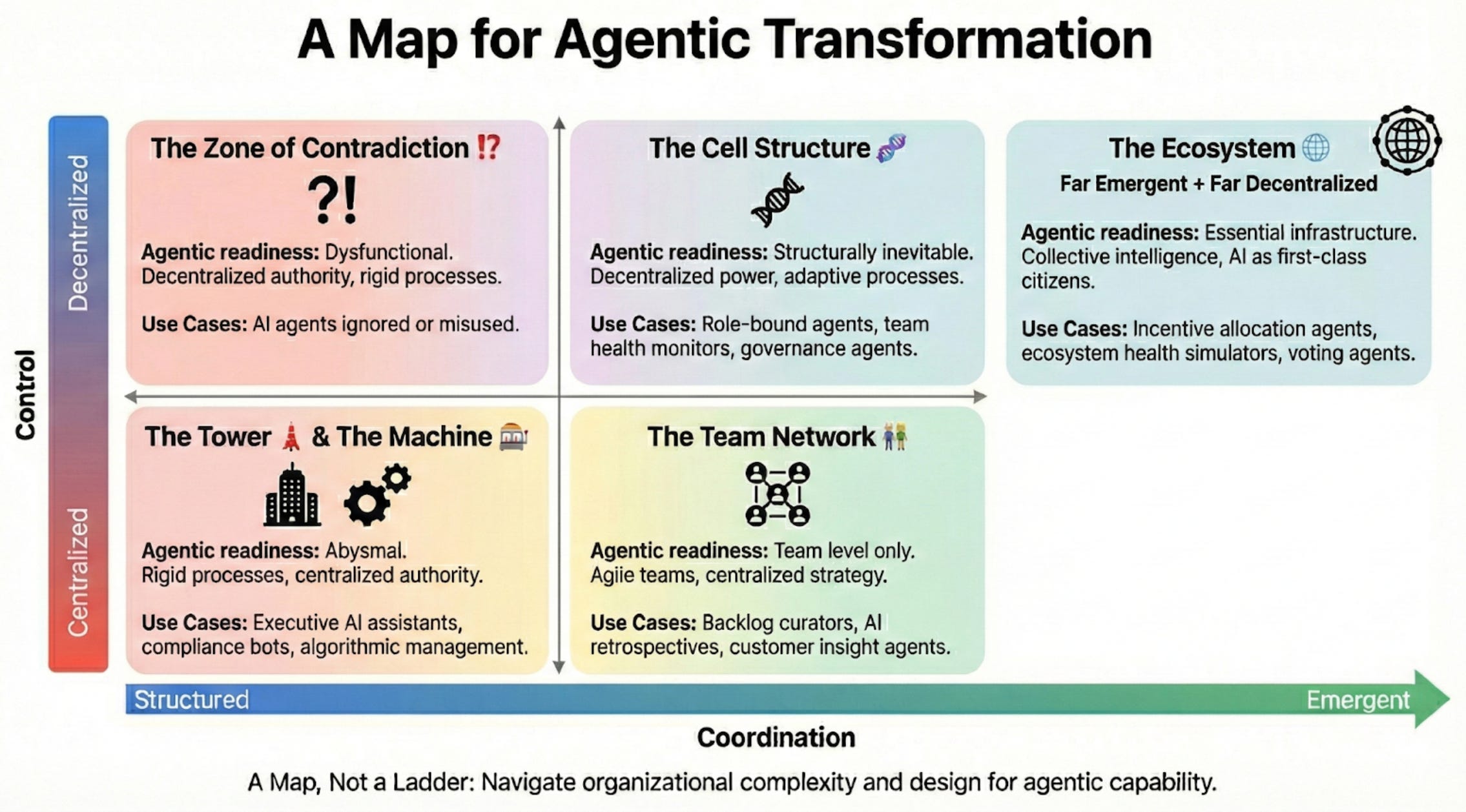
Image: A Map for Agentic Transformation (generated with Nano Banana Pro)
Note: Decentralized ≠ Distributed
Decentralization is about power—who makes decisions. Distribution is about location—where people and systems sit. A globally distributed team can be completely centralized in decision-making. A co-located team can operate with radically decentralized authority. This map tracks power structures, not geography.
Five Organizational Archetypes for Agentic Readiness
The Tower 🗼 & The Machine 🎰
Quadrant: Structured + Centralized
These archetypes dominate the traditional corporate landscape. The Tower worships hierarchical control and top-down decision-making. The Machine obsesses over efficiency, repeatability, and process orthodoxy. Most large organizations are uncomfortable hybrids of both.
Agentic readiness here is predictably abysmal. Rigid processes and centralized authority create a perfect storm of resistance to autonomous execution. Why would a system built on control and predictability welcome agents that “think” for themselves?
Agentic Use Cases: Executive AI assistants that reinforce rather than challenge existing power structures; compliance bots that ensure rules are followed, not questioned; algorithmic management tools that feed the surveillance apparatus without changing its fundamental paradigm.
The Team Network 🧑🤝🧑
Quadrant: Emergent + Centralized
Welcome to the agile enterprise. Teams operate with emergent practices—sprints, retrospectives, feedback loops—but strategy, budgets, and governance remain firmly centralized. It’s mostly decentralization theater: teams can experiment with how they work, but not what they work on or why.
Agentic tools can flourish at the team level but consistently slam into organizational roadblocks. Teams want AI assistants; executives want control dashboards.
Agentic Use Cases: Backlog curators that prioritize work based on real-time user data; AI-powered retrospectives that surface collaboration anti-patterns that human facilitators miss; customer insight agents that translate sentiment into concrete user stories.
The Cell Structure 🧬
Quadrant: Emergent + Decentralized
These organizations have made peace with emergence. Inspired by models like Holacracy and Sociocracy and by companies such as Haier, Buurtzorg and Morning Star, they decentralize power to roles or teams and let processes evolve adaptively. Structure supports responsiveness rather than strangling it.
This is where agentic design stops being a nice-to-have and becomes structurally inevitable. The organization’s DNA already expects autonomous actors. It just hadn’t considered the non-human ones.
Agentic Use Cases: Role-bound agents that manage shared responsibilities without human micromanagement; team health monitors that surface dysfunction before it metastasizes; governance agents that propose structural changes for human ratification.
The Zone of Contradiction ⁉️
Quadrant: Structured + Decentralized
This quadrant shouldn’t exist, but it probably does. Organizations land here when authority gets decentralized but rigid, top-down processes remain untouched. You get bureaucracy without enforcers or peer pressure that emerges to restore some semblance of control.
This isn't an aspirational destination. It's organizational cognitive dissonance made visible.
Agentic Use Cases: Probably dysfunctional. AI agents either get ignored (because no one has clear authority to implement their recommendations) or misused (as tools to enforce prescribed processes that conflict with decentralized authority).
The Ecosystem 🌐
Quadrant: Far Emergent + Far Decentralized
This region of the map represents a philosophical commitment to collective intelligence. Purpose, strategy, and coordination emerge from the interactions of all participants—human and non-human alike. Think AI-operated DAOs, solopreneurs with agentic workforces, and frontier firms operating with pervasive algorithmic management. These are the Networked Agentic Organizations I described in earlier posts.
Agents here aren’t auxiliary tools; they’re essential infrastructure. The organization’s nervous system includes both carbon and silicon-based intelligence as first-class citizens.
Agentic Use Cases: Incentive allocation agents that manage contributor rewards based on emergent value metrics; ecosystem health simulators that model long-term sustainability; agents that hold actual voting rights or initiate protocol changes through governance mechanisms.
Why Hybridity Matters More Than Maturity Models
Let’s be honest. No organization fits squarely in any of these quadrants. Most are messy hybrids that stretch across the map. Understanding your organization’s hybrid position matters more than pretending it neatly fits one quadrant. A coherent agentic strategy starts with brutal self-diagnosis.
The role of agentic systems transforms dramatically across the map:
Tower: Enhance executive efficiency while reinforcing central control
Machine: Enforce prescribed processes and ensure operational compliance
Team Network: Augment team collaboration and accelerate value streams
Cell Structure: Facilitate decentralized operations and support dynamic governance
Ecosystem: Function as foundational, co-governing components of the system
Movement across the map gets driven by tensions that every organization must navigate:
Autonomy vs. Coordination (Individualist ↔️ Collectivist)
Balancing individual freedom with collective needsSpontaneity vs. Discipline (Experimental ↔️ Controlled)
Balancing improvisation with governancePerformance vs. Agility (Optimized ↔️ Adapted)
Balancing excellence with adaptationSelf-actualization vs. Resilience (Flexible ↔️ Coherent)
Balancing individual growth with shared purpose
Agentic transformation is never smooth because these tensions aren’t problems to solve. They’re features to manage. They’re the engine of organizational evolution, and trying to resolve them completely misses the point. The organizations that thrive with agentic systems are those that learn to surf these tensions rather than fight them.
I’m a founder, intrapreneur, and former CIO rethinking governance for the one-person business, navigating sole accountability in the age of intelligent machines—informed by plenty of scar tissue. All posts are free, always. Paying supporters keep it that way (and get a full-color PDF of my book Human Robot Agent plus other monthly extras as a thank-you)—for just one café latte per month.
A Map, Not a Ladder: Beyond Agentic Maturity Models
The framework I offer here represents something more useful than another maturity model: a dynamic map that acknowledges organizational complexity instead of reducing it to a linear progression. It helps leaders and change agents:
Diagnose their organization’s actual structural logic and hybrid contradictions
Identify internal tensions as sources of energy rather than problems to solve
Design realistic steps toward agentic capability that work with constraints, not against them
Becoming an agentic organization isn’t about reaching some final evolutionary stage. It’s about deliberately designing for intelligence, autonomy, and purpose, starting from where you are, with all your beautiful contradictions intact.
This map provides a compass. The terrain—and the route you choose through it—remains entirely yours to navigate.
Jurgen, Solo Chief
P.S. Which quadrant does your organization actually live in? (Hint: if you said just one, you're fooling yourself.)
Let's Start from Scratch: Organizational Design in the Age of AI

It is time we revamp our mental models.

The Agentic Organization

Humans are the bottleneck. Agentic organizations separate AI workflows from human processes, like ring roads that bypass city centers. Dual-lane processes should prevent intellectual traffic jams.