

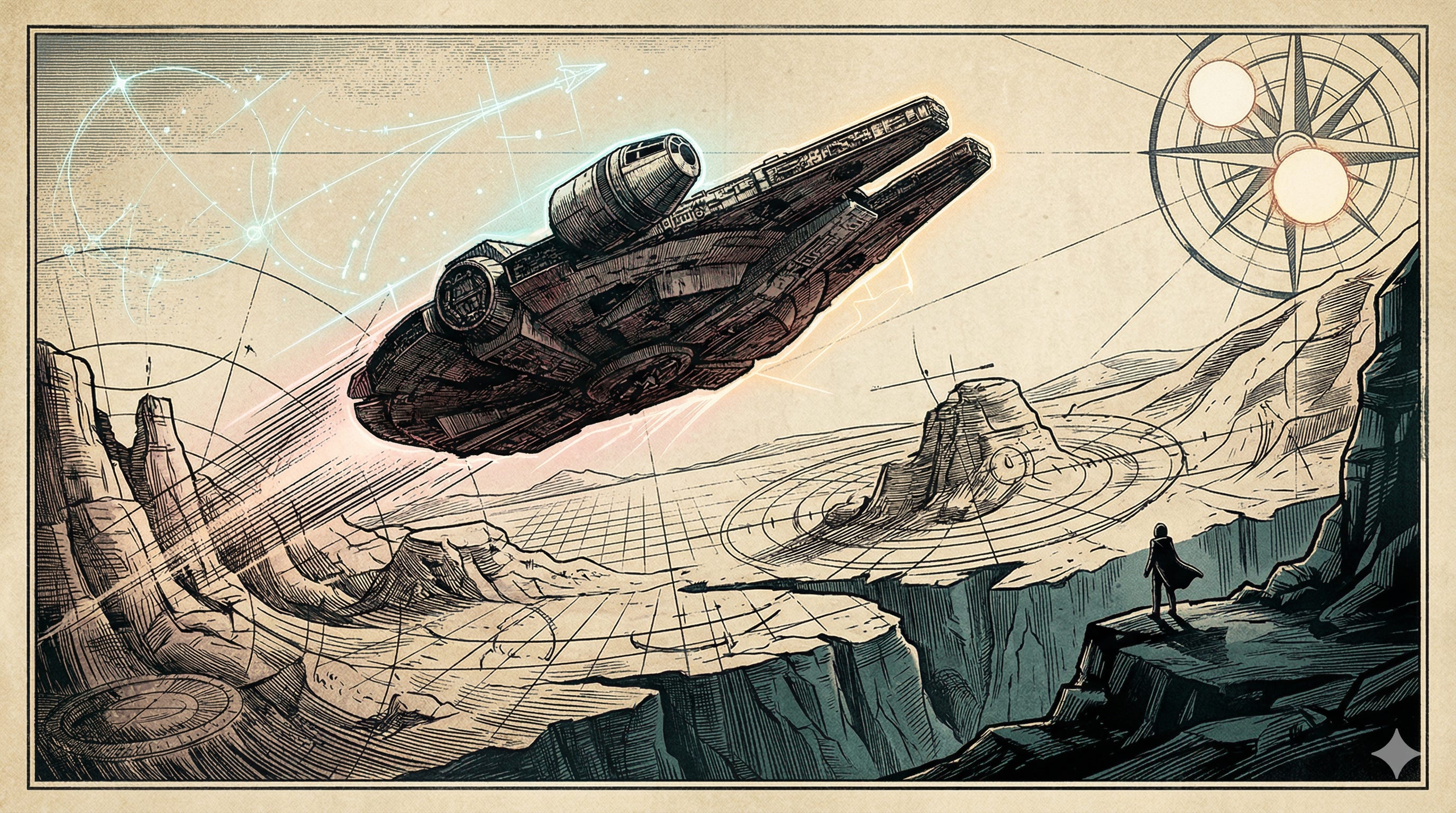
The gap between AI tinkerers and everyone else is closing fast. Your window to claim your own galaxy is now.
While most people chat with bots, a few solopreneurs run autonomous AI agents that operate their businesses 24/7. That capability gap is your temporary window to build something competitors can’t replicate. You have no time to lose.
I’m a founder, intrapreneur, and former CIO rethinking governance for the one-person business, navigating sole accountability in the age of intelligent machines—informed by plenty of scar tissue. All posts are free, always. Paying supporters keep it that way (and get a full-color PDF of my book Human Robot Agent plus other monthly extras as a thank-you)—for just one café latte per month.
Halt!
Stop what you’re doing for a moment.
Actually, I don’t care. Keep scrolling if you want. But 2026 is the kind of moment most people only recognize when it’s already far behind them, and I’d rather not watch you miss it while you’re binge-watching Andor or The Mandalorean.
Right now, a tiny number of solopreneurs and one-person businesses are building their own AI agent orchestration. With real AI agents. Digital assistants that crawl, build, deploy, and run entire business operations 24/7 while their creators walk the dog, watch Skeleton Crew, or cook dinner for friends.
Meanwhile, most people are still asking ChatGPT to write their resumes or generate a slide deck from three bullet points.
That capability gap is temporary. It will close fast. And if you don’t jump to lightspeed now, you’ll spend the rest of your life wondering how you could let such a unique opportunity pass by unnoticed. (As I did by not claiming a hundred domain names in 1995.)
I call this the Hyperdrive Advantage.
My Clunky, Self-Made AI Agent Stack
I’m no expert when it comes to AI agent orchestration. I should probably say that louder. I’M NO EXPERT. But I do spend a lot of time building my own workflows, and I’ve failed at enough of them to have opinions.
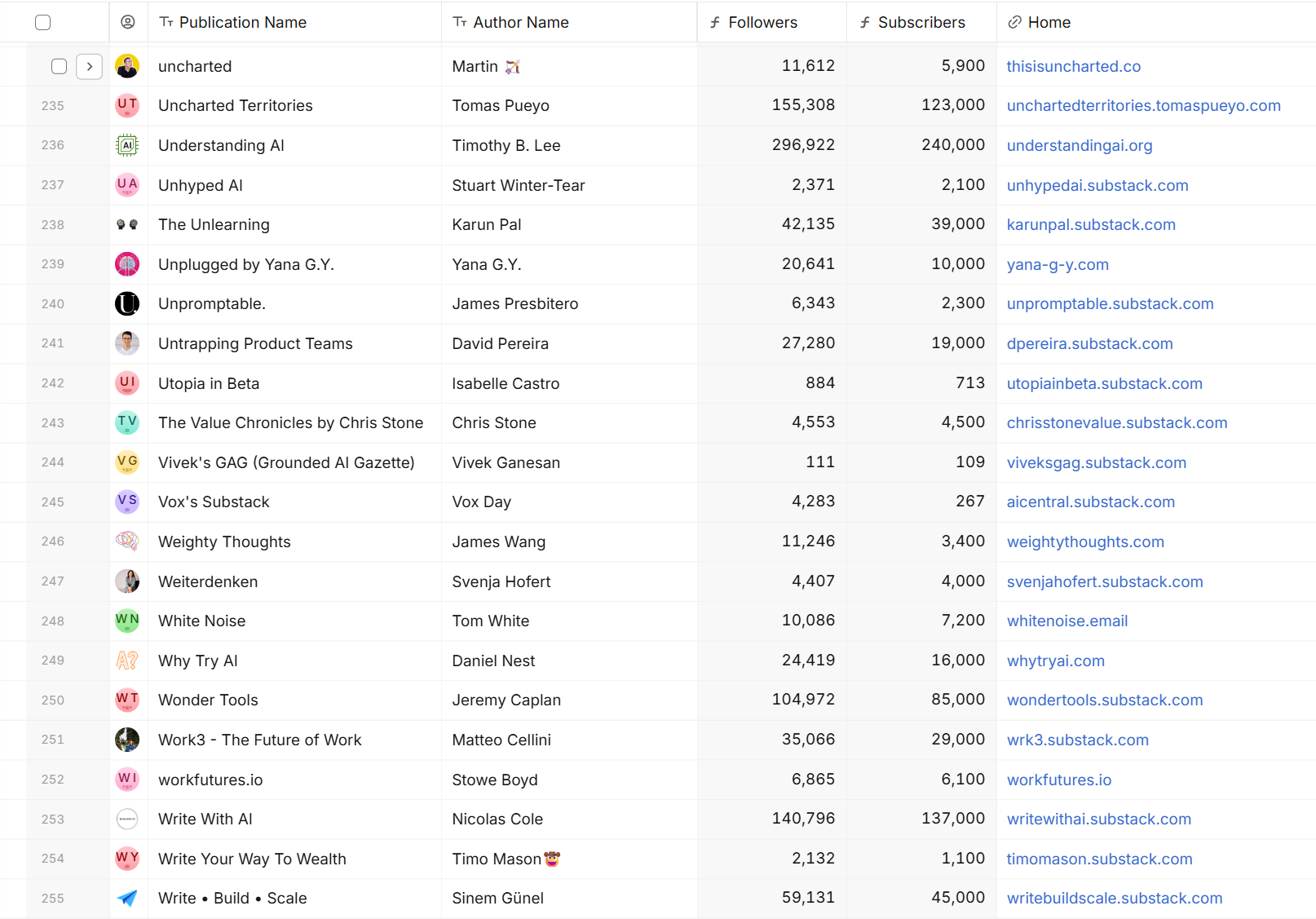
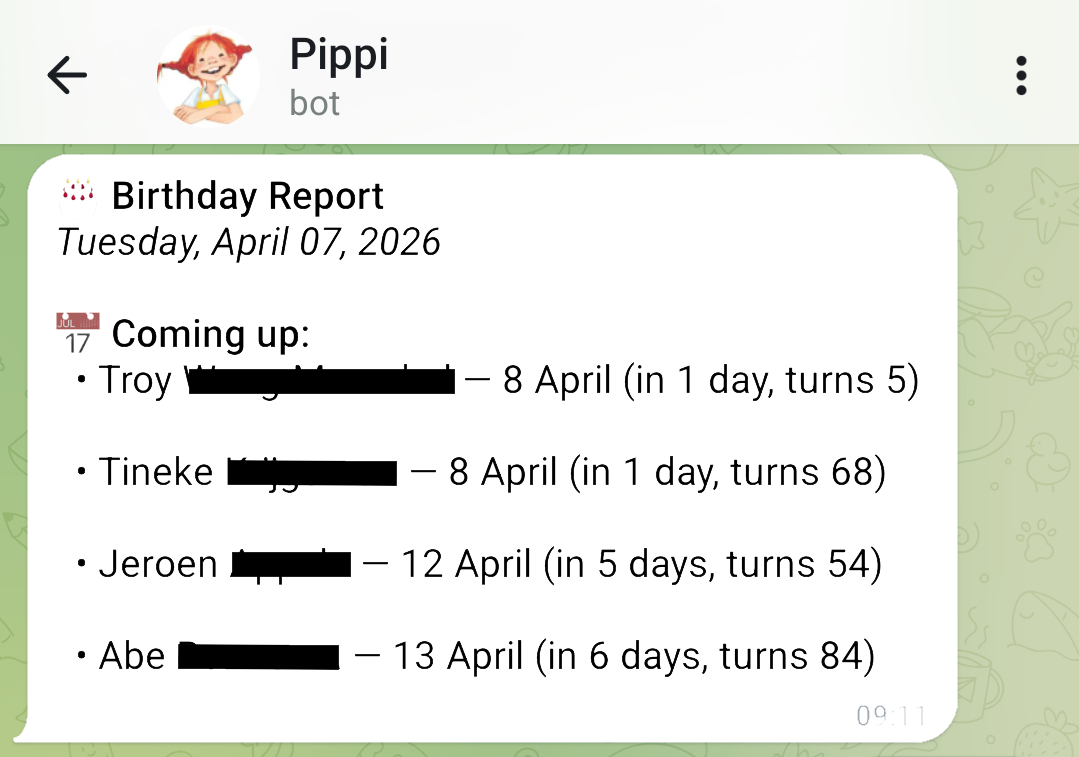
For example, I have an automated workflow keeping track of hundreds of Substack publications and their follower and subscriber counts. I also have several agentic workflows where Claude, ChatGPT, Gemini, and Grok act as an LLM council, offering me different perspectives on a research question or a provocative statement before I turn that into an essay. I even have an agent proactively informing me of the upcoming birthdays of the people closest to me.
Most of the struggle with AI orchestration (in my case) is just dealing with all the edge cases. An external service is down for an hour; I run out of tokens mid-workflow; some input is formatted in an unexpected way. Each time, I reroute the power and improve the workflow. It’s slow going, but rewarding. The scenarios are getting more solid every day.
And then there are the problems that don’t get me any further. They just eat up my time. Claude had a bug in its Cowork architecture that messed things up and held me back for several weeks. Make has a few annoying quirks with arrays that waste my time each time I use them. Last weekend, I ran into a wall with Perplexity: the MCP connectors available in Perplexity Computer are not available in Perplexity Chat, which completely defies the point of using Perplexity as an interface to my agentic workflows. There goes another two hours of work leading to nothing (until they fix this)... 🤷🏻♂️
It’s the pain of living at the frontier of AI agent orchestration. Only half of everything works. The other part is permanently under construction. 🚧 Every day is a struggle with tokens, time-outs, and the ever-present “Something went wrong.”

But I persist. I do not want to wait until turnkey agentic AI orchestration is available for everyone. That’s exactly why I’m doing this now. My clunky, self-made agentic stack is a temporary project because I aim to exploit the Hyperdrive Advantage.
I am a rebel patching my own Millennium Falcon so I can go on adventures before the rest of the universe arrives in their standard X-wings.
Some early mornings, I stare at yet another failed workflow and wonder if I’m wasting my time. Should I just wait for the polished tools like everyone else? Maybe this whole bespoke-AI-stack thing is just me being stubborn? Then I remember: that feeling of doubt is exactly what makes this moment valuable. If it were easy, everyone would already be doing it, and there’d be no advantage left to claim.
The Original Hyperdrive Maneuver
In 1975, George Lucas wanted visual effects nobody had ever seen. The technology didn’t exist. So he rented a warehouse in Van Nuys (a neighborhood in Los Angeles) for $2,300 a month, hired a ragtag crew of college students, artists, and engineers, and called it Industrial Light and Magic. Everything was hand-built, one-of-a-kind, and constantly breaking. John Dykstra, his effects supervisor, admitted it was “a long shot.”
But Lucas didn’t build ILM to sell special effects. He built it to make Star Wars. The tech was the engine; the franchise was the destination. By the time Hollywood figured out what happened, Lucas owned the characters, the merchandise rights, and a fan base that would follow him for decades. His moat was never the effects shop. It was the galaxy he built with it.
That’s a Hyperdrive Maneuver: build clunky, bespoke technology before anyone else can, and use the head start to lock in something permanent.
Jeff Bezos did the same thing in 1994, building online retail infrastructure when “buying things on the internet” sounded as trustworthy as getting medical advice from a stranger in a parking lot. By the time e-commerce tools became cheap and polished, he already owned the customer data, the logistics, and the habits of millions of buyers. The bespoke tech was the ladder. The moat was everything he built while climbing it.
Right now, we’re at that same moment with agentic AI.
Your Agentic AI Advantage
It seems common knowledge that many people are using AI, but only few go as deep as the technology allows. Most are just chatting with a bot. Nothing more. The number of people running their own AI agents (digital workers that autonomously research, create, publish, and operate) is vanishingly small.
That gap between early adopters and everyone else is your window. Every major technology wave had one: electricity, the internet, smartphones. Each time, the people who moved while the tools were still rough ended up owning systems that latecomers could never quite replicate.
Think of it like evolutionary biology. In ecology, when a new habitat opens up (a volcanic island forms, a forest fire clears a valley, an asteroid wipes out the dinosaurs), the species that colonize first don’t necessarily have the best genes. They have the best timing. They radiate into empty niches and establish themselves before competition even arrives. Biologists call this adaptive radiation. I call it what’s happening right now with agentic AI.
Agentic AI is in its Internet-in-the-1990s phase. Clunky, unreliable, confusing to most people, and wildly powerful for the few who bother to make the modifications themselves.
If you have the grit and savviness to wrestle with today’s messy AI orchestration tools, you can pull an Agentic Hyperdrive Maneuver: launch yourself into economic spaces that barely exist yet and establish yourself before the rest of the world shows up. That’s the Agentic Hyperdrive Advantage.
More Than a First-Mover Advantage
You might be thinking: “Isn’t this just first-mover advantage with a Star Wars theme bolted on top?” Fair question. Wrong answer.
The first-mover advantage has a well-known weakness: the fastest-learner advantage. It doesn’t matter who moves first if a smarter competitor can show up later and out-learn you. Google was nowhere near the first search engine. But they learned faster than AltaVista, Lycos, and all the others combined. The first movers’ head start turned out to be worthless because search engines have no customer lock-in. Users switch in less than ten seconds.
The Hyperdrive Advantage works differently. We’re talking about a technology that gives you access to economic systems that were straight-up inaccessible before. New markets. New services. New ways of operating that weren’t economically viable until you wired up your own agents to do the work. This isn’t about bolting a faster engine onto the same kind of vehicle and hoping nobody catches up.
Google could beat AltaVista because they were competing on the same road. George Lucas couldn’t be beaten that way because he wasn’t selling special effects. He used special effects to sell a galaxy. By the time competitors got their own effects shops, Lucas had already built the franchise, the merchandise empire, and the audience. The system was claimed.
That’s the Hyperdrive Advantage: a first-mover advantage large enough that it gives you first access to a vast new space waiting to be claimed by you. You don’t get a head start by building the best technology. You use improvised technology so you can be the first to plant a flag in unexplored terrain.
This is the crucial takeaway: with the Hyperdrive Maneuver, you don’t make infrastructure your moat. Instead, you use temporary infrastructure to make a moat out of data, reputation, or network. You assume the infrastructure is replaceable.
Here’s where it gets lonely, though. When you’re building your own AI orchestration, there’s no manual. No support team. No one to call when the whole thing falls apart at 3am. You are the single wringable neck for your own duct tape-architecture and for the business you’re trying to build on top of it. That double weight is real. And if you’re already building your own agentic stack, you probably feel it too. (If it helps, know that George Lucas apparently threw up from the stress during the filming of Star Wars. So at least we’re in good company.)
Solo Operators Building Their Hyperdrives
We’re still early. So early that the agentic Lucas and agentic Bezos haven’t revealed themselves yet. In the 1990s, nobody could have pointed at a clear winner of the internet either. But the hyperdrives are being assembled right now, in warehouses and home offices, by people operating in the Outer Rim of their industries.
Aaron Sneed runs a defense-tech company, solo. His secret is “The Council”: about 15 custom AI agents acting as functional departments. Legal, Ops, HR, Marketing, Research. They handle continuous work and escalate only the hard decisions to him. One person operating in a market that normally requires a funded team just to clear compliance.
A photo booth entrepreneur (yes, photo booths) orchestrates over 20 AI agents handling inbound messages, quoting, booking, content editing, marketing, and bookkeeping. A traditionally labor-heavy local service, now scaling across multiple regions with a single operator.
Okay, maybe these examples don’t sound impressive to you. But that’s the point. These aren’t billion-dollar empires—yet. They’re just scrappy little spacecraft. But give them some time.
Meanwhile, I’m building my own hyperdrive right now. Soon, I will point it at some faraway systems. Who knows? Maybe I can claim some little moon or asteroid belt for myself.
Build the Moat Before the Fleet Arrives
Your Hyperdrive Advantage is temporary. I can’t say this enough. The clunky tools you’re wrestling with today will be polished, packaged, and sold to everyone within a couple of years, maybe sooner. Your bespoke AI stack will be outdated. That’s fine, as long as you’ve used the head start to build something that outlasts the tech.
Lucas didn’t cling to his improvised motion-control cameras. He used them to lock in Star Wars. You need to do the same: use your heavily customized agentic hyperdrive to accumulate data, reputation, and relationships before the fleet arrives with their standardized models.
Every client you serve, every experiment you run, every failure you recover from compounds into something latecomers can’t buy. Your prompts get sharper. Your domain knowledge gets deeper. Your name becomes the one people associate with solving a specific problem. Investors call this a compounding economic moat. I call it the whole point.
Your moat might be the 500 clients whose workflows you’ve automated. The proprietary dataset your agents have been quietly building for eighteen months. The reputation as the person who cracked a problem before anyone else even understood the question. It doesn’t matter that you did all of that with a hand-modified, cobbled-together, famously unreliable hyperdrive. You use your clunky tech stack to turn yourself from a rebel into the ruler of your own galaxy far, far away.
Soon, everyone will have their own turnkey, off-the-shelf, X-wing style hyperdrives. Manufacturers will churn out AI orchestration stacks that beat anything you can build yourself. Heck, you might even swap out your own agentic AI orchestration for the new technologies that come onto the market. That’s perfectly fine. You’ve already built your moat. You already rule a system, maybe even an entire galaxy. You took advantage of the Hyperdrive Maneuver.
Your Falcon Is Waiting
And here’s why this moment favors you, the solo operator: while large organizations are stuck in committee meetings debating their AI strategy (and convening sub-committees to evaluate the committee’s recommendations), you’re already patching your Falcon and jumping to lightspeed. No procurement process. No risk assessment framework. No six-month pilot program. You tinker, ship, blow things up, and fix them before their Imperial Senate has even scheduled the next session.
Speed is the solopreneur’s superpower right now. Not capital, not headcount, not brand recognition. Speed. The ability to try something at 10am, watch it fail by noon, fix it by 3pm, and have it running by dinner. Large organizations can’t do this. They have too many layers, too many stakeholders, too many people whose job it is to say, “Let’s discuss this in our upcoming PI planning next month.”
⚠️ And sorry to burst a few bubbles, but Substack subscriptions and self-paced courses on “how to make your own hyperdrive” are not what I mean here. Make-money-online schemes don’t count. Selling hyperdrive manuals and leaving the exploration to the actual rebels does not make you the ruler of your own faraway galaxy. ⚠️
If you’re sitting there thinking, “But I’m not technical enough for this,” remember: neither was George Lucas. He found a handful of film-school dropouts, hobbyist engineers, and other misfits who were crazy enough to try. They figured it out as they went. Like the Millennium Falcon, your AI orchestration stack will be held together with improvisation and determination, not engineering degrees.
The speed gap won’t last long.
Use it wisely.
Jurgen, Solo Chief.
P.S. What does your clunky Millennium Falcon look like right now? Tell me about your stack!
The Sleepy Agent Boss

Most AI agent content is about building AI agents. That’s not a business, it’s a pyramid scheme.
Which AI Should I Use? A Guide for Solopreneurs (2026)

Benchmark scores won’t tell you which AI to use. Your personality will.

The clunky early stack point is something I think about a lot. My setup has about 40 shell scripts, 3 Python watchers, and a folder structure that made sense 6 months ago but is now held together with duct tape. None of it is pretty. All of it runs.
The Make quirks you mention - I hit the same kind of friction with cron job sequencing. Took 3 weeks to get reliable execution order. But the agent is now doing work I'd otherwise skip entirely. The data and reputation moat argument is more compelling to me than the technology moat.
The tools will commoditize. What compounds is the operating knowledge of what actually works at your specific scale.