

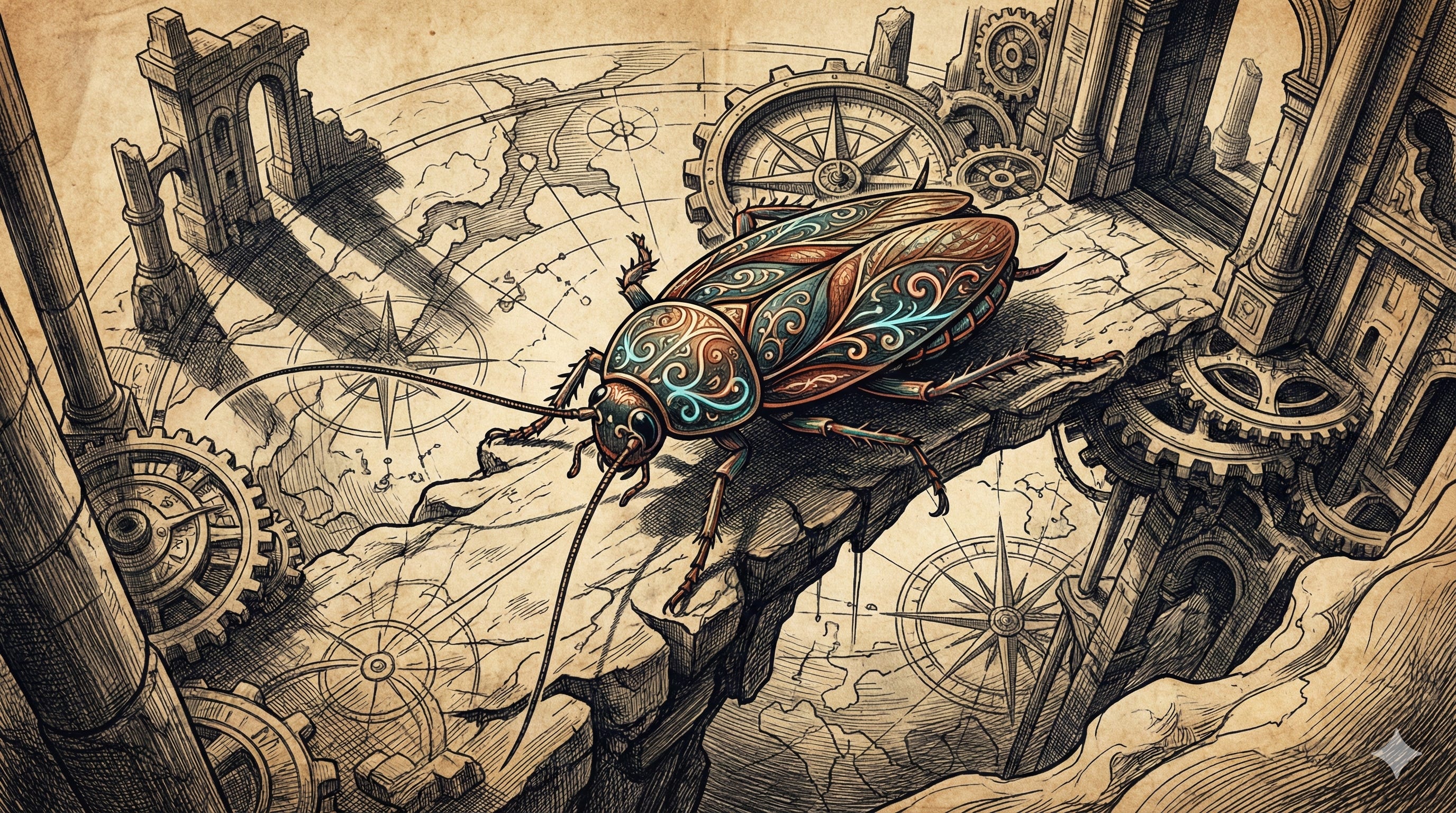
“I want to have a cockroach business.” 🪳🪳🪳
The agility versus viability comparison exposes a critical blind spot: agile methods optimize for short-term value, not long-term survival.
I’m having fascinating conversations this week with solopreneurs, founders, intrapreneurs and other lone managers to better understand their concerns in the age of AI. And there was one thing Peter Bell told me that blew me away.
“I want to have a cockroach business. The kind that’s going to survive any nuclear winters that may come up.”
A cockroach business! 🪳🪳🪳
Surviving and thriving, no matter what happens.
The Viability vs Agility Blind Spot
Yes, it’s become a tired cliché to say that the future of work has never looked so uncertain. I mean, just look at the rate of innovation in the world of AI and you see that technostress and FOBO (Fear Of Becoming Obsolete) are consuming anyone trying to keep their business running.
Just when you’re deciding between Claude Code and Google Antigravity, suddenly Claude Cowork is dominating the conversation. But you barely have time to watch YouTube videos about it because Clawd Bot has already conquered the memespace. For now. Probably until next week. Because, guaranteed, there will be yet another AI technology making waves.
We can safely say that agility, speed of innovation, and “responding to change” have become inescapable in 2026. It’s suffocating us.
So what now?
I believe I have the answer.
From Agility to Viability: Short-Term Focus Fails
I’ve written before that agile methods and frameworks have a dangerous blind spot. They optimize for the present, not the future. They shorten feedback cycles and accelerate the rate of value delivered to customers. Great. But the widespread adoption of AI technologies has revealed that when you replace junior workers with large language models, you can move faster, at lower costs, and deliver more value to stakeholders. Better, faster, cheaper! The fantasy of every lean and agile consultant. Who doesn’t want that?
But disrupting the careers of junior workers, and by extension, your future talent funnel, is not in the interest of the company. It’s a short-term gain masking a long-term loss. And no agile framework truly addresses this risk.
It’s a short-term gain masking a long-term loss.
Or consider the vibe coding tools that are dominating the discourse these days. Claude Code, Codex, Lovable, Cursor, Replit, Bolt, Base44, you name it. There’s no end to the list of platforms that enable you to generate a tsunami of code in no time, with tireless AI agents that plan, check, and verify the prototype apps and websites they produce in just minutes. It’s agility on steroids!
But what about Sturgeon’s Law, which says that 90% of everything is crap? In the case of vibe-coded software architectures, this percentage is probably conservative. Who is going to fix and maintain all that garbage in the future?
The most critical blind spot of agility is perhaps the question, “When should we not be agile? When do we choose not to respond to change?” The constant technostress and fear of becoming irrelevant is burning through our time and mindspace. Simply trying to keep up in the world of AI can drive the average professional insane. Not every signal in the environment deserves processing. Not everything deserves a response.
When should we not be agile? When do we choose not to respond to change?
There is value in not being an explorer or pioneer. Sometimes, it’s perfectly fine to wait strategically until the dust has settled and we migrate to a new technological terrain later. The term agility captures our need to respond, but it doesn’t capture our need to ignore.
But the word viability does.
Here’s what Perplexity says about the difference:
Key differences between Agility and Viability
Agility is about how quickly and effectively a system can change; viability is about whether that system can continue to exist as a coherent entity over time.
Agility: The ability of an organization to rapidly adapt its strategies, structures, and operations in response to changes in its environment, customers, or technology, while staying productive and competitive.
Viability: The ability of a system or business to survive and sustain itself over the long term, preserving its identity while remaining financially and operationally sound in a changing environment.
Focus:
Agility focuses on speed, flexibility, and responsiveness to change in the short-to-medium term.
Viability focuses on continued existence, resilience, and long-term sustainability (including financial, structural, and ecological aspects).
Time horizon:
Agility emphasizes near-term adaptation and iterative change.
Viability emphasizes endurance across many adaptations and shocks.
Scope:
Agility is usually discussed at the level of ways of working, organizational design, and decision-making practices.
Viability encompasses the whole system, including financial health, identity, and structural capacity to regulate itself.
Agility is a necessary aspect of viability in turbulent environments, but viability is the larger concept that also requires structural coherence, identity, and resourcing.
So you can coherently say: agility is one of the capacities required for viability, but viability is the broader property of being able to survive and maintain identity over time.
I’m a founder, intrapreneur, and former CIO rethinking governance for the one-person business, navigating sole accountability in the age of intelligent machines—informed by plenty of scar tissue. All posts are free, always. Paying supporters keep it that way (and get a full-color PDF of my book Human Robot Agent plus other monthly extras as a thank-you)—for just one café latte per month.
It’s Time We Aim for Viability, Not Only Agility
I loved Peter Bell’s comment, “I want to have a cockroach business.”
As solopreneurs, founders, intrapreneurs and accountable leaders, we want our business to survive and thrive in an ever-accelerating environment. Yes, we need to respond to change where it’s relevant. Everything the agile movement has taught us remains valuable today. But in an increasingly uncertain market, we should be wary of prioritizing short-term wins over long-term losses. We’re not interested in change for the sake of change. We cannot respond to every signal all the time.
To be honest, I don’t expect the term “cockroach business” to catch on or win any marketing awards. At least, I hope not. I prefer to talk about viable businesses (in the sense of Stafford Beer’s Viable System Model).
We need agility as a component of viability.
With agility, we aim for acceleration. Because, even in 2026, many organizations remain painfully slow.
With viability, we aim for calibration. Because, in 2026 and beyond, nobody wants to accelerate themselves to death.
Training the next kind of board member
Scale-ups need board members who can diagnose reality, ask the right questions, and support founders through messy growth transitions.
This is exactly what the ScaleUpBoard Program is built for.
ScaleUpBoard is an in-person program in Amsterdam for experienced entrepreneurs, advisors, investors, and board members who want to become more effective in scaling companies.
It’s grounded in:
Research on 500,000+ ventures
Hands-on work with 125+ scale-ups
A clear focus on companies growing towards €50–100M in revenue
Across 5 highly experiential days, participants work on real board challenges:
Diagnosing a scale-up’s position and next growth leap
Supporting founders without taking over
Managing VC dynamics and boardroom tension
Anticipating conflicts and blind spots
Turning board meetings from “judgment day” into collective creativity
Class 22 starts on February 5th and convenes on location in Amsterdam.
I’m still happy to discuss agility, but only as part of the larger concern of viability.
Jurgen, Solo Chief
P.S. Is your business agile or viable, or both?
The Sassy AI Glossary for 2026

Trying to keep up with the future of work means understanding what the industry is talking about. And lately, the industry has been talking a lot.
AI Wrecks the Corporate Career Ladder. Give Juniors the Steering Wheel!

Corporate apprenticeship is dead in the age of AI.

"Agility is a necessary aspect in turbulent environments." Well, except if you think of a big ship able to navigate through turbulent waters. In that case, it's size and stability, more than agility, that enables it to handle the turbulence. Indeed, more pivoting in such an environment can be destabilizing.