

Joel Salinas is a humanitarian and business leader born in Bolivia, now working at the intersection of AI and leadership strategy. He is the founder of Leadership in Change, a Substack newsletter dedicated to helping leaders worldwide thrive in the age of AI — no hype, just practical frameworks you can use starting Monday morning. In the post below, he shares the details behind his AI tool stack.
TL;DR: The best AI stack for solopreneurs depends less on which tools you choose and more on how well you know your own strengths and weaknesses. A leader who understands how their brain actually works can match tools to how they think, building what amounts to a mirror of themselves rather than a copy of someone else’s setup.

Is AI working as a prism for you, expanding the reach of your efforts? It should.
Two solopreneurs walk into 2026 with the same three AI tools. Same subscriptions, same access, same tutorials bookmarked. Six months later, one of them is running a smoother operation than they have ever had. The other is drowning in half-configured dashboards, abandoned automations, and a growing suspicion that AI is just expensive noise.
What separates them has nothing to do with the tools.
I didn’t figure that out from reading about it, I figured it out by switching tools myself and watching what actually changed. (I help leaders build exactly this kind of self-aware AI setup in my coaching practice.)
In this post, you’ll learn:
Why tool-hopping is a symptom, not a strategy
How I matched three specific tools to how my brain actually works
The three questions that should determine your AI stack before you sign up for anything new
The Tool-Hopper
You know this person, or… maybe you’ve been this person.
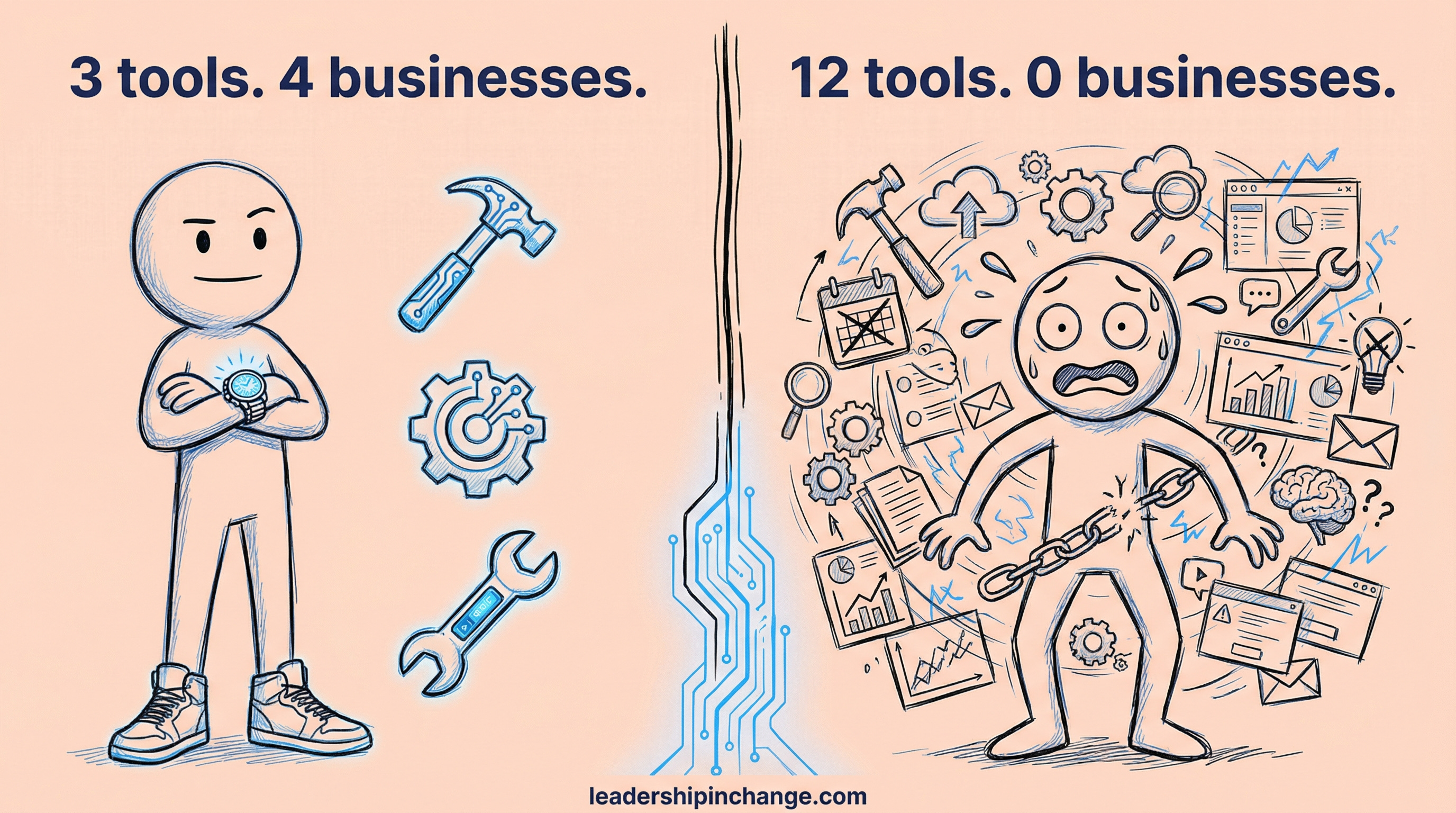
They follow every “my AI workflow” post on Substack and sign up for the new tool the week it launches. Look, their setup is impressive: Claude, ChatGPT, Gemini, Perplexity, Copilot, and three automation platforms, each doing roughly 10% of what it could. It looks great in a screenshot, but in practice, they spend more time configuring workflows than doing the work those workflows were supposed to handle.
Jurgen Appelo nailed this in his piece on technostress and FOBO, the fear of better options. The tool-hopper lives in FOBO. They are always one tool away from the breakthrough, and the breakthrough never comes, because the problem was never the tool.
What I Actually Use
I run four businesses: Leadership in Change (a Substack newsletter on AI leadership), Cozora (an AI education platform with live weekly sessions), Newsletter Compass (a growth tool for newsletter creators), and a coaching and AI build practice at jsalinas.org. My entire AI stack is three tools.
Claude is my thinking partner.
I don’t use it the way most people describe. I don’t ask “what should I do?” I dump seven paragraphs of raw thinking into a conversation and say, “What other approaches exist here? What am I missing? How does this connect to what you already know about my audience?” This works because I’ve invested the time to build the context. I maintain 10 to 12 page skill documents for each of my businesses inside Claude. When I mention Leadership in Change, it pulls the right document automatically and has the full picture: my voice, my audience, my strategy, my constraints. Claude is also my copy editor. I write rough, fast, and big, and Claude helps me refine without flattening.
Gemini generates my images.
Claude creates an on-brand prompt based on my visual guidelines, and I feed that prompt to Gemini for generation. Two tools collaborating on one output, each doing what it does best.
NotebookLM is my research layer.
Here’s the thing: before I go deep into any business decision or article, I load my sources into NotebookLM first and ask questions against those specific documents. This nearly eliminates hallucinations, which matters enormously when the research feeds business decisions, not just blog posts.
Three tools. Each one matched to a specific gap or strength in how my brain works.
Why This Stack Works for Me (and Probably Won’t Work for You)
Here is what I want to be direct about: there is no magic AI stack. Just like there is no magic prompt, no magic business strategy, and no magic Substack note that will make you go viral.
A leader with unexamined flaws is just going to be a leader with unexamined flaws who now also has AI. But a leader who knows their strengths can use AI to amplify them, and a leader who knows their flaws can use AI to compensate for them strategically.
I am not great with details. I think in big connected ideas, and I like to collaborate, to go back and forth, to refine through conversation. Claude is built for exactly that kind of brain. I spent a full year inside ChatGPT before I realized it was the wrong fit for how my brain works. That year wasn’t wasted; it taught me what I actually needed, but it was a year of building in the wrong tool. When I tried Claude, its project system and skill documents matched how I actually think and collaborate. I didn’t switch because Claude was “better.” I switched because Claude was better for me.
The tool-hopper copies someone else’s stack and wonders why the results feel hollow. The self-aware solopreneur builds what I think of as a Mirror Stack, an AI setup that reflects how their specific brain works, not a screenshot of someone else’s workflow.
Three Questions Before Your Next Tool
Before you evaluate another AI tool, before you read another “my perfect workflow” post, answer these honestly:
What am I genuinely bad at? Not “what do I wish I were better at.” What actually falls through the cracks, consistently, when nobody is watching?
What kind of thinking do I do best? Collaboration? Deep solo focus? Visual processing? Verbal reasoning? Big picture strategy? Granular detail?
When I’m doing my best work, what does the process actually look like? Fast and messy, then refined? Slow and methodical from the start? Conversational and iterative?
Your answers should determine your stack. Not a Substack post. Not a YouTube tutorial. Not mine.
If You Only Remember This
The gap between two solopreneurs using the same AI tools is self-awareness, not software. The tools are commodities. Knowing your own brain is the competitive advantage.
Go deep into one tool before you touch another. Breadth feels productive but produces shallow, fragile systems. Depth compounds.
Build a Mirror Stack, not a borrowed one. Match every tool to a specific strength you want to amplify or a specific flaw you need to cover. If you can’t name which one, you don’t need that tool yet.
What’s the one thing you’re genuinely bad at that you haven’t matched a tool to yet? I’d love to hear it in the comments.
Joel Salinas is an AI leadership coach and strategist who writes Leadership in Change on Substack and helps leaders build AI-aware practices at jsalinas.org.

Thanks for the opportunity, Jurgen!
Four businesses means four sets of repeatable workflows, and the coordination overhead across them is where solo operators usually lose time they never track. The tool choices matter less than the connective tissue between them. I write about AI automation for solopreneurs on my Substack and help people build the systems that link their stack together. What is the biggest workflow you are still doing manually across those four?