

Layoffs make headlines. The explosion of solo businesses doesn’t. Both are the same trend.
Widesizing means AI lets one capable person do what once took a team. The economy isn’t shrinking; it’s fragmenting into smaller, scrappier units.
Large tech companies shed people with the same solemn theater used for royal funerals, and half the internet reacts as if paid work itself just fell off a cliff.
Yes, Block cuts jobs. Oracle cuts jobs. Amazon cuts jobs. Every week another CEO waves some consultancy’s AI slide deck around and calls it their new strategy playbook. Then the alarmists rush in: “Human jobs are finished when corporations need only one-tenth the staff. We need a revolt!”
Slow down, everyone.
Widesizing: The Thing Nobody Talks About While Staring at Layoffs
Headcount inside giant firms is only one place where work shows up. If one company has 100,000 employees, or 1,000 firms have 100 each, or 100,000 solo operators each carry their own little shop, you still have 100,000 people making a living. The shape changes. The payroll department changes. The org chart gets set on fire. Work itself keeps evolving. And let’s not forget that the enterprise itself is a fairly recent invention. The East India Company got its charter in 1600. Before that, humans organized work perfectly well for millennia without an HR department or a Microsoft subscription. The corporation might not last forever either.
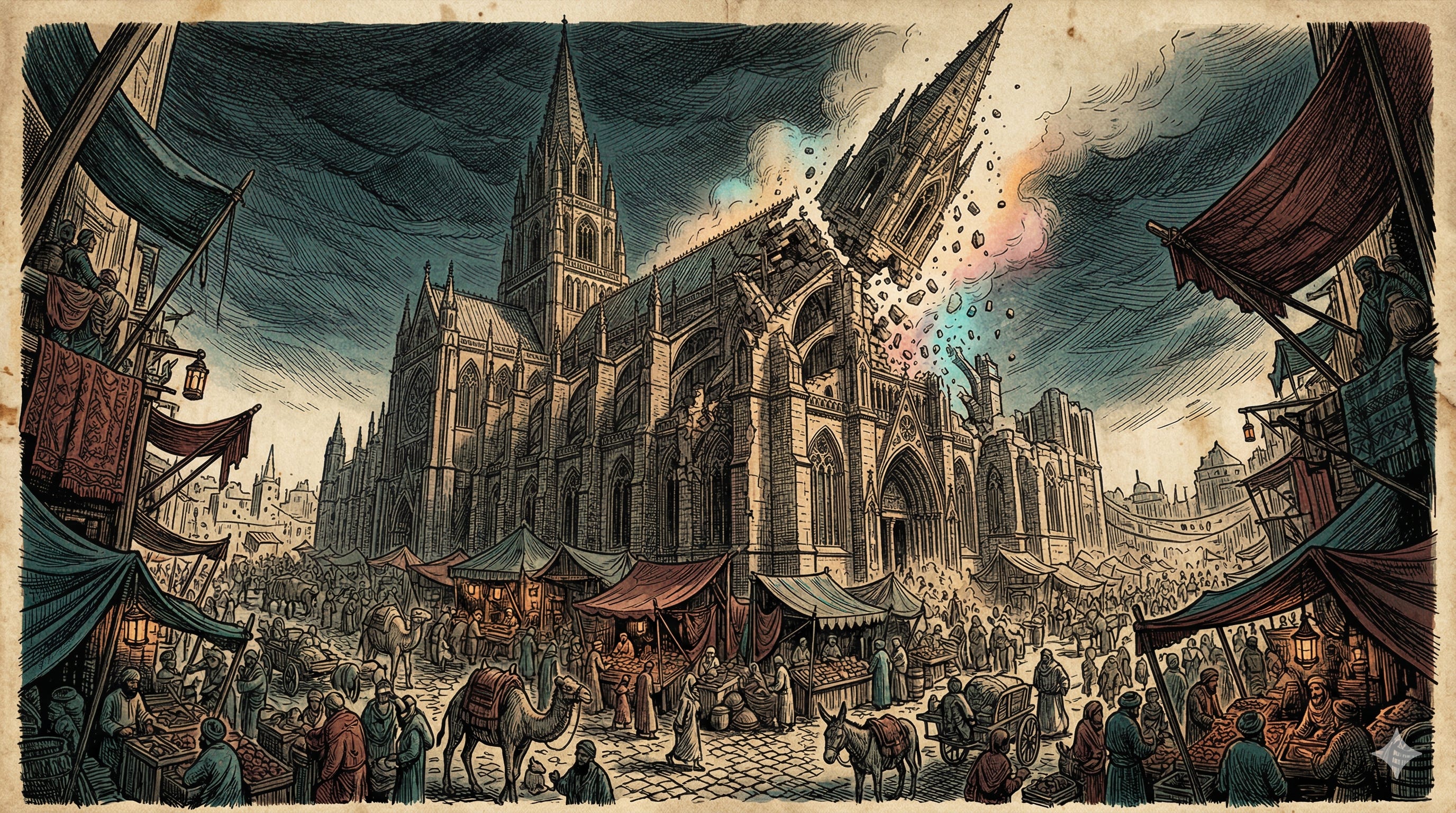
That’s why I have little patience for the usual AI doom-chanting. Negativity bias makes people stare at downsizing and completely miss what I’d call widesizing. They see layoffs at the cathedral and ignore the bazaar springing up outside.
Widesizing Is Already Happening
And the bazaar is real. Around the world, millions of new business applications are being filed each year, and much of the jump comes from non-employer firms. Solo businesses. Tiny outfits. One-person agencies. People who used to need a coordinator, analyst, copywriter, junior assistant, and a corporate permission slip can now do the work themselves with software and stubbornness.
That matters.
Widesizing means AI lowers the minimum viable size of a business. A lot of economic activity that once demanded a team can now be handled by one capable person with a laptop, a few subscriptions, and a mild allergy to bureaucracy. Schumpeter would recognize the pattern immediately. Creative destruction is messy because the old machine breaks in public and on the news, while the new machine starts in coffee bars, spare bedrooms, and WhatsApp groups. Nobody writes a headline about someone quietly launching a profitable consultancy from their kitchen table. But multiply that by a few million and you’ve got a trend that dwarfs any single round of layoffs at Meta.
“Widesizing means AI lowers the minimum viable size of a business.”
I’m sympathetic to that world because I’ve lived in it. Actually, no, I’ve failed in it. Repeatedly. I’ve had big ideas, shiny diagrams, brave talk, and the confidence that should come with adult supervision. Some bets worked. Some face-planted so hard they left a crater. (My attempts at building online platforms deserve their own postmortem, which I’ll write once the emotional wounds heal.) So when I say smaller units can win, I’m not selling a fantasy of heroic founders sipping espresso while AI does the laundry. I’m saying the center of gravity is shifting, and widesizing is the word nobody’s using for it yet.
But Let’s Not Get Romantic About It
The cheerful “everyone can become a solopreneur now” crowd skips over the ugly bits. A steady salary bundles income, benefits, training, legal cover, a bit of status, and someone else to absorb economic shocks. Solo work bundles freedom with risk, cash-flow swings, admin sludge, and that charming moment when a client pays three months late while your mortgage remains weirdly punctual.
And AI can punch solopreneurs in the face too.
The Upwork data after ChatGPT’s earlier releases showed freelance writers and designers getting fewer jobs and lower earnings. That’s a real warning. When AI turns entry-level output into a commodity, clients don’t automatically spread the money across thousands of independents. Often they keep the savings and ask one person to do the work of four. Sometimes they do it themselves badly (which is its own small revenge, but cold comfort if you’re the one who lost the gig).
Then there’s the platform trap. Ask the graveyard of “AI wrapper” founders who built neat little products on top of Claude and got screwed when Anthropic announced native features that swallowed their businesses before lunch. Courage didn’t save them. Neither did imagination. Building on someone else’s castle grounds means the landlord can move the fence whenever they feel like it. This is something Joel Spolsky warned about over two decades ago, and it’s still true: don’t build your house on a platform that doesn’t love you back.
And no, some parts of the economy won’t fragment into cheerful little hobbit businesses. Chip fabs, frontier models, biotech labs, cloud infrastructure, defense contracts, power grids. You’re unlikely to go solo with a semiconductor plant. Some layers stay huge because physics, capital, regulation, and plain stubborn reality demand concentration. TSMC isn’t about to be disrupted by some guy in a garage with a 3D printer.
The Barbell Economy, Not the Cliff
So where does that leave us?
We will have a split future, which is less cinematic than “AI will destroy everything” and more useful than “everyone should just learn to code.”
A small number of firms will get bigger because AI rewards scale in data, distribution, and compute. Think barbell strategy applied to the whole economy. Countless tiny firms will also appear because AI slashes coordination costs and expands what one skilled person can deliver. Both things can happen at once. In fact, they already do. The middle is the dangerous place, the comfortable mid-sized company that’s too big to be nimble and too small to compete on raw infrastructure.
That’s the part the doom merchants and the techno-messianists both mangle.
The alarmists talk as if every layoff is a one-way ticket to irrelevance. The evangelists chirp as if everyone can turn a pink slip into a thriving solo practice before the weekend. Rubbish. Some people will get crushed. Some will do better than they ever did inside a large company. A lot will bounce between contracts, products, part-time roles, and experiments while the market sorts out what humans are still best at and what buyers still value.
Nobody knows how this shakes out. Anyone who tells you they do is selling something. (Probably a course.)
I’m a founder, intrapreneur, and former CIO rethinking governance for the one-person business, navigating sole accountability in the age of intelligent machines—informed by plenty of scar tissue. All posts are free, always. Paying supporters keep it that way (and get a full-color PDF of my book Human Robot Agent plus other monthly extras as a thank-you)—for just one café latte per month.
So What’s the Useful Question?
I wouldn’t ask whether AI will wipe out jobs. That question is too blunt, like asking whether “transportation” will kill the horse. (It did kill the horse-as-transport. It didn’t kill the horse.) I’d ask who gets to shape the next layer of work: giant firms, tiny firms, or people who can switch between both without waiting for permission.
I think that last group has the best shot.
The old deal was simple. Join the enterprise. Climb the ladder. Hope the machine loves you back. The new deal is harsher but more honest. Build a portfolio of skills that don’t evaporate when the next model drops. Own your distribution (your reputation, your network, your ability to find clients without a recruiter). Use AI as a force multiplier where it helps, keep your judgment where it counts, and avoid building businesses that can vanish during somebody else’s product launch keynote.
Widesizing isn’t a utopia. It’s a map of where economic activity goes when AI makes organizations flatter, smaller, and more numerous.
The future of work won’t be decided by pearl-clutching LinkedIn prophets or billionaire CEOs who think every human problem looks better inside a dashboard. It’ll be decided by millions of workers choosing whether to stay ornamental inside bloated organizations or become useful in smaller ones.
“The future of work won’t be decided by pearl-clutching LinkedIn prophets or billionaire CEOs who think every human problem looks better inside a dashboard.”
Some will wait for the wave to hit them.
Others will grab a surfboard.
Jurgen, Solo Chief.
P.S. Are you downsizing, widesizing, or still deciding which board to grab?
The Barbell Economy Is Reshaping Your Career

My friend’s employer just lost three clients to a one-person scaleup.
Ten Times the Impact with One-Tenth the People

Is the speed of learning and innovation more important than ever?
Which AI Should I Use? A Guide for Solopreneurs (2026)

Benchmark scores won’t tell you which AI to use. Your personality will.
Love this. I appreciate the sober look at what the future may hold. I was laid off in February. I am thinking about how to leverage my "portfolio of skills" in this new world. Thank you, Jurgen!